
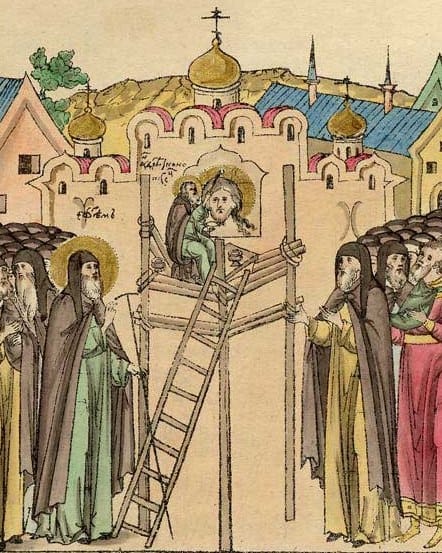
St. Andrei Rublev
St. Andrei Rublev, a monk of Moscow's Andronikov Monastery, is the greatest of Russian iconographers and the painter of the icon of the Holy Trinity, which the Church has held up since the sixteenth century as the model for depicting the Trinity.
Glorified in 1988, he is honored as a venerable father whose art grew out of fasting and prayer.
Almost nothing is known of his origins: his birth is usually placed about 1360, and his name in the world is lost. He belonged to the spiritual family of St. Sergius of Radonezh, whose disciples led the monasteries where he lived and worked. The chronicle first names him in 1405 as 'the monk Andrei Rublev', painting the Annunciation Cathedral in the Moscow Kremlin with Theophanes the Greek and Elder Prokhor of Gorodets. In 1408 he and the iconographer Daniel painted the Dormition Cathedral in Vladimir, where part of their Last Judgment survives.
His Trinity, made for the monastery of St. Sergius about 1412 or in the 1420s, shows the three angels who visited Abraham seated around a table with a single cup. Abraham and Sarah are left out, so that the eye rests on the communion of the three Persons. In 1551 the Council of the Hundred Chapters directed iconographers to paint the Trinity as the Greek masters and Andrei Rublev had painted it. The icons of the Zvenigorod Deesis, among them the Savior now in the Tretyakov Gallery, are also ascribed to him.
St. Joseph of Volokolamsk, who collected his icons, wrote down what an elder had told him of Andrei and Daniel: they so loved fasting and the monastic life that they never busied themselves with earthly things, but always lifted their minds to the immaterial, divine light; and on the feast of Pascha itself, and on other days when they were not painting, they sat before the holy icons, gazing on them and filled with divine joy. With Daniel he painted the stone cathedral of the Trinity Monastery about 1425-1427, and his last work was the Savior Cathedral of the Andronikov Monastery, where he reposed about 1430. Joseph adds that Andrei died first, and that as Daniel lay dying he saw his fellow ascetic in great glory, joyfully calling him into eternal blessedness. The place of their graves at the Andronikov Monastery is no longer known.
Venerated as a saint soon after his death, he appears with a halo in sixteenth-century miniatures. The Local Council of the Russian Orthodox Church glorified him in 1988, and his memory is kept on July 4, the day of his namesake St. Andrew of Crete, and with the saints of Radonezh and of Moscow.
Sources
- Trinity Chronicle, years 1405 and 1408 (reconstruction by M. D. Priselkov, 1950)
- St. Joseph of Volokolamsk, Spiritual Charter, Discourse 10 ('Answer to the Critics'), in the Great Menaion Reader, September 1-13
- Pravoslavnaya Entsiklopediya, vol. 2, 'Andrei Rublev'
- Stoglav (Council of the Hundred Chapters, 1551), chapter 41
- OCA, Lives of the Saints: Venerable Andrew Rublev the Iconographer
No recorded sayings. Read the Life to meet this saint.
Troparion · Tone 8
In you, O Father, God's image was preserved to perfection; for you took the cross upon yourself and followed Christ, and in your conduct you taught that one should think little of the flesh, for it is fleeting, and take care of the soul, a thing that does not die. And so, O venerable Andrei, your spirit exults together with the angels.
Translated for Axios! from the Church Slavonic General Menaion (the common troparion of a venerable father)
Kontakion · Tone 2
Armed in godly fashion with the soul's purity, and firmly taking up ceaseless prayer as a lance, you pierced the ranks of the demons, O Andrei, our father: pray without ceasing for us all.
Translated for Axios! from the Church Slavonic General Menaion (the common kontakion of a venerable father)
Saints around July 4
Get the full library
770+ saints, in your pocket
Their Lives, sayings and prayers, A to Z and by feast, with search. The Church calendar, the holy icons, and the saying of the day on your Home Screen. All in Axios! for iPhone, iPad and Android.