
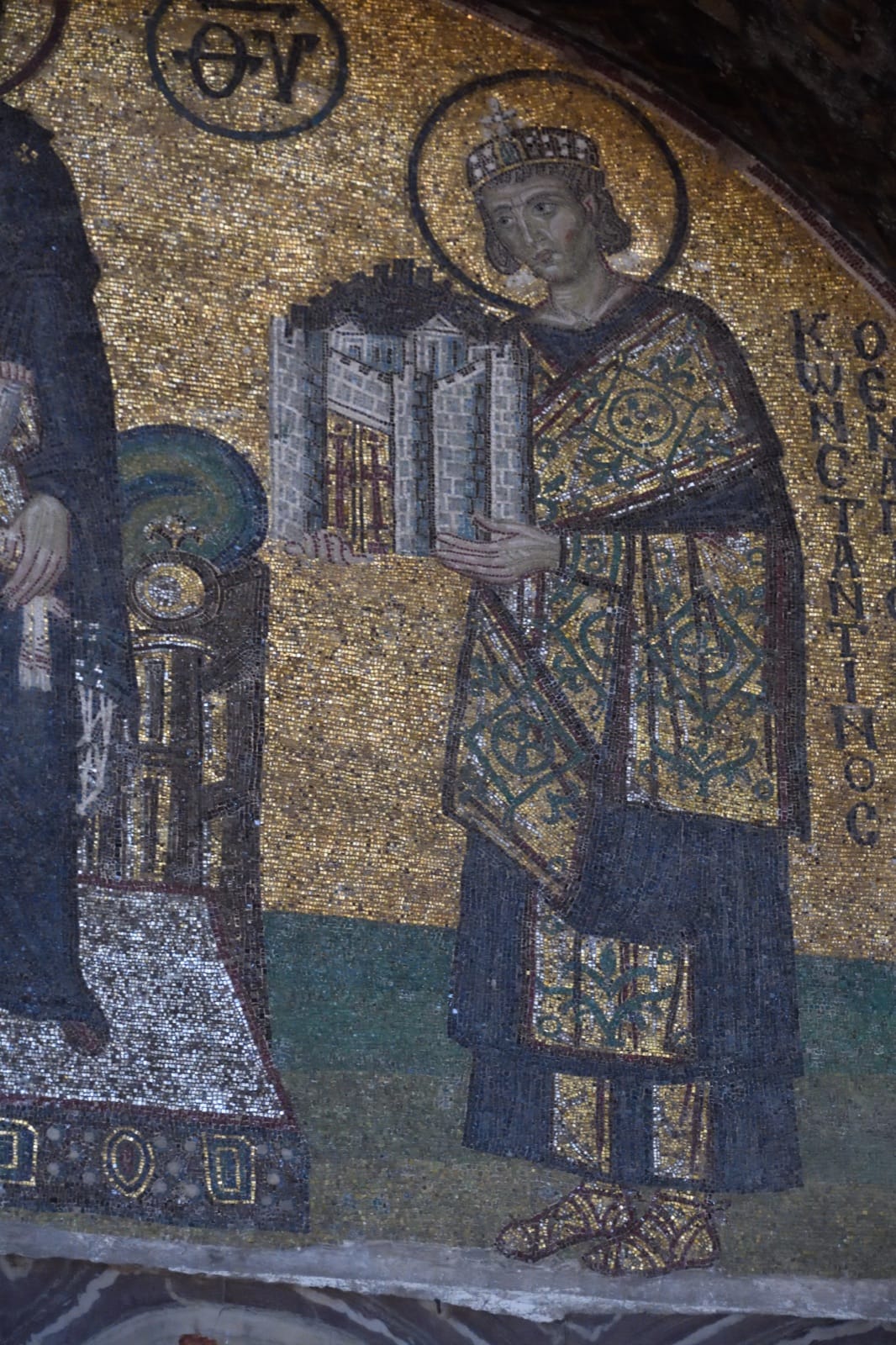
St. Constantine the Great
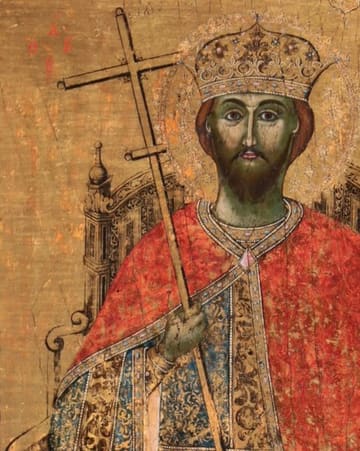
St. Constantine the Great, the first Christian emperor of Rome, is honored by the Church as Equal-to-the-Apostles. He ended the persecution of Christians and gave the Church her freedom, convened the First Ecumenical Council at Nicaea in 325, and founded Constantinople as a new capital.
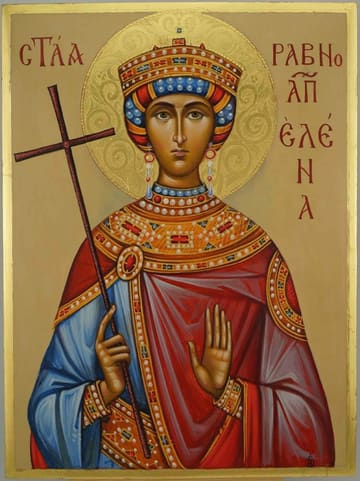
The Church keeps his memory on May 21 together with his mother, St. Helena.
He was born about 272 at Naissus, today Niš in Serbia, the son of the officer Constantius and Helena, and as a young man at the court of Diocletian he saw the Great Persecution begin. Proclaimed emperor by his father's troops at York in 306, he fought his way to power in the West. Eusebius of Caesarea writes that the emperor told him under oath how, on his campaign against Maxentius in 312, he and his army saw a cross of light in the sky with the words "By this conquer", and how Christ then showed him the same sign in a dream; Lactantius, writing earlier, speaks of a dream before the battle at the Milvian Bridge that told him to mark the sign of Christ on his soldiers' shields. Victorious, he openly favored the faith of Christ, and in 313 he and his fellow emperor Licinius granted freedom of worship to all and restored to the Church what had been taken from her.
In 321 he made Sunday a day of rest; as sole ruler from 324 he built great churches, among them the Holy Sepulchre in Jerusalem, and called the bishops to Nicaea, where he took part in the council that confessed the Son to be of one essence with the Father. On May 11, 330, he dedicated Constantinople. Historians also record the shadows of his reign: in 326 he had his eldest son Crispus and then his wife Fausta put to death, for reasons never made clear; he kept the pagan title of chief priest; and in his last years, at the urging of bishops of the Arian party, he readmitted Arius to communion and exiled St. Athanasius to Trier.
He did not put off Holy Baptism to the end of his life: before he founded Constantinople, he was taught the faith and baptized by Bishop Sylvester. Falling ill in 337, he spent his last days in Nicomedia. He reposed on May 22, 337, at Pentecost, and was buried in Constantinople in the church of the Holy Apostles, among memorials of the Twelve. The Church honors him not as a man without sin but as the ruler through whom God gave peace to His Church.
Sources
- Eusebius, Life of Constantine I.28-29, II.56-72, III-IV
- Lactantius, On the Deaths of the Persecutors 44 and 48
- Eusebius, Church History X.5 (the Edict of Milan)
- Greek Menaion and Synaxarion, May 21
- Pravoslavnaya Entsiklopediya, 'Konstantin I Veliky'
- OCA, Lives of the Saints: Equal-to-the-Apostles Constantine and Helena
Let those, therefore, who still delight in error, be made welcome to the same degree of peace and tranquility which they have who believe. For it may be that this restoration of equal privileges to all will prevail to lead them into the straight path.
Letter to the Eastern Provincials, in Eusebius, Life of Constantine II.56 (NPNF, trans. Richardson, spelling adapted)
Restore me then my quiet days, and untroubled nights, that the joy of undimmed light, the delight of a tranquil life, may henceforth be my portion.
Letter to Alexander and Arius, in Eusebius, Life of Constantine II.72 (NPNF, trans. Richardson)
You are bishops whose jurisdiction is within the Church: I also am a bishop, ordained by God to overlook whatever is external to the Church.
Eusebius, Life of Constantine IV.24 (NPNF, trans. Richardson)
The time is arrived which I have long hoped for, with an earnest desire and prayer that I might obtain the salvation of God. The hour has come in which I too may have the blessing of that seal which confers immortality; the hour in which I may receive the seal of salvation.
Eusebius, Life of Constantine IV.62 (NPNF, trans. Richardson)
Now I know that I am truly blessed: now I feel assured that I am accounted worthy of immortality, and am made a partaker of Divine light.
Eusebius, Life of Constantine IV.63 (NPNF, trans. Richardson)
Troparion of Sts. Constantine and Helena (Tone 8)
Having beheld the figure of Your Cross in heaven, and, like Paul, having received his calling not from men, Your apostle among kings, O Lord, placed the imperial city into Your hand. Keep it always safe in peace, at the intercessions of the Theotokos, O only Lover of mankind.
Translated for Axios! from the Greek Menaion, May 21
Saints around May 21
Get the full library
770+ saints, in your pocket
Their Lives, sayings and prayers, A to Z and by feast, with search. The Church calendar, the holy icons, and the saying of the day on your Home Screen. All in Axios! for iPhone, iPad and Android.