
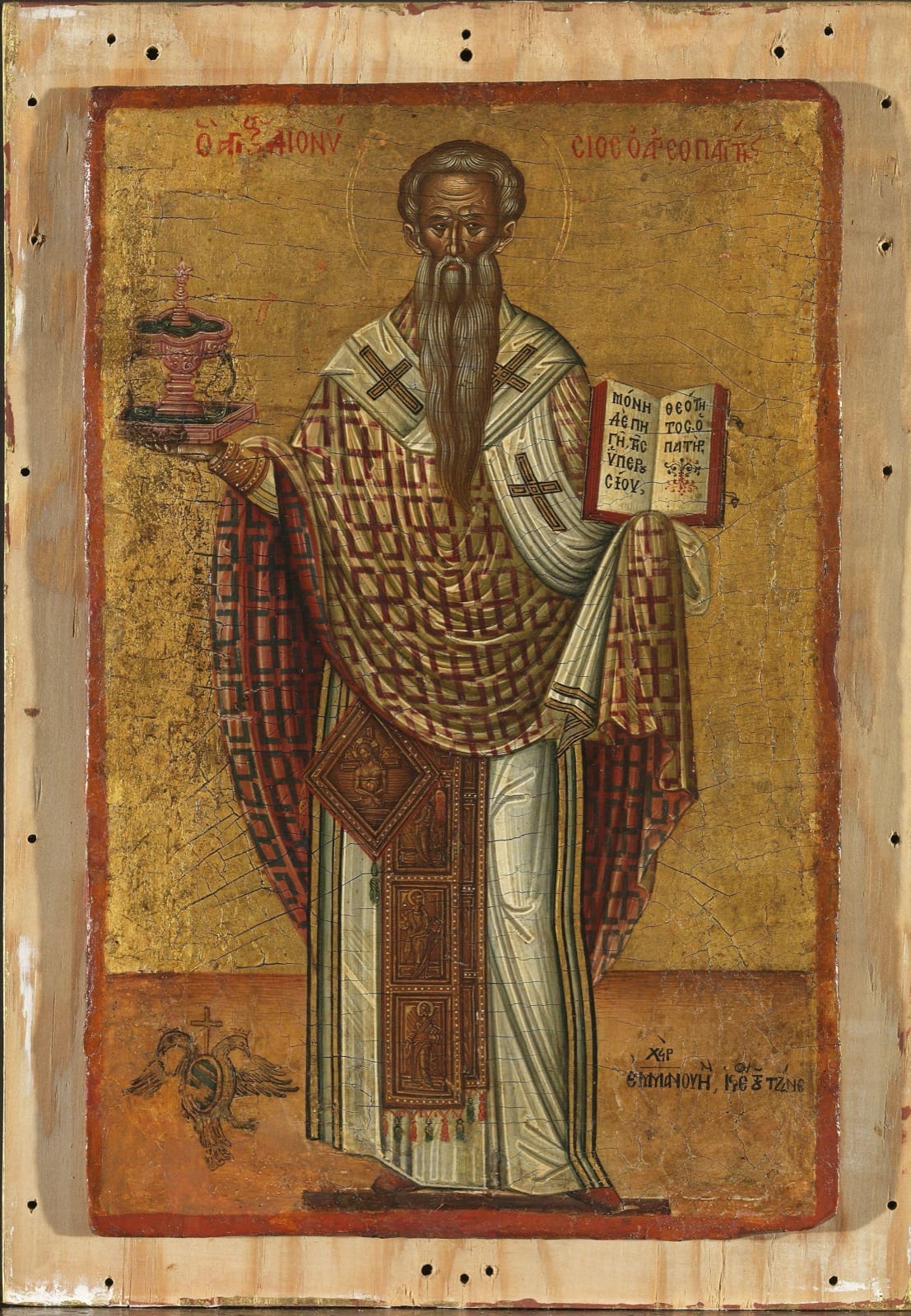
St. Dionysius the Areopagite
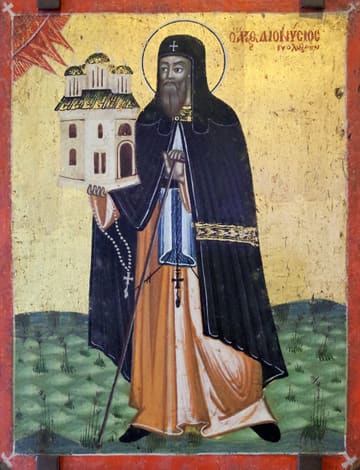
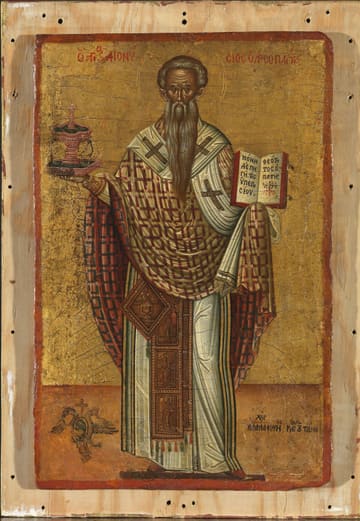
St. Dionysius the Areopagite was a member of the Areopagus, the ancient high council of Athens, who believed when St. Paul preached there.
The Church honors him as the first bishop of Athens and as a hieromartyr, and for many centuries she received under his name a body of mystical writings that deeply shaped Orthodox theology.
Luke records that after Paul's speech on the Areopagus "certain men joined with him and believed, including Dionysius the Areopagite, and a woman named Damaris" (Acts 17:34). A seat on that court suggests a man of rank and learning. About the year 170, St. Dionysius, bishop of Corinth, wrote that the Areopagite had been the first bishop of the Church of Athens, as Eusebius reports (Church History III.4; IV.23), and the Apostolic Constitutions say that Paul ordained him. Later tradition took Damaris to be his wife.
Later Lives, drawing on the writings under his name, added much: that as a young man he saw the darkness at the Crucifixion from Heliopolis in Egypt, and that he was present at the falling asleep of the Theotokos. In the eighth century a Life written in Rome joined his story to that of St. Denis, the martyred first bishop of Paris, and in the ninth century Abbot Hilduin of the abbey of St. Denis near Paris spread this identification. The Greek Synaxarion follows it: Dionysius went west, preached with the presbyter Rusticus and the deacon Eleutherius, and was beheaded with them, and its verses recall that he carried his own head. In the West he is honored as St. Denis of Paris, whose memory the OCA also keeps on October 9.
Four treatises (on the Celestial Hierarchy, the Ecclesiastical Hierarchy, the Divine Names and the Mystical Theology) and ten letters bear his name. They are unknown before the early sixth century: Severus of Antioch quotes them after 510, and at a debate in Constantinople in 532 Bishop Hypatius of Ephesus already questioned their apostolic origin. Tradition holds that he wrote them himself. The Church nevertheless treasured their teaching: St. Maximus the Confessor commented on them, St. John of Damascus and St. Gregory Palamas drew on them, and the nine ranks of angels honored at the Synaxis of the Archangels (November 8) come from them.
The Church keeps his feast on October 3, together with Sts. Rusticus and Eleutherius, and remembers him with the Seventy on January 4.
Sources
- Acts 17:16-34
- Dionysius of Corinth, in Eusebius, Church History III.4 and IV.23
- Greek Menaion and Synaxarion, October 3
- OCA, Lives of the Saints: Hieromartyr Dionysius the Areopagite; Hieromartyr Dionysius of Paris
- Pravoslavnaya Entsiklopediya, 'Dionisy Areopagit' and 'Areopagitiki'
Concerning this hidden super-essential Godhead we must not dare, as I have said, to speak, or even to form any conception of It, except those things which are divinely revealed to us from the Holy Scriptures.
Divine Names I.2 (trans. after C. E. Rolt, 1920, adapted), from the writings under St. Dionysius's name, composed about 500
God is known in all things and apart from all things; and God is known through knowledge and through unknowing... He is all things in all things and nothing in any.
Divine Names VII.3 (trans. after C. E. Rolt, 1920, adapted), from the writings under St. Dionysius's name, composed about 500
The Divine Yearning brings ecstasy, not allowing those who are touched by it to belong to themselves, but only to the objects of their affection.
Divine Names IV.13 (trans. after C. E. Rolt, 1920, adapted), from the writings under St. Dionysius's name, composed about 500
Trinity, which exceeds all being, deity, and goodness! You who instruct Christians in Your heavenly wisdom! Guide us to that topmost height of mystic lore which exceeds light and more than exceeds knowledge...
Mystical Theology I.1 (trans. after C. E. Rolt, 1920, adapted), from the writings under St. Dionysius's name, composed about 500
I counsel you, dear Timothy, that in the earnest exercise of mystic contemplation you leave the senses and the activities of the intellect... and that, your understanding being laid to rest, you strain (so far as you may) towards a union with Him whom neither being nor understanding can contain.
Mystical Theology I.1 (trans. after C. E. Rolt, 1920, adapted), from the writings under St. Dionysius's name, composed about 500
Troparion · Tone 4
Having been taught goodness and being sober in all things, you clothed yourself with a good conscience as befits a priest. You drew ineffable things from the Chosen Vessel, and having kept the faith you finished the same course, O Hieromartyr Dionysius. Intercede with Christ our God that our souls may be saved.
Translated for Axios! from the Greek Menaion, October 3
Kontakion · Tone 8
Having passed in spirit through the gates of heaven, and been taught by the Apostle who reached beyond the three heavens, O Dionysius, you were enriched with all knowledge of things ineffable, and you enlightened those who once slept in the darkness of ignorance. Therefore we cry to you: Rejoice, O Father of all the world!
Translated for Axios! from the Greek Menaion, October 3
Saints around October 3
Get the full library
770+ saints, in your pocket
Their Lives, sayings and prayers, A to Z and by feast, with search. The Church calendar, the holy icons, and the saying of the day on your Home Screen. All in Axios! for iPhone, iPad and Android.