
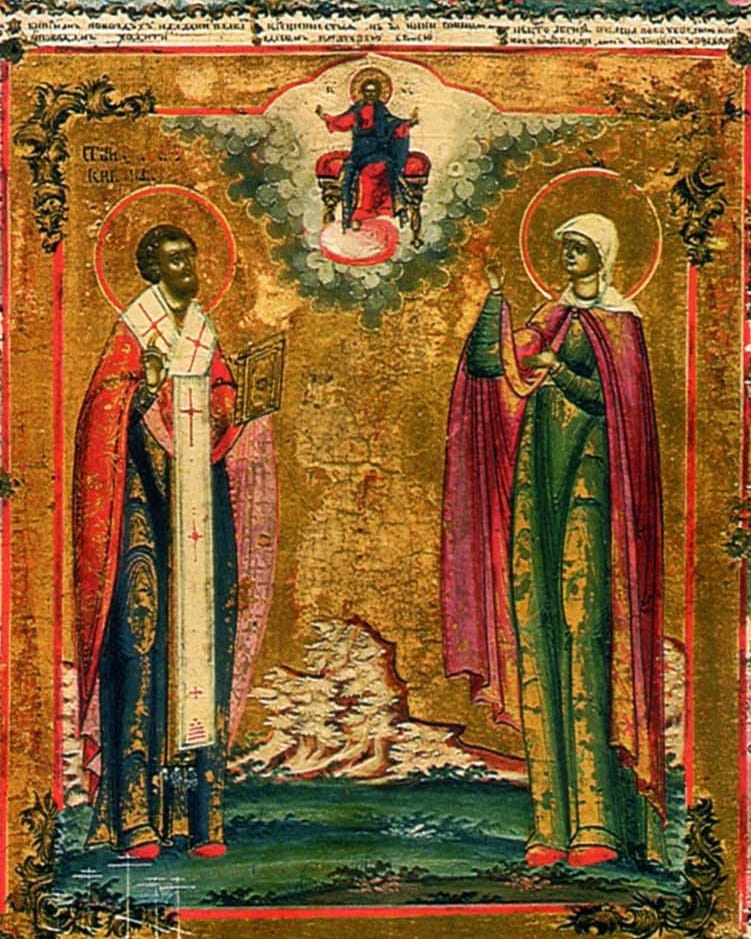
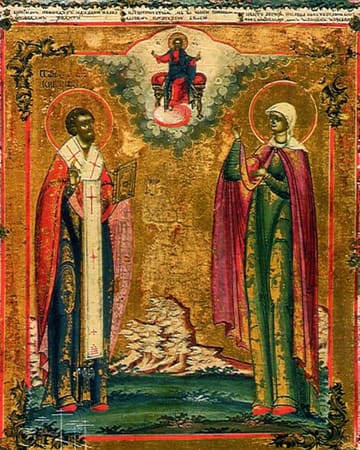
St. Cyprian and St. Justina
St. Cyprian and St. Justina are honored as martyrs: Justina, a Christian virgin of Antioch whose prayer and the sign of the Cross put the powers of darkness to flight, and Cyprian, a famous sorcerer of the same city whom her faith brought to Christ.
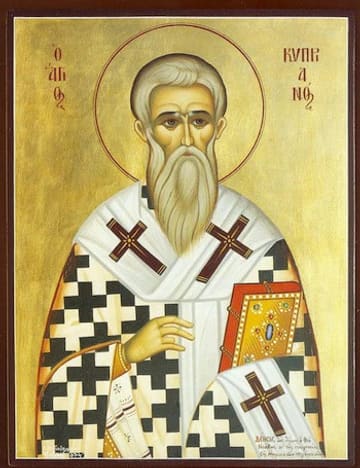
The Church keeps their memory on October 2. This St. Cyprian is not St. Cyprian of Carthage, the 3rd-century bishop and writer, who has his own feast on August 31, although the two have often been confused.
According to their Life, Cyprian was dedicated to the pagan gods as a child and spent his youth learning the occult arts in the great centers of paganism, until he became a priest of the idols and a master of magic at Antioch. Justina had led her parents to the faith and resolved to belong to Christ alone. When a pagan youth named Aglaidas, whom she had refused, asked Cyprian to win her for him by sorcery, the magician sent demon after demon against her, and each was driven off by her prayer and the sign of the Cross. Seeing that the spirits he served trembled before that sign, Cyprian went in repentance to Bishop Anthimus, burned his books of magic and was baptized.
Tradition says that Cyprian rose through the orders of the clergy to become a bishop, though no Cyprian appears among the bishops of Antioch, and that Justina came to lead a community of virgins. In a time of persecution at the end of the 3rd century (most accounts say that of Diocletian, while the Greek Synaxarion speaks of earlier emperors) they were arrested, tortured and sent to Nicomedia, where they were beheaded. Justina was put to death first, at Cyprian's request, so that she would not be shaken by the sight of his death, and a soldier named Theoctistus, who confessed Christ there and then, was beheaded with them. Christian sailors later carried their bodies to Rome.
Their story is told in Greek writings of the late 4th and early 5th centuries, among them a Confession attributed to Cyprian himself, and the Empress Eudocia, wife of Theodosius II, retold it in verse. How much of it is history cannot be known. In 379 or 380 St. Gregory the Theologian, preaching in Constantinople, already merged this Cyprian with the bishop of Carthage, and Greek books still often do. The Church honors them as martyrs and asks their prayers for protection against sorcery and evil spirits.
Sources
- Greek Menaion and Synaxarion, October 2
- St. Gregory the Theologian, Oration 24, On St. Cyprian
- OCA, Lives of the Saints: Hieromartyr Cyprian, Virgin Martyr Justina, and Martyr Theoctistus
- Mystagogy Resource Center, 'Synaxarion of Saints Cyprian and Justina'
- Catholic Encyclopedia (1908), 'Sts. Cyprian and Justina'
No recorded sayings. Read the Life to meet this saint.
Troparion · Tone 4
Partaker of the apostles' ways and successor to their thrones, you found in action, O God-inspired one, the way up to contemplation. Therefore you rightly handled the word of truth and contended also for the faith to the point of bloodshed, O Hieromartyr Cyprian. Intercede with Christ our God that our souls may be saved.
Translated for Axios! from the Greek Menaion, October 2
Kontakion · Tone 8
As a venerable hierarch and a most steadfast athlete, the whole world fittingly honors you, O far-famed Cyprian, and glorifies your holy memory with hymns, asking always that forgiveness of sins be granted through you to those who sing your praise. Alleluia.
Translated for Axios! from the Greek Menaion, October 2
Kontakion · Tone 1
O godly-minded one, you turned from the craft of magic to divine knowledge and appeared before the world as a healer most wise, bestowing cures on those who revere you, O Cyprian, together with Justina. With her, entreat the Master who loves mankind for the salvation of your servants.
Translated for Axios! from the Greek Menaion, October 2
Saints around October 2
Get the full library
770+ saints, in your pocket
Their Lives, sayings and prayers, A to Z and by feast, with search. The Church calendar, the holy icons, and the saying of the day on your Home Screen. All in Axios! for iPhone, iPad and Android.