
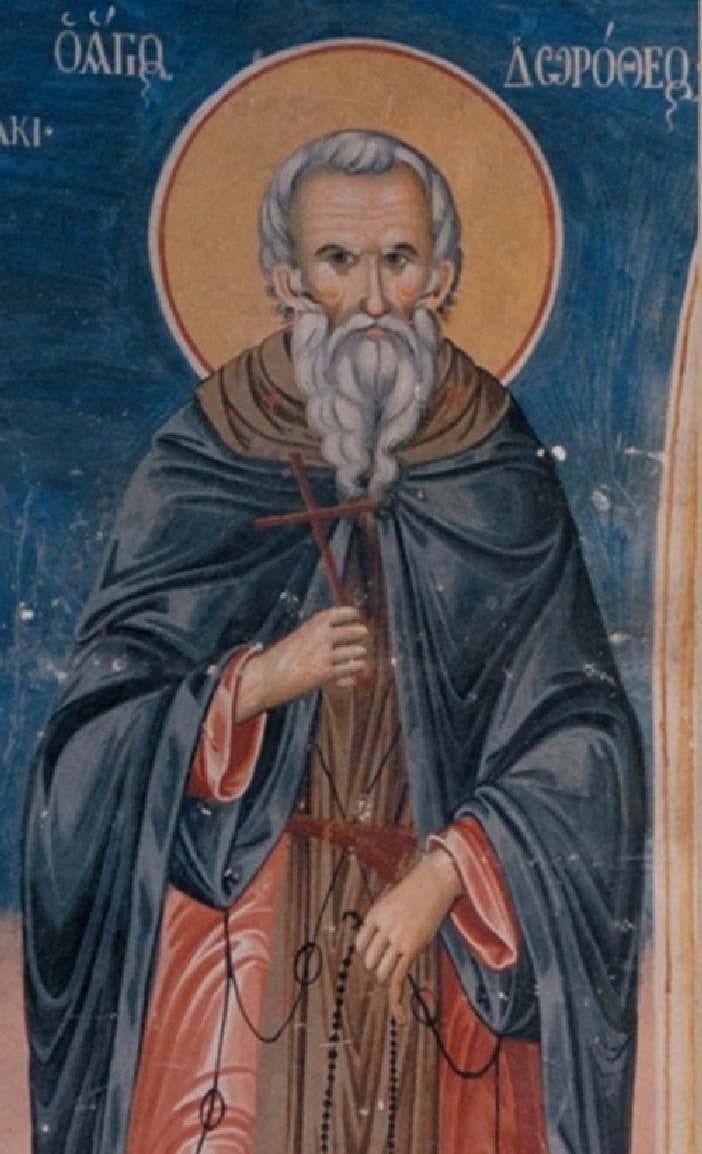
St. Dorotheus of Gaza
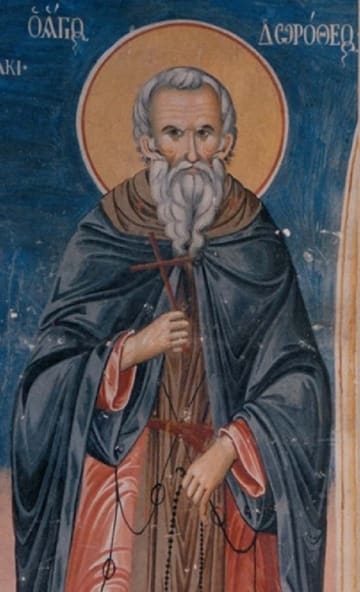
St. Dorotheus of Gaza, known in the Church simply as Abba Dorotheus, was a sixth-century monk of Palestine whose Instructions on humility, obedience and the conscience have been read in Orthodox monasteries ever since.
Simple, warm and practical, they are still among the first books given to those beginning the spiritual life.
He was well educated before he became a monk, and he later told his monks how his love of study had grown so strong that he forgot to eat; when he entered the monastery he resolved to bring the same zeal to virtue. His monastery was that of Abba Seridos near Gaza, where the great elders St. Barsanuphius and St. John the Prophet lived as recluses, and many of the letters in which they answered his questions survive. He served as guest-master, built an infirmary with money from his brother and cared for the sick himself, and for some ten years attended Abba John, entrusting every thought to him. There too he guided the young St. Dositheus, whose short life of obedience became a famous example.
After the deaths of Abba John and Abba Seridos, when Barsanuphius had withdrawn into complete silence, Dorotheus left and founded his own monastery between Gaza and Maiuma. There, as abba, he gave the talks later gathered as his Instructions, together with letters and sayings. He taught that the root of all our trouble is that we do not blame ourselves, that a monk falls only by trusting his own heart, and that conscience is a divine spark planted in every person.
In a famous image he compared human lives to lines drawn from the edge of a circle to its center, God: the nearer they come to Him, the nearer they come to one another. He reposed in his monastery in old age, in the later sixth century.
His Instructions were copied everywhere, and in Russia St. Cyril of Belozersk copied them by hand. The Greek Synaxaristes keeps his memory on August 13 together with Abba Seridos and St. Dositheus; the Russian Church and the OCA keep him on June 5.
Sources
- Abba Dorotheus, Instructions (Didaskaliai), letters and sayings (PG 88)
- Barsanuphius and John, Questions and Answers (the letters to Dorotheus)
- Life of St. Dositheus (6th century)
- Great Synaxaristes, August 13: St. Dorotheus (synaxarion.gr)
- OCA, Lives of the Saints: Venerable Abba Dorotheus of Palestine
When trees bear much fruit, the fruit itself bends their branches down, while a branch that bears no fruit rises straight up... So it is with the soul: when it is humbled, then it bears fruit, and the more fruit it bears, the humbler it becomes.
Abba Dorotheus, Instructions 2, On humility (translated for Axios! from the Greek)
The closer the saints draw to God, the more they see themselves as sinners.
Abba Dorotheus, Instructions 2, On humility (translated for Axios! from the Greek)
When God made man, He sowed in him something divine, like a thought, warm and bright as a spark, that lights up the mind and shows it the good from the evil. This is called conscience, and it is the natural law.
Abba Dorotheus, Instructions 3, On conscience (translated for Axios! from the Greek)
I know no other fall of a monk except from trusting his own heart... Have you seen someone fall? Know that he followed himself. Nothing is heavier than following oneself, nothing more ruinous.
Abba Dorotheus, Instructions 5, On not following one's own understanding (translated for Axios! from the Greek)
Each of you, as far as he is able, strive to be united with one another; for the more one is united to his neighbor, the more he is united to God.
Abba Dorotheus, Instructions 6, On not judging one's neighbor (translated for Axios! from the Greek)
Think of this circle as the world, its center as God, and the straight lines from the circle to the center as the ways of human life... The closer the saints come to God, the closer they come to one another; and the closer they come to one another, the closer they come to God.
Abba Dorotheus, Instructions 6, On not judging one's neighbor (translated for Axios! from the Greek)
If we search carefully, the cause of all our trouble is that we do not blame ourselves. From this comes all our distress; because of this we never find rest.
Abba Dorotheus, Instructions 7, On self-accusation (translated for Axios! from the Greek)
Troparion · Tone 8
In you, O Father, God's image was preserved to perfection; for you took the cross upon yourself and followed Christ, and in your conduct you taught that one should think little of the flesh, for it is fleeting, and take care of the soul, a thing that does not die. And so, O venerable Dorotheus, your spirit exults together with the angels.
Translated for Axios! from the Greek General Menaion (the common troparion of a venerable father)
Kontakion · Tone 2
Armed in godly fashion with the soul's purity and wielding ceaseless prayer as a lance, you mightily cut through the battle lines of the demons, O Dorotheus, wonderworker, our father, interceding without ceasing for us all.
Translated for Axios! from the Greek Menaion (the common kontakion of a venerable father)
Saints around August 13
Get the full library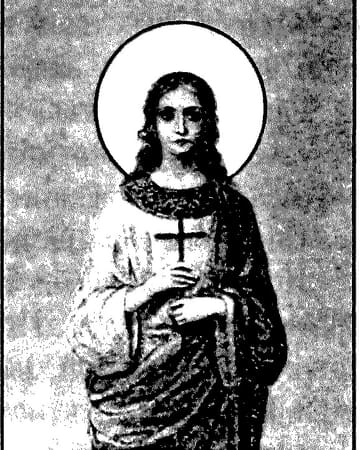
770+ saints, in your pocket
Their Lives, sayings and prayers, A to Z and by feast, with search. The Church calendar, the holy icons, and the saying of the day on your Home Screen. All in Axios! for iPhone, iPad and Android.