
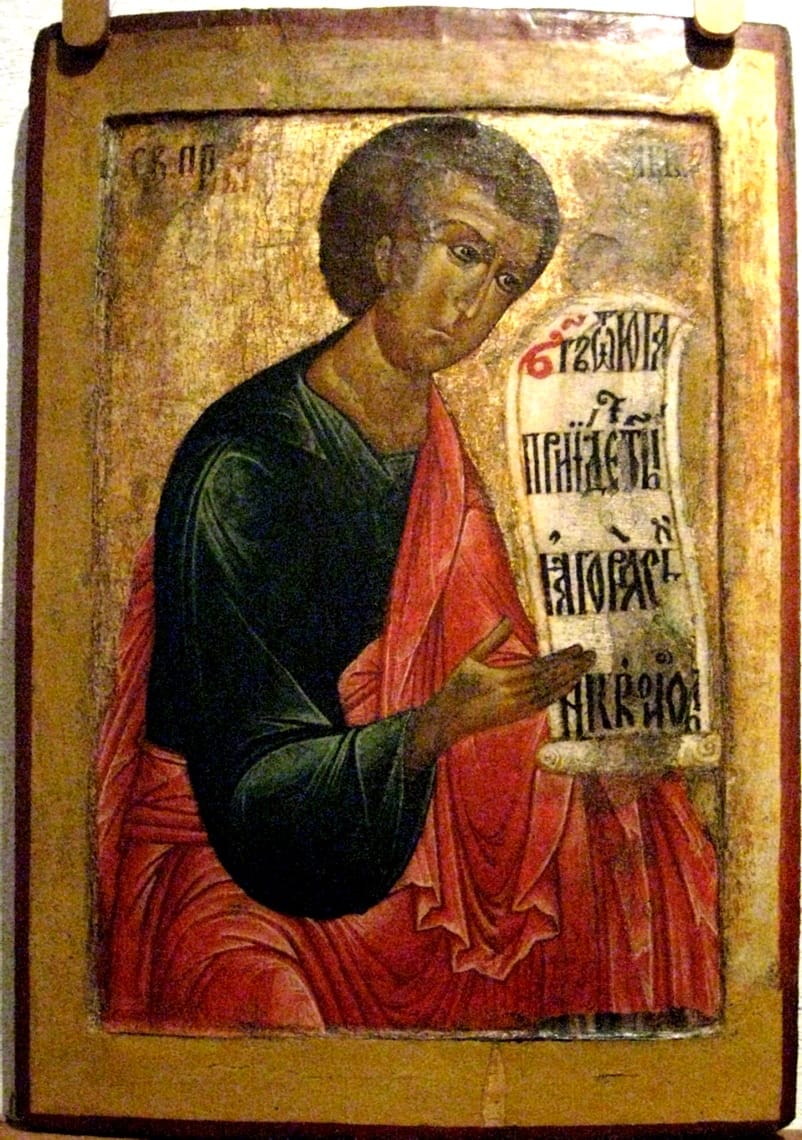
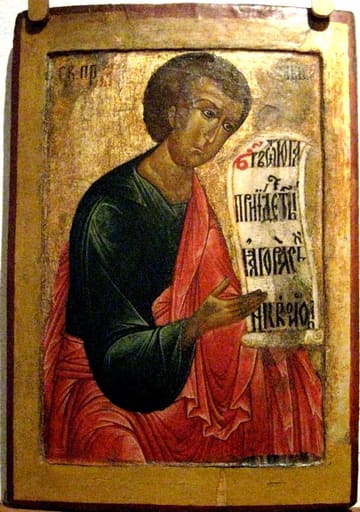
St. Habakkuk the Prophet
St. Habakkuk is one of the Twelve Prophets, the watchman who stood at his post to wait for God's answer and heard the word "the righteous shall live by faith," which St. Paul made a pillar of his preaching.
His prayer in the third chapter of his book is sung by the Church as the fourth biblical ode of Matins, and in its Greek text she hears the coming of Christ, born of the Virgin.
His short book says nothing of his family or life. He prophesied in Judah as the Chaldeans of Babylon were rising to power, late in the 7th century BC, and he dared to question God: how long would the righteous cry out while violence went unpunished, and why would the Holy One use a cruel nation to chastise His people? Standing on his watch, he received the answer that the vision would surely come at its appointed time, and that the righteous would live by faith. The book closes with his prayer, which ends in joy in God even if the fig tree should not blossom and the stalls stand empty.
The Church sings that prayer from the Septuagint, which reads differently from the Hebrew: "In the midst of two living creatures You will be made known," and "God will come from Teman, and the Holy One from the shaded, thickly wooded mountain." Her hymns see in that shaded mountain the Virgin, from whom the Master came to set mankind free, and in the Paschal canon St. John of Damascus calls on Habakkuk to stand with the faithful on the divine watch and point to the shining angel who proclaims that Christ is risen.
Tradition, recorded in the ancient Lives of the Prophets, makes him a man of the tribe of Simeon who fled to Ostrakine, on the border of Egypt, when Nebuchadnezzar came against Jerusalem and later returned to work his field. The Greek chapters of Daniel tell that an angel carried him to Babylon with the meal he had cooked for his reapers, so that he might feed St. Daniel in the lions' den. He is said to have died in his own land before the exiles returned.
The historian Sozomen records that in the reign of Theodosius the Great his relics were found at Keilah, revealed in a dream to Zebennus, bishop of Eleutheropolis. The Church keeps his memory on December 2.
Sources
- The Book of Habakkuk (Septuagint and Hebrew); Bel and the Dragon 33-39 (Daniel 14 LXX); Romans 1:17
- Synaxarion and Menaion, December 2
- Lives of the Prophets (attributed to St. Epiphanius of Cyprus), Habakkuk
- Sozomen, Ecclesiastical History VII.29 (NPNF II/2)
- St. Dimitri of Rostov, Lives of the Saints, December 2: Prophet Habakkuk
- OCA, Lives of the Saints: Prophet Habakkuk
Lord, how long will I cry, and you will not hear?
Habakkuk 1:2 (WEBBE)
Aren't you from everlasting, Lord my God, my Holy One? We will not die.
Habakkuk 1:12 (WEBBE)
I will stand upon my watch and mount upon the rock, and I will keep watch to see what He will say within me, and what I will answer to my reproof.
Habakkuk 2:1 (LXX, translated for Axios!)
O Lord, I have heard the report of You and was afraid; I considered Your works and was amazed. In the midst of two living creatures You will be made known; as the years draw near You will be recognized; when the time has come You will be shown forth.
Habakkuk 3:2 (LXX, translated for Axios!)
God will come from Teman, and the Holy One from the shaded, thickly wooded mountain of Paran. His excellence covered the heavens, and the earth is full of His praise.
Habakkuk 3:3 (LXX, translated for Axios!)
For even though the fig tree doesn't flourish, nor fruit be in the vines, the labor of the olive fails, the fields yield no food, the flocks are cut off from the fold, and there is no herd in the stalls, yet I will rejoice in the Lord. I will be joyful in the God of my salvation!
Habakkuk 3:17-18 (WEBBE)
Troparion · Tone 2
Celebrating the commemoration of Your prophet Habakkuk, O Lord, we implore You through him: Save our souls.
Translated for Axios! from the Greek Menaion, December 2
Kontakion · Tone 4
You saw clearly the holy Disciples as horses troubling the seas of ignorance and drowning error with the doctrines of true faith, O Habakkuk, herald of God. Therefore we praise you as a true Prophet and ask you to intercede that we may be shown mercy.
Translated for Axios! from the Greek Menaion, December 2
Saints around December 2
Get the full library
770+ saints, in your pocket
Their Lives, sayings and prayers, A to Z and by feast, with search. The Church calendar, the holy icons, and the saying of the day on your Home Screen. All in Axios! for iPhone, iPad and Android.