
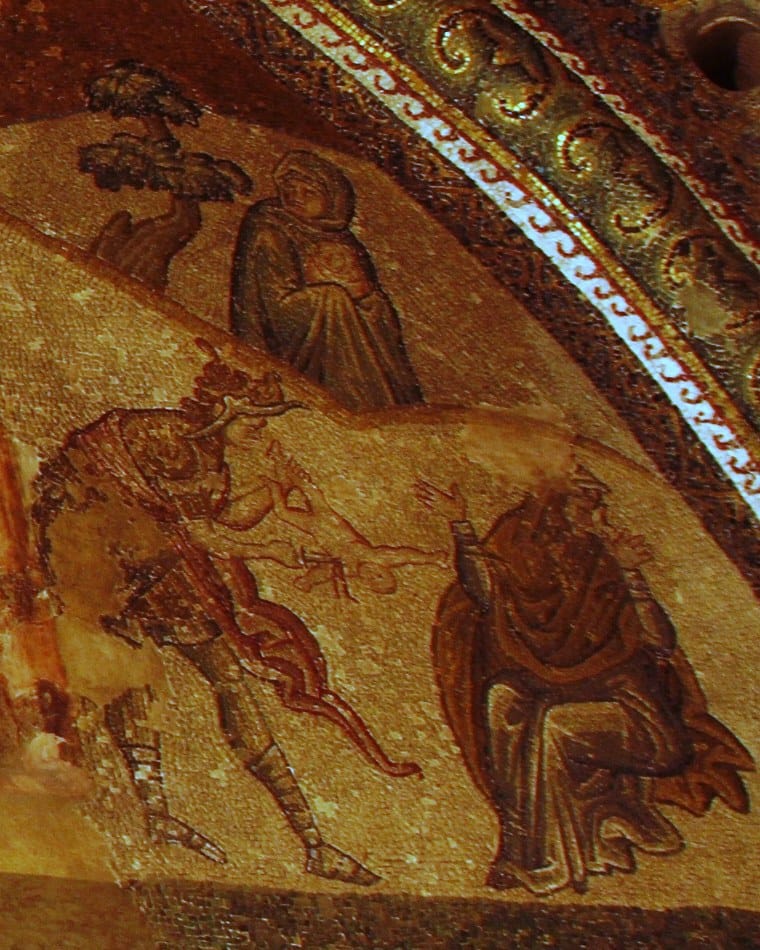
The Holy Innocents
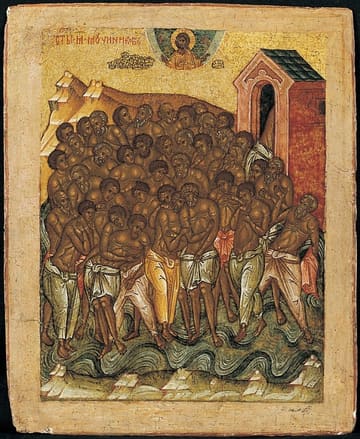
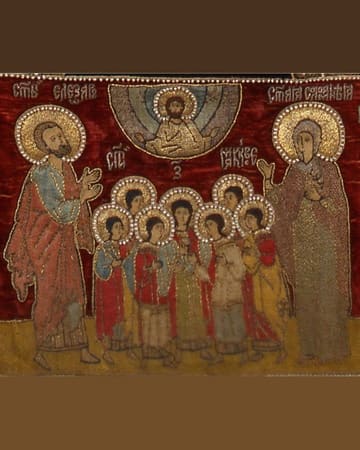
The Holy Innocents are the little boys of Bethlehem whom King Herod put to death when he tried to kill the newborn Christ.
Too young to speak a word of faith, they died in His place and for His sake. The Church counts them the first to shed their blood for Christ (St. Stephen is called the Protomartyr as the first to die confessing Him) and keeps their memory on December 29, in the days after the Nativity.
St. Matthew tells their story (Matthew 2:1-18). Magi came from the east to Jerusalem seeking the newborn King of the Jews, whose star they had seen. Herod learned from them exactly when the star had appeared, sent them on to Bethlehem and asked them to bring him word.
Warned in a dream, the Magi went home by another road, and an angel told Joseph to flee into Egypt with the Child and His mother. When Herod saw that he had been tricked, he sent men to kill every boy two years old and under in Bethlehem and all the country around it, reckoning from the time the Magi had given him. The evangelist heard in the mothers' grief the word of Jeremiah: Rachel weeping for her children and refusing to be comforted.
This happened in the last years of Herod the Great, who died about 4 BC. Josephus, the Jewish historian of Herod's reign, does not mention the massacre, but it fits the portrait he draws of a man of great barbarity who had three of his own sons put to death. The Gospel gives no number.
The Byzantine service books, followed by the Slavonic, speak of fourteen thousand children; whatever their number, the hymns of the feast sing of them as one choir of infants offered to the Lord who became an infant for our sake. The Protoevangelium of James, a 2nd-century writing outside the Scriptures, adds that Elizabeth fled into the hills with the infant John, the future Forerunner, and that his father Zachariah was killed in the Temple because he would not say where his son was hidden. St. Andrew of Crete recalls Elizabeth's flight in a hymn sung at Vespers of the feast.
The early Church saw these children as true martyrs. In the 2nd century St. Irenaeus of Lyons wrote that Christ, being Himself an infant, so ordered things that infants should be martyrs and be sent ahead of Him into His kingdom. In the next century St. Cyprian of Carthage, preparing his flock for persecution, pointed to them: an age not yet ready for battle was found ready for the crown. Western Christians keep their feast on December 28.
Sources
- Matthew 2:1-18
- Greek Menaion and Synaxarion, December 29
- St. Irenaeus of Lyons, Against Heresies III.16.4
- St. Cyprian of Carthage, Epistle 55 (58), To the People of Thibaris 6
- Josephus, Jewish Antiquities XVI.11.7 and XVII.8.1
- Protoevangelium of James 22-23
No recorded sayings. Read the Life to meet this saint.
Troparion · Tone 1
Be moved, O Lord, by the torments that the saints suffered for You, and heal us of all our afflictions, O Lover of mankind, we pray.
Translated for Axios! from the Greek Menaion, December 29
Kontakion · Tone 4
A star sent the Magi to the One who had been born, and Herod sent out an unjust army in vain, thinking to slay the One who lay in the manger as an infant.
Translated for Axios! from the Greek Menaion, December 29
Saints around December 29
Get the full library
770+ saints, in your pocket
Their Lives, sayings and prayers, A to Z and by feast, with search. The Church calendar, the holy icons, and the saying of the day on your Home Screen. All in Axios! for iPhone, iPad and Android.