
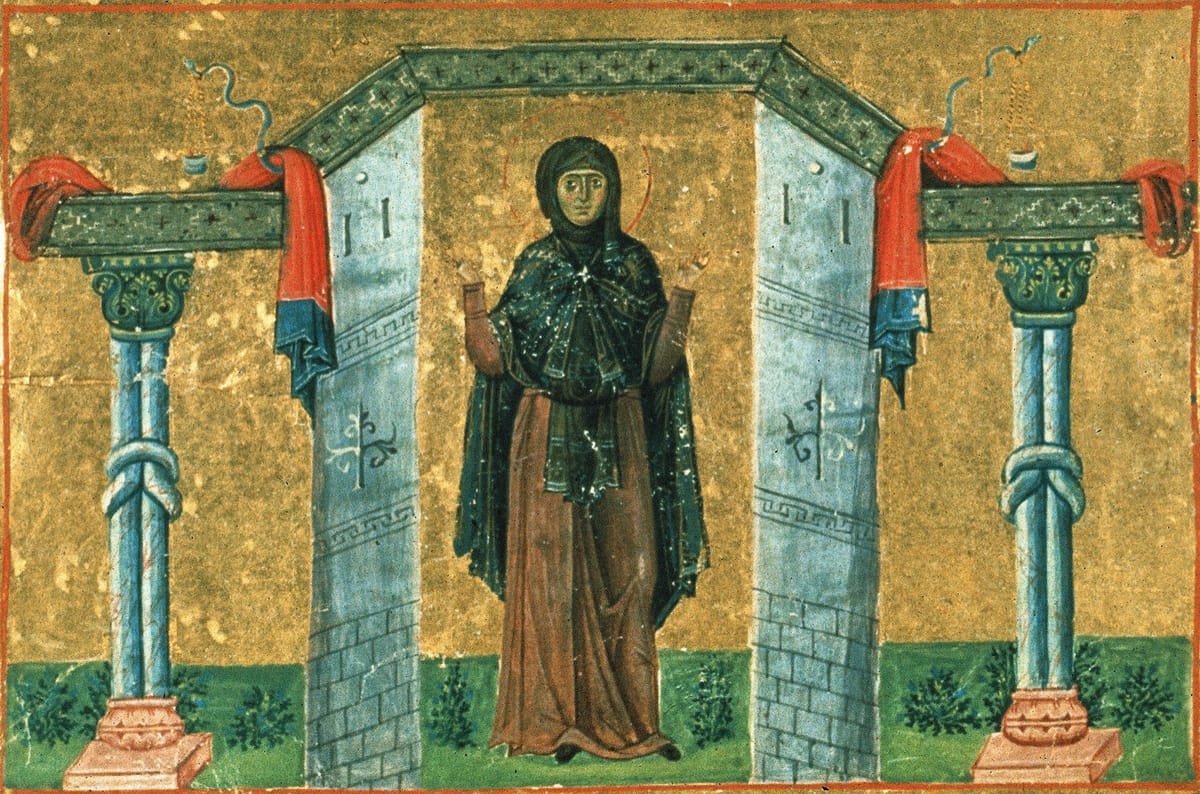
St. Melania the Younger
St. Melania the Younger, one of the richest women of the Roman world, gave away an immense fortune for Christ and ended her life as a nun on the Mount of Olives.
She is known from the Life written by Gerontius, the priest of her monasteries, and from the Lausiac History of Palladius, who knew her, so that few holy women of the early Church are better documented.
She was born in Rome about 383 to the senator Valerius Publicola and Albina; her grandmother was Melania the Elder, a famous ascetic. Married against her will at about fourteen to the young nobleman Pinian, she begged him to live with her in chastity. Only after their two children had died and she herself had nearly died did he agree, and about 404, when she was some twenty years old, they renounced the world together.
Their estates reached from Spain and Gaul to Sicily, Africa and Britain. Relatives and senators opposed the sale, but Serena, the niece of Emperor Theodosius, won them the protection of Emperor Honorius. Palladius records that Melania freed eight thousand slaves and sent gold to the churches and monasteries of Egypt, Antioch, Palestine and the islands.
Before Alaric sacked Rome in 410 they had left for Sicily and then Africa, where they spent seven years at Thagaste with its bishop Alypius, the friend of Blessed Augustine, and founded two monasteries. Melania studied the Scriptures, copied books with her own hand, and fasted severely.
In 417 they sailed to Alexandria, where St. Cyril received them, visited the monks of Egypt, and settled in Jerusalem. Melania lived for years in a small cell on the Mount of Olives. After her mother's death she gathered a convent of about ninety virgins, and after Pinian's death about 431 she founded a monastery of men and a chapel for the relics of martyrs.
In 436 she traveled to Constantinople to her dying uncle Volusian, a pagan and former prefect of Rome, who was baptized before his death; her Life adds that she taught there against the errors of Nestorius. Empress Eudocia later visited her in Jerusalem.
She kept her last Christmas at Bethlehem, saying she would not see another, and fell ill after the feast of St. Stephen. Having received Holy Communion from the bishop, she reposed peacefully on the Mount of Olives on Sunday, December 31, 439, the day on which the Church keeps her memory.
Sources
- Gerontius, Life of St. Melania the Younger (Latin ed. Analecta Bollandiana 8, 1889; Greek ed. H. Delehaye, Analecta Bollandiana 22, 1903)
- Palladius, Lausiac History 61 (trans. W. K. Lowther Clarke, 1918)
- Synaxarion, December 31 (Greek Menaion)
- OCA, Lives of the Saints: Venerable Melania the Younger of Rome
If you choose to practice asceticism with me in chastity, I acknowledge you as master and lord of my life. But if this seems grievous to you, young as you are, take all my belongings and set my body free, that I may fulfill my desire toward God.
Her words to Pinian, Palladius, Lausiac History 61.2 (trans. W. K. Lowther Clarke, 1918, adapted)
As Abel offered the firstfruits, so we too must offer praises to God and keep watch at all times, for we do not know at what hour the Bridegroom will come, in the evening, at midnight, at dawn or at cockcrow; and when He comes, let Him not find us asleep, in mind any more than in body.
Her words to the virgins, in Gerontius, Life of St. Melania the Younger I.23 (translated for Axios! from the ancient Latin version)
The devil can imitate the servants of God in everything else: in fasting, for since he was made he has never eaten; and in keeping vigil, for he has never known sleep. But humility and love he cannot imitate. So, as far as it rests with you, have love for one another.
Her teaching to the virgins, passed on from other holy teachers, in Gerontius, Life of St. Melania the Younger II.12 (translated for Axios! from the ancient Latin version)
Keep obedience, my little daughters. For obedience means that each one does not what she herself wants but what she is bidden; to do what one wants is not obedience, but the crooked will of one's own fault.
Her teaching to the virgins, in Gerontius, Life of St. Melania the Younger II.13 (translated for Axios! from the ancient Latin version)
Mercy is profitable toward every soul.
Her words on going to visit a woman in mortal danger in childbirth, in Gerontius, Life of St. Melania the Younger II.29 (translated for Axios! from the ancient Latin version)
Troparion · Tone 8
In you, O Mother, God's image was preserved to perfection; for you took the cross upon yourself and followed Christ, and in your conduct you taught that one should think little of the flesh, for it is fleeting, and take care of the soul, a thing that does not die. And so, O venerable Melania, your spirit exults together with the angels.
Translated for Axios! from the Greek General Menaion (the common troparion of a venerable mother)
Kontakion · Tone 3
Loving the purity of virginity and urging your husband toward the good, you poured out a great abundance of riches for the dwelling of monastics, O God-blessed one, and raised up abodes for them. Therefore, now dwelling in the heavenly abodes, remember us, O all-honored Melania.
Translated for Axios! from the Church Slavonic Menaion, December 30 (her service, sung on the eve of her feast)
Saints around December 31
Get the full library
770+ saints, in your pocket
Their Lives, sayings and prayers, A to Z and by feast, with search. The Church calendar, the holy icons, and the saying of the day on your Home Screen. All in Axios! for iPhone, iPad and Android.