
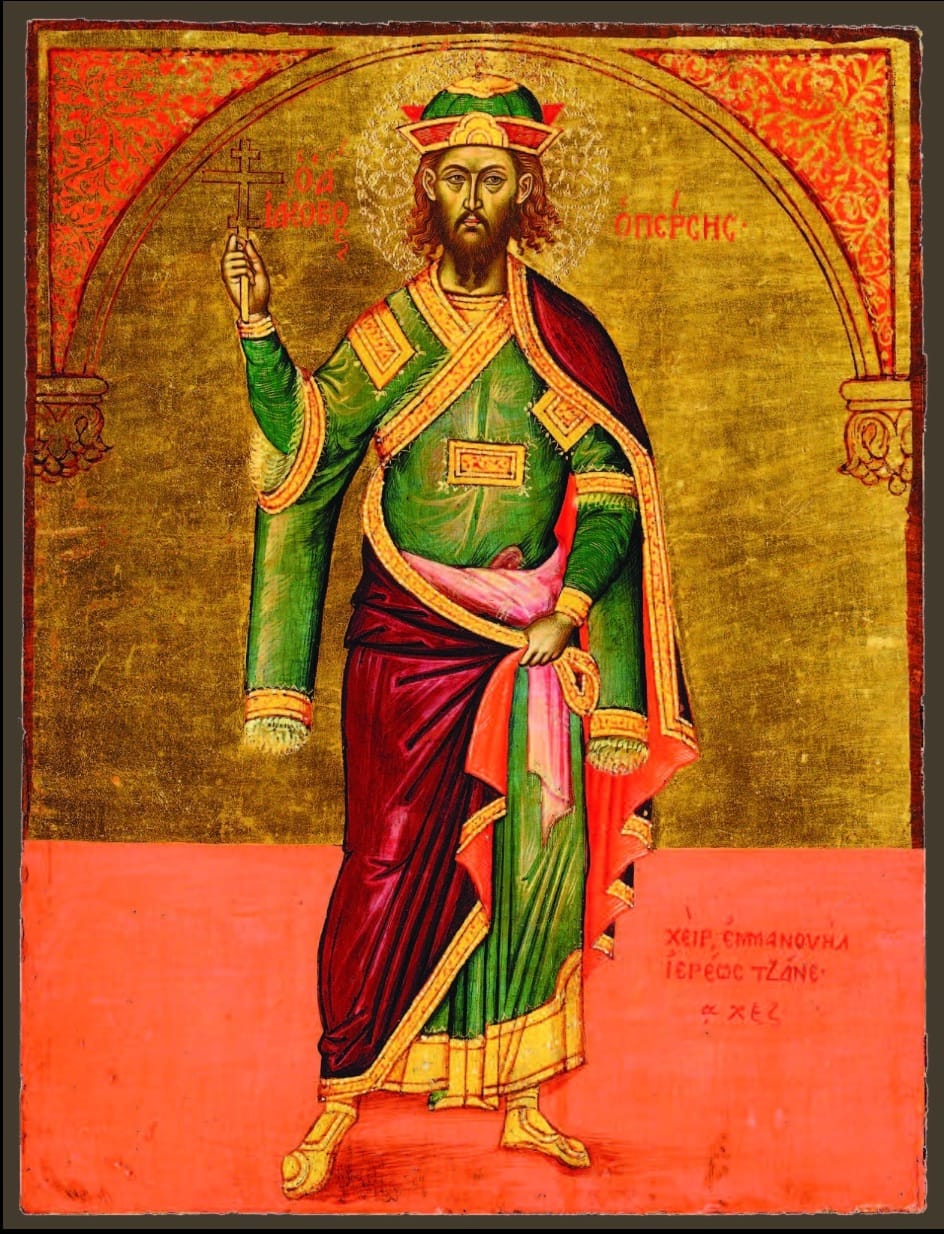
St. James the Persian
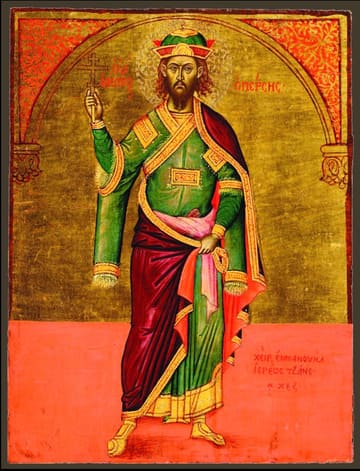
St. James the Persian, called the Dismembered (Intercisus in Latin), is honored by the Church as a Great Martyr. A nobleman of the Persian court, he denied Christ to keep the king's favor, repented, and confessed Him again at the cost of being cut apart limb by limb, about the year 400.
His memory on November 27 proclaims that repentance can turn even a fall into a crown.
He came of a noble Christian family of Beth Lapat (Gundeshapur) in Khuzistan, in the southwest of the Persian Empire, and served at the royal court in Ctesiphon. At the end of the reign of Yazdegerd I (399-420), as the historian Theodoret records, persecution broke out against the Church in Persia after a bishop destroyed a fire temple, and Yazdegerd's son Bahram V (420-438) inherited the war against the faith along with the throne. Won over by royal favor, James renounced Christ and joined in the worship of the court. The Greek Synaxarion connects his fall with Yazdegerd, while the Syriac Acts name Bahram.
According to his Acts, preserved in Syriac, Greek and many other languages, his mother and his wife wrote to him in grief: they would have nothing to do with him as long as he remained in his denial. Shaken, James wept for his sin and returned to the Scriptures, and when he was summoned before the king he declared that he was a Christian. On the advice of one of the royal counselors he was condemned to an unheard-of death. Joint by joint the executioners severed his limbs, beginning with the fingers and toes, and all the while he prayed and recited the words of Scripture, strengthening himself and teaching the onlookers who begged him to save his life.
When only his head and torso remained, he prayed once more and was beheaded. Christians gathered his remains by night and buried them with honor. The Syriac Acts date his death to Friday, November 27, in the first year of Bahram, but the Prologue places it around the year 400, in the reign of Yazdegerd.
His veneration spread quickly through East and West. Constantinople had shrines in his honor, and Russian pilgrims of the fourteenth century venerated his head in the city's Pantokrator monastery. Portions of his relics are kept today in the Holy Land, in Egypt, on Mount Athos and in many churches of Greece and Russia.
Sources
- Martyrdom of St. James the Persian (Syriac and Greek Acts)
- Theodoret, Church History V.38 (NPNF)
- Greek Menaion and Synaxarion, November 27
- Pravoslavnaya Entsiklopediya, 'Iakov Persyanin'
- OCA, Lives of the Saints: Greatmartyr James the Persian
No recorded sayings. Read the Life to meet this saint.
Troparion · Tone 4
Your martyr, O Lord, by his contest won from You, our God, the crown of incorruption; for, holding Your strength, he threw the tyrants down and shattered too the powerless audacity of demons. At his entreaties, O Christ God, save our souls.
Translated for Axios! from the Greek Menaion, November 27
Kontakion · Tone 2
Persuaded by your good wife, O steadfast soul, and fearing the dread judgment seat, you scorned the pride of the Persians and their terror, O James, and you were shown to be a wondrous martyr, your body cut like a vine branch.
Translated for Axios! from the Greek Menaion, November 27
Saints around November 27
Get the full library
770+ saints, in your pocket
Their Lives, sayings and prayers, A to Z and by feast, with search. The Church calendar, the holy icons, and the saying of the day on your Home Screen. All in Axios! for iPhone, iPad and Android.