
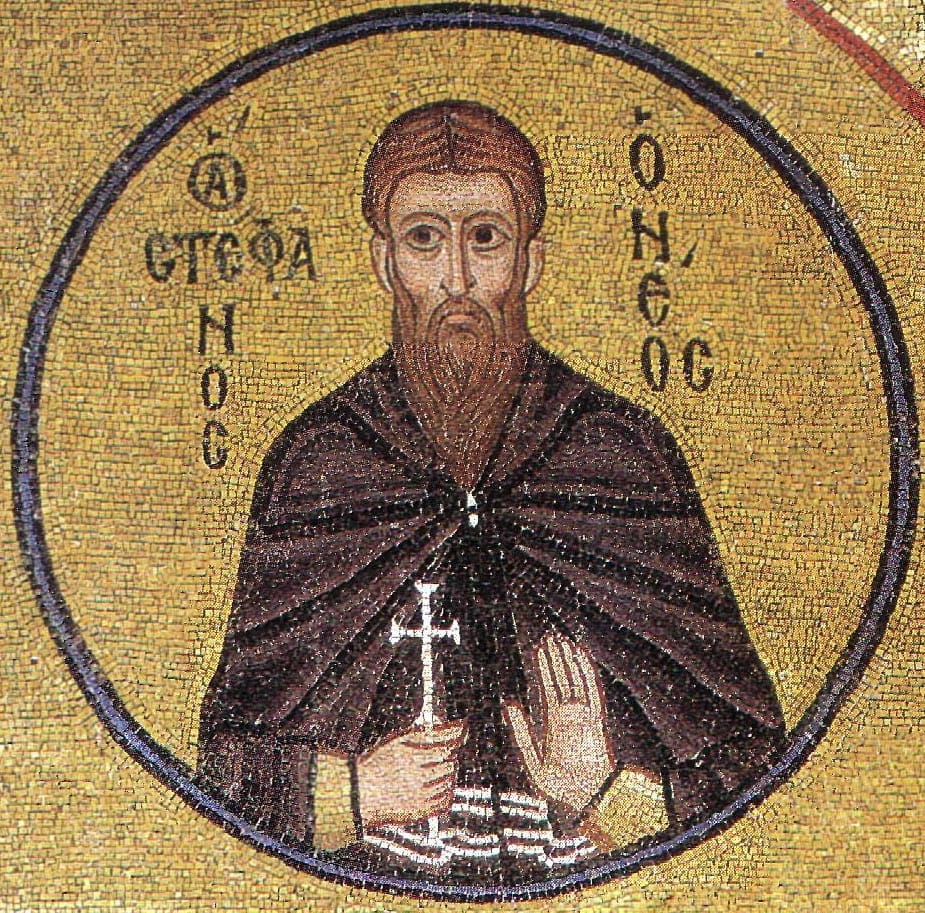
St. Stephen the New
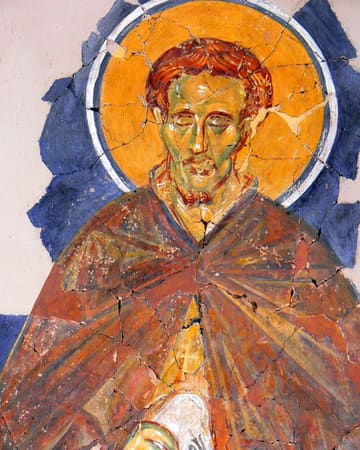
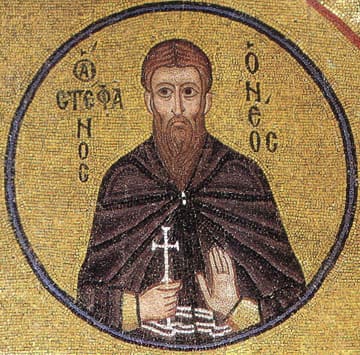
St. Stephen the New is the great martyr of the first age of Iconoclasm. A hermit of Mount Auxentius near Chalcedon, he refused Emperor Constantine V's condemnation of the holy icons and was killed in the streets of Constantinople on November 28, 767.
He is called "the New" because his name and witness recall St. Stephen the Protomartyr.
According to his Life, written some forty years later by Stephen, a deacon of Hagia Sophia, he was born in Constantinople about 715 to Gregory and Anna. His mother prayed for a son at the church of the Theotokos at Blachernae, and Patriarch Germanus blessed the child in her womb and foretold his name. In his sixteenth year he was entrusted to John, the fifth hermit to live in the cave of St. Auxentius, and served him until his death.
At thirty-one he enclosed himself in a narrow cell, weaving nets and copying books so as to burden no one and to help the poor. Disciples gathered, and a monastery grew below.
In 754 the emperor's Council of Hieria declared the icons idols, and Stephen would not sign its decree. When the patrician Callistus brought the imperial command with a gift of dates and figs, he sent the food back and held out his cupped palm: even that much blood he would pour out for the image of Christ. His enemies then accused him of sin with Anna, a nun he had guided.
Questioned by the emperor, she would not slander him, and the Synaxarion says she died under the blows. His monastery was destroyed and he was exiled to Proconnesus in the Sea of Marmara.
Brought back to the capital, he faced the emperor himself. Taking out a coin stamped with the emperor's image, he asked whether trampling it would be punished, then threw it down and trod on it: how much greater, he said, is the guilt of those who trample the image of Christ and His Mother. For eleven months he shared the Praetorium prison with 342 monks, many of them mutilated for the icons, and made it a place of prayer.
On November 28 a mob roused by the emperor dragged him into the street. As he raised his head to venerate the chapel of St. Theodore, a man named Philomates struck him dead with a beam. His torn body was thrown into the pit of the condemned at the ruined church of St. Pelagius.
The Church remembers with him Peter, Andrew, Anna and others who died for the icons. The Seventh Ecumenical Council vindicated their faith in 787, and the final restoration of the icons in 843 is kept on the Sunday of Orthodoxy.
Sources
- Stephen the Deacon, Life of St. Stephen the Younger (PG 100.1069-1186; ed. M.-F. Auzépy, 1997)
- Greek Menaion and Synaxarion, November 28
- OCA, Lives of the Saints: Monastic Martyr and Confessor Stephen the New
- Oxford Dictionary of Byzantium, 'Stephen the Younger'
Listen, my lord patrician. Since the decree of this false council holds a heretical belief, I, Stephen, will not sign it, nor call bitter sweet, lest I bring the prophet's woe upon myself. For the veneration of the holy icons I will most gladly accept death.
His reply to the patrician Callistus, in Stephen the Deacon, Life of St. Stephen the Younger, PG 100.1123-1124 (translated for Axios! from the Latin version of J. Loppin, 1688)
Even if I had only this much life-blood in me, let it be poured out for the image of Christ.
His words to Callistus, showing his cupped palm, in Stephen the Deacon, Life of St. Stephen the Younger, PG 100.1123-1124 (translated for Axios! from the Latin version of J. Loppin, 1688)
O emperor, Christians have never decreed that matter should be worshipped in an icon. Rather, we venerate the name of the one shown to us through the image, rising in mind to the originals themselves.
His answer to Emperor Constantine V, in Stephen the Deacon, Life of St. Stephen the Younger, PG 100.1157-1158 (translated for Axios! from the Latin version of J. Loppin, 1688)
If that is your judgment, what punishment will he suffer who has trampled and burned the name of Christ and of His Mother in an icon? Will he not be handed over to the eternal fire that never dies and to the worm that never sleeps?
His words after the question of the coin, in Stephen the Deacon, Life of St. Stephen the Younger, PG 100.1159-1160 (translated for Axios! from the Latin version of J. Loppin, 1688)
Troparion · Tone 4
Trained first in ascetic struggle on the mountain, with the full armor of the Cross you destroyed the unseen battle lines of the enemy, O all-blessed one. Then once more you stripped manfully for the contest, slaying Copronymus with the sword of the Faith; and for both you were crowned by God, O renowned venerable martyr Stephen.
Translated for Axios! from the Greek Menaion, November 28
Kontakion · Tone 4
Today the Church keeps a joyful feast in your memory, and faithfully praising you she cries out to you: O godly Stephen, boast of the venerable!
Translated for Axios! from the Greek Menaion, November 28
Saints around November 28
Get the full library
770+ saints, in your pocket
Their Lives, sayings and prayers, A to Z and by feast, with search. The Church calendar, the holy icons, and the saying of the day on your Home Screen. All in Axios! for iPhone, iPad and Android.