
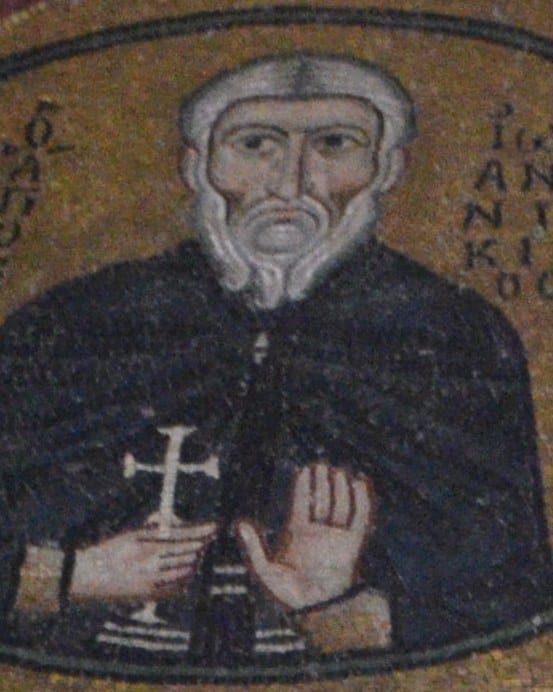
St. Joannicius the Great
St. Joannicius the Great, a soldier who became a hermit of Mount Olympus in Bithynia, was the most revered monastic elder of the second age of Iconoclasm.
Famed for his long ascetic life, his miracles and his gift of prophecy, he lived to see the icons restored in 843, and the short prayer he loved, "My hope is the Father, my refuge is the Son, my shelter is the Holy Spirit", is still said at the end of Compline.
He was born about 752 at Marykatos in Bithynia, near Lake Apolloniatis, and as a boy herded his family's sheep. He grew up an iconoclast. At nineteen he joined the excubitors of the imperial guard and served about twenty years.
His Life, written by the monk Sabas soon after his death, tells how an old monk he met on Mount Olympus rebuked him for despising the icons and won him to the Orthodox faith, and how he fought bravely against the Bulgarians. After the battle of Markellai in Thrace he left the army and, at about forty, gave himself to God on Mount Olympus, first at the monastery of Agauroi and then at Antidion.
For decades he lived as a wandering hermit in the mountains of Bithynia, Lycia and Cilicia, received the monastic habit at the monastery of Eriste about 806, and for years at a time shut himself away. During one seclusion of three years, Sabas writes, he sang the thirty psalms he knew with a single short troparion to the Holy Trinity. He became known as a wonderworker who healed the sick, drove off serpents and demons and freed captives of the Bulgarians, and as a prophet who foretold the deaths of emperors.
When Leo V renewed Iconoclasm in 815 he went into hiding. St. Theodore the Studite and many bishops and abbots came to see him, and he built churches in honor of the Theotokos, the Apostles and St. Eustathius.
In old age he returned to Antidion. Emperor Theophilus sent to consult him about the icons, and he foretold the election of St. Methodius as patriarch and defended him by letter against his detractors. On November 1, 846, Methodius came to visit him.
Joannicius embraced him, urged him to bear insults nobly, and told him that he would soon follow. Two days later he fell ill, and on November 4 he reposed, past ninety, and was buried in the church of Antidion. Methodius died the following June, as he had foretold.
His Lives by the monks Sabas and Peter are among the chief witnesses to the monasticism of his time, and his canon was written by St. Joseph the Hymnographer.
Sources
- Sabas the Monk, Life of St. Joannicius (BHG 935; Acta Sanctorum Nov. II.1, 1894, pp. 332-383)
- Peter the Monk, Life of St. Joannicius (BHG 936; Acta Sanctorum Nov. II.1, pp. 384-435)
- Bollandists, Commentarius praevius on St. Joannicius (Acta Sanctorum Nov. II.1, pp. 311-332)
- Greek Menaion and Synaxarion, November 4
- The Horologion, Small Compline
My hope is God, my refuge is Christ, my shelter is the Holy Spirit.
The troparion he sang with the Psalms, Sabas, Life of St. Joannicius III (Acta Sanctorum Nov. II.1, pp. 340-341; translated for Axios! from the Greek)
My brothers and fathers, truly I am a sinner, as you say, and wretched; but there is repentance.
His answer to monks who reviled him, Sabas, Life of St. Joannicius XI (Acta Sanctorum Nov. II.1; translated for Axios! from the Greek)
Therefore, as the Seraphim believe, so I believe: in three holinesses, each a Person, I worship one lordship and one Godhead, God the Father, God the Son, God the Holy Spirit.
His profession of faith, Sabas, Life of St. Joannicius XI (Acta Sanctorum Nov. II.1; translated for Axios! from the Greek)
Those who dare to rise up against you, holy master, are fighting rather against God and taking up arms against their own salvation. Therefore bear insults nobly.
His words to Patriarch Methodius, Sabas, Life of St. Joannicius XII (Acta Sanctorum Nov. II.1; translated for Axios! from the Greek)
Troparion · Tone 8
By the outpouring of your tears you tilled the barren ground of the desert, and with deep-drawn sighs you made your labors yield fruit a hundredfold, and became a light-giver to the world, gleaming with wonders, O Joannicius, our venerable father. Intercede with Christ our God that our souls may be saved.
Translated for Axios! from the Greek Menaion, November 4
Kontakion · Tone 8
You appeared as an all-radiant star shining on the earth, giving light to those in the darkness of the passions, and as a physician most ready to help the sick. Since you have received the grace of healing, grant every healing to those who ask you, that we may cry: Rejoice, O Father Joannicius!
Translated for Axios! from the Greek Menaion, November 4
Prayer of St. Joannicius
My hope is the Father, my refuge is the Son, my shelter is the Holy Spirit: O Holy Trinity, glory to You.
The Horologion, end of Small Compline (translated for Axios! from the Greek); his own troparion, recorded in the form 'My hope is God, my refuge is Christ, my shelter is the Holy Spirit' by Sabas, Life of St. Joannicius III
Saints around November 4
Get the full library November 2St. Acindynus, St. Pegasius, St. Anempodistus and Those with Them
 November 2St. Gabriel of Georgia
 November 3St. Acepsimas, St. Joseph and St. Aithalas
 November 5St. Galaction and St. Episteme
 November 5St. Jonah of Novgorod
 November 5St. Patrobas, St. Hermas, St. Linus, St. Gaius and St. Philologus
770+ saints, in your pocket
Their Lives, sayings and prayers, A to Z and by feast, with search. The Church calendar, the holy icons, and the saying of the day on your Home Screen. All in Axios! for iPhone, iPad and Android.