
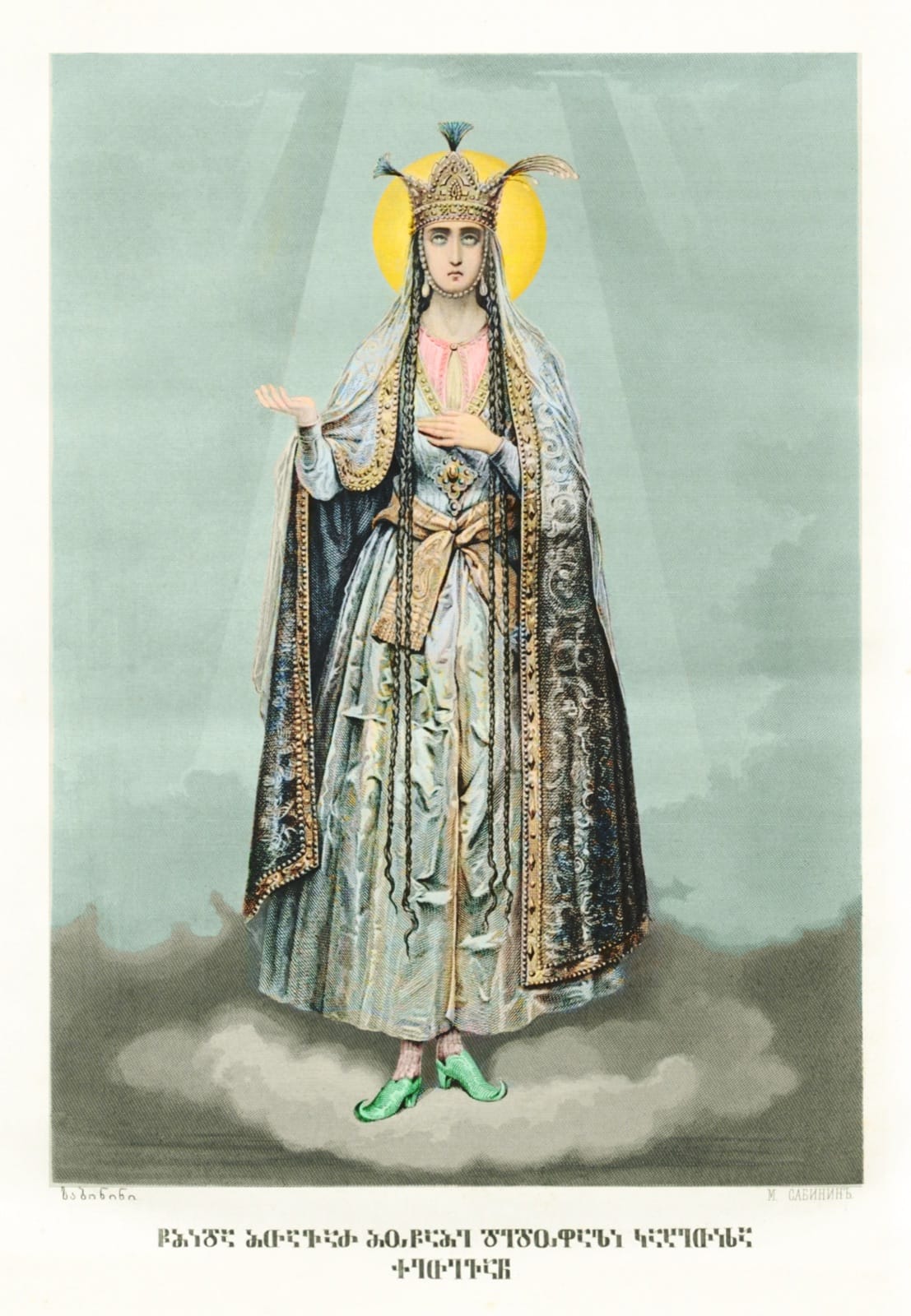
St. Ketevan the Great Martyr
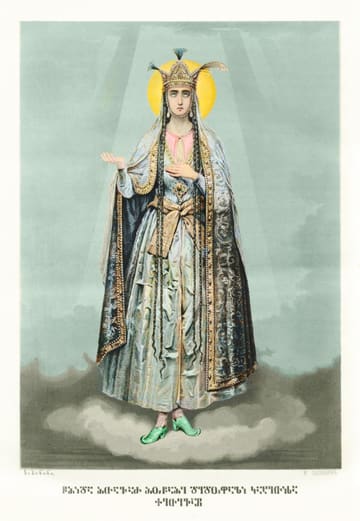
St. Ketevan, Queen of Kakheti in eastern Georgia, is venerated as a Great Martyr. Held captive for ten years by Shah Abbas I of Persia, she would not renounce Christ for a throne or for riches and was tortured to death in Shiraz in 1624.
The Georgian Church glorified her almost at once, and her sufferings moved Christians as far away as Portugal and Germany.
Born in 1575, she was the daughter of Prince Ashotan of Mukhrani, of the royal house of the Bagrations. In 1589 she married Prince David of Kakheti, who reigned briefly as King David I and died in 1602, leaving her a widow with young children. In 1605 Constantine, a son of King Alexander II who had accepted Islam at the Persian court, murdered his father and brother at the shah's bidding and demanded that Ketevan marry him.
She refused and rallied the nobles of Kakheti; encouraged by her to trust in the Cross, they overthrew and killed the usurper. She then won the return of her son Teimuraz from Persia as king, guided the kingdom for a time, and gave herself to works of mercy, offering her jewels to the Church, building churches and caring for the poor.
In 1614, when Shah Abbas demanded hostages, she went to him at the urging of her son and people; the shah kept her and her two grandsons captive, laid Kakheti waste, and sent the queen to Shiraz. There she lived for ten years like a nun, fasting, keeping vigils, sleeping on a hard bed and sharing all she had with the poor. She strengthened the faith of the Georgian women held in the shah's household: when Abbas asked why they would not accept Islam, he was told that they would not while the mother of Teimuraz remained a Christian. Promised the honor of a queen and great riches if she would accept Islam, she would not deny Christ.
In September 1624 she was tortured in public with red-hot pincers and irons, and at last, on the shah's order, a red-hot cauldron was set on her head, and she died. Portuguese Augustinian monks in Shiraz, who had visited her and witnessed her death, secretly recovered her relics in January 1625. Part was carried to their house in Goa in India, and in 1628 they brought her head to Teimuraz, who laid it in the altar of the cathedral of Alaverdi; fragments found at Goa in 2005 were identified by DNA and returned to Georgia in 2021.
Catholicos Zachariah glorified her as a Great Martyr soon after her death. The Georgian Church first kept her feast on March 1, and since the 18th century it keeps it on September 13, the date her son gave for her martyrdom.
Sources
- Pravoslavnaya Entsiklopediya, 'Ketevan' (with the accounts of the eyewitness Ambrosio dos Anjos, 1625, and of King Teimuraz I)
- OCA, Lives of the Saints: Greatmartyr Ketevan, Queen of Georgia (September 13)
No recorded sayings. Read the Life to meet this saint.
Troparion · Tone 4
Your lamb Ketevan, O Jesus, cries with a great voice: For You, my Bridegroom, I yearn, and in seeking You I contend; I am crucified with You, and in Your baptism I am buried with You; I suffer for You, to reign with You; I die on Your behalf, so that in You I may also live. But receive as a blameless offering her who is slain for You with longing. At her intercessions, in Your mercy, save our souls.
Translated for Axios! from the Greek General Menaion (the common troparion of a woman martyr)
Kontakion · Tone 2
Having found your all-honored temple to be a healing of souls, all of us faithful cry to you aloud, O martyr Ketevan, of great renown: Pray to Christ God without ceasing for us all.
Translated for Axios! from the Church Slavonic General Menaion (the common kontakion of a woman martyr)
Saints around September 13
Get the full library
770+ saints, in your pocket
Their Lives, sayings and prayers, A to Z and by feast, with search. The Church calendar, the holy icons, and the saying of the day on your Home Screen. All in Axios! for iPhone, iPad and Android.