
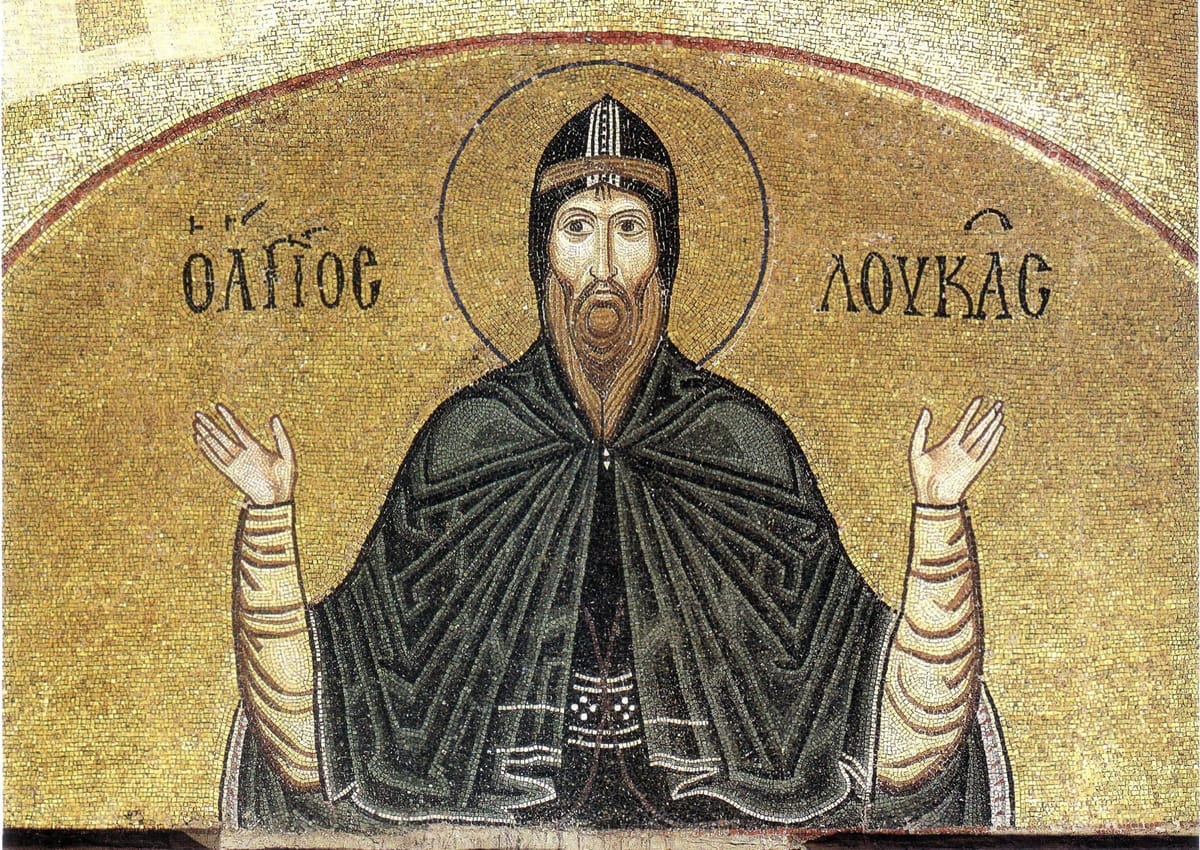
St. Luke of Steiris
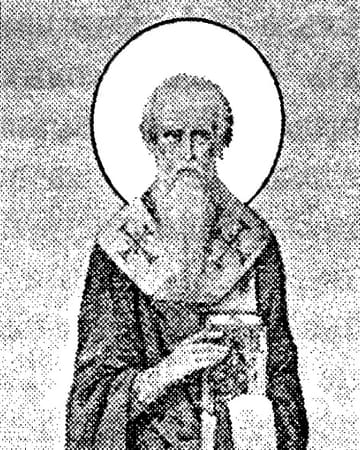
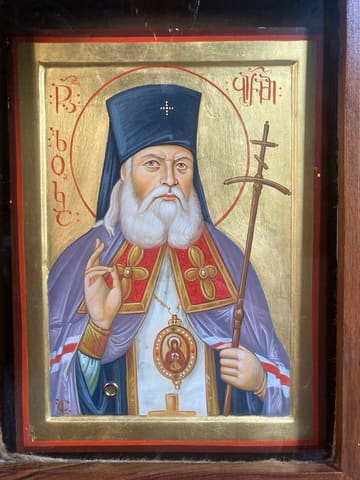
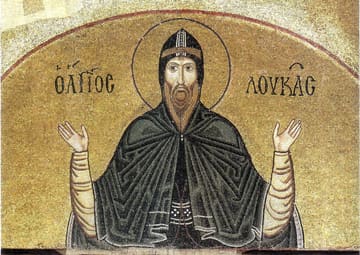
St. Luke of Steiris, also called Luke of Hellas and Luke the Younger, is the hermit and wonderworker of 10th-century central Greece over whose tomb rose the Monastery of Hosios Loukas, one of the glories of Byzantine art.
In a land torn by raids he lived as a man of prayer, mercy and prophecy, and the Church keeps his memory on February 7, the day of his repose in 946.
His family had fled Arab raids on the island of Aegina, and he was born about 896 in the village of Kastorion in Phocis, to Stephen and Euphrosyne. As a boy he kept sheep and worked the fields, giving his food, his clothes and even the seed grain to the poor; according to his Life, the little seed he had left yielded a rich harvest. After his father's death he left home to become a monk, was seized in Thessaly as a runaway slave, and received the habit in Athens.
His mother's prayers brought him back, and with her blessing he went to Mount Ioannitsa, where he lived seven years beside a church of St. Cosmas and St. Damian. Two elders bound for Rome gave him the great schema there.
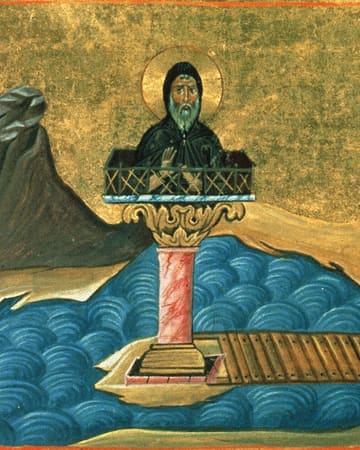
When the Bulgarians ravaged central Greece in 917 he went to Corinth and then served a stylite near Patras for ten years. Back on Ioannitsa, he was besieged by visitors, and the learned Theophylact of Corinth counseled him with the word once given to St. Arsenius: flee from men and be saved. He lived at Kalamion by the sea, sheltered on the waterless islet of Ampelon during the Hungarian raid of 943, and soon afterward settled at Steiris, near Mount Helicon.
Disciples gathered, and the general Krinites helped build a church of St. Barbara. His Life tells that he foretold that Crete, then held by the Arabs, would be freed under an emperor named Romanos, as it was in 961.
Knowing his end, he shut himself in his cell for three months. He asked to be thrown into a ravine as food for beasts, then bade the brethren bury him where he lay, and he reposed saying, "Into Your hands, O Lord, I commend my spirit." Myrrh and healings at his tomb drew pilgrims; a church of the Theotokos rose in the later 10th century, and in the early 11th the great katholikon with its mosaics was built over his grave.
In the Crusader period his relics were mistaken for those of St. Luke the Evangelist and carried off, at last to Venice; they were returned to Hosios Loukas in December 1986. With Daphni and Nea Moni, the monastery is a UNESCO World Heritage Site.
Sources
- Anonymous Life of St. Luke the Younger (BHG 994; excerpts in Greek and Latin, PG 111, 441-480)
- Greek Menaion and Synaxarion, February 7
- Pravoslavnaya Entsiklopediya, 'Luka Elladsky'
- OCA, Lives of the Saints: Venerable Luke of Hellas
By no means, my lord: I did not come in need of gold, but of prayers and teaching. What is gold to me, who have chosen to live this way? Give me what I need and thirst for: teach me, unlearned and rustic as I am, how I may gain salvation.
His answer to the bishop of Corinth, who offered him gold, in the anonymous Life of St. Luke the Younger, PG 111.455-456 (translated for Axios! from the Latin version of F. Combefis printed beside the Greek)
Do not harm me, and I will not harm you. Let each of us go his own way, for we are both creatures of the one Maker, and without His leave and will we can do nothing.
His words to a viper that hung from his foot, in the anonymous Life of St. Luke the Younger, PG 111.457-458 (translated for Axios! from the Latin version of F. Combefis printed beside the Greek)
This is a spring cloud, brothers: it will soon be scattered, and fair weather will shine on us more brightly.
His words to the people who wished to flee to the Peloponnese during a raid, in the anonymous Life of St. Luke the Younger, PG 111.461-462 (translated for Axios! from the Latin version of F. Combefis printed beside the Greek)
What? Is it not plainly shameful to seem not to know this? Tie ropes to my feet and throw me into some ravine, so that, if I am useless for anything else, I may at least serve as food for the beasts.
His answer when asked where he wished to be buried, in the anonymous Life of St. Luke the Younger, PG 111.473-474 (translated for Axios! from the Latin version of F. Combefis printed beside the Greek)
It is God's will, for hidden reasons that He knows, to glorify this place until the end of the world, as the faithful flock here and glorify His divine name.
His last words about his tomb, in the anonymous Life of St. Luke the Younger, PG 111.475-476 (translated for Axios! from the Latin version of F. Combefis printed beside the Greek)
Troparion · Tone 1
The glory of Hellas and the boast of the venerable, the luminary and holy dweller of Steiris, Luke the God-bearer, let us devoutly honor with songs and odes; for he ever unites to Christ those who cry out in faith: Glory to Him who gave you strength! Glory to Him who crowned you! Glory to Him who works healings for all through you!
Translated for Axios! from the Greek Menaion, February 7
Kontakion · Tone 8
God, who chose you before you were formed, for His good pleasure, by judgments that He knows, took you to Himself from the womb and sanctified you, and He shows you to be His own servant, guiding your steps, O Luke: the Lover of mankind, before whom you now stand rejoicing.
Translated for Axios! from the Greek Menaion, February 7
Saints around February 7
Get the full library
770+ saints, in your pocket
Their Lives, sayings and prayers, A to Z and by feast, with search. The Church calendar, the holy icons, and the saying of the day on your Home Screen. All in Axios! for iPhone, iPad and Android.