
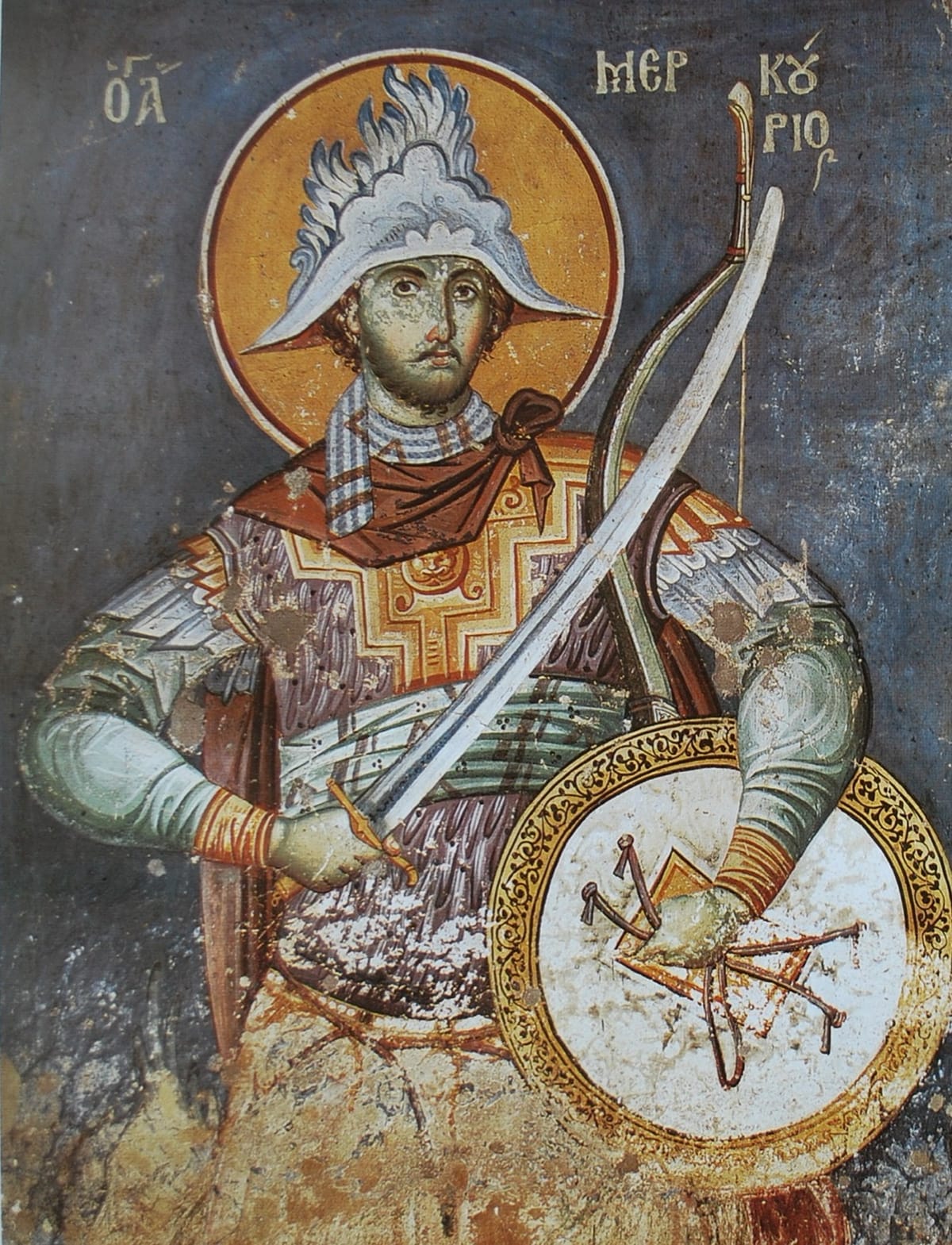
St. Mercurius the Great Martyr
Also commemorated
- November 25Greek usage
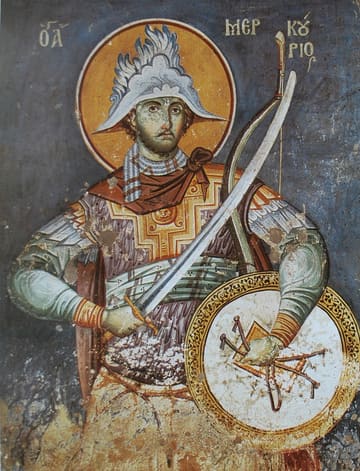
St. Mercurius is one of the soldier saints whom the Church honors as Great Martyrs. He is remembered as an officer of the Roman army who refused to sacrifice to the gods and was beheaded at Caesarea in Cappadocia about the middle of the third century, and he became one of the best-loved martyrs of the Christian East.
The Greek Church keeps his memory on November 25, together with St. Catherine, and the Slavic Churches on November 24.
Firm history about him is slight. His veneration was rooted in Caesarea, the city of St. Basil the Great: by the sixth century a pilgrim named Theodosius had seen his relics there, and the Lives of St. Basil speak of a church of Mercurius in the city. Scholars such as Hippolyte Delehaye judge that his Passion, which survives in three Greek versions, is built largely from themes shared with the Passions of other soldier martyrs, so its details are best received as the Church's tradition.
According to the Passion, he served under the emperors Decius and Valerian, about 250. In a hard battle against the barbarians an angel in white gave him a sword, promised him victory and told him not to forget the Lord; Mercurius slew the enemy king and was made a general. When the angel came to him again, he remembered the faith taught him by his father Gordian, a Christian officer of Scythian origin.
Summoned to sacrifice in the temple of Artemis, he stayed away, and before Decius he threw down his cloak and belt of office and confessed Christ. He was hung over a fire and cut with knives, was healed in prison, and was sent to Caesarea, where Christ appeared to him on the eve of his death. After he was beheaded, the Passion says, his body shone white as snow and gave off a sweet fragrance.
Byzantine tradition also made him the avenger of the Church against Julian the Apostate, who fell in Persia in 363. The sixth-century chronicler John Malalas tells that St. Basil saw in a vision Christ sending Mercurius to strike down the persecutor, and the Life of St. Basil ascribed to St. Amphilochius adds that the martyr's weapons, kept at his shrine, were found missing; in the twelfth century the historian Michael Glykas already doubted the story. His veneration spread far: the Copts call him Abu Sefein, "father of two swords", and Benevento in southern Italy has honored him as its patron since Duke Arechis II brought relics said to be his there in the eighth century. Portions of his relics are venerated on Mount Athos and in many monasteries of Greece.
Sources
- Passion of St. Mercurius (BHG 1274-1276), ed. H. Delehaye, Les légendes grecques des saints militaires (1909)
- John Malalas, Chronicle XIII; Pseudo-Amphilochius, Life of St. Basil
- Greek Menaion and Synaxarion, November 25
- Pravoslavnaya Entsiklopediya, 'Merkury'
- OCA, Lives of the Saints: Great Martyr Mercurius of Caesarea in Cappadocia
No recorded sayings. Read the Life to meet this saint.
Troparion · Tone 4
Your martyr Mercurius, O Lord, in his suffering received from You, our God, an incorruptible crown; for, holding Your strength, he threw the tormentors down and crushed too the feeble audacity of demons. By his prayers save our souls.
Translated for Axios! from the Church Slavonic Menaion, November 24
Kontakion · Tone 4
The warrior unconquerable in battles and the unfailing protector in misfortunes, Mercurius, let us bless with songs and glorify; for he delivers from misfortunes and sorrows those who joyfully celebrate his memory.
Translated for Axios! from the Church Slavonic Menaion, November 24
Saints around November 24
Get the full library
770+ saints, in your pocket
Their Lives, sayings and prayers, A to Z and by feast, with search. The Church calendar, the holy icons, and the saying of the day on your Home Screen. All in Axios! for iPhone, iPad and Android.