
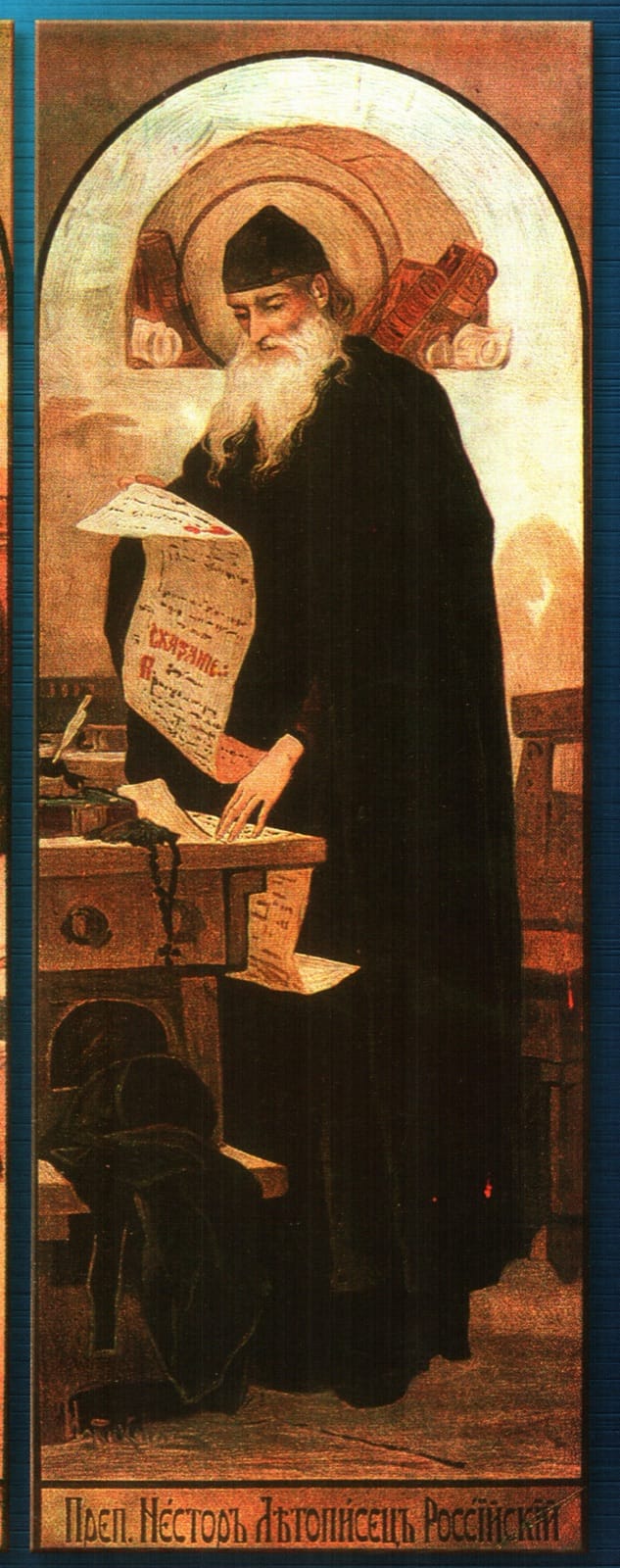
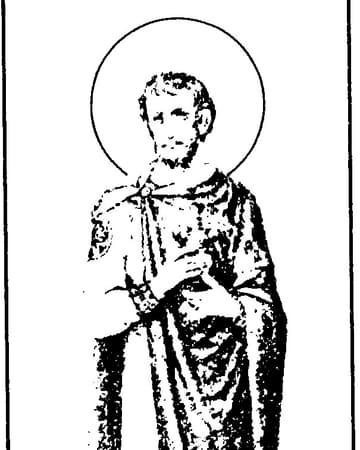
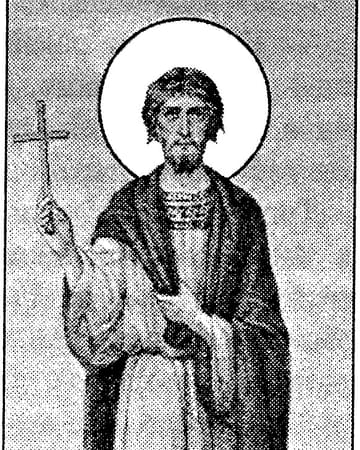
St. Nestor the Chronicler
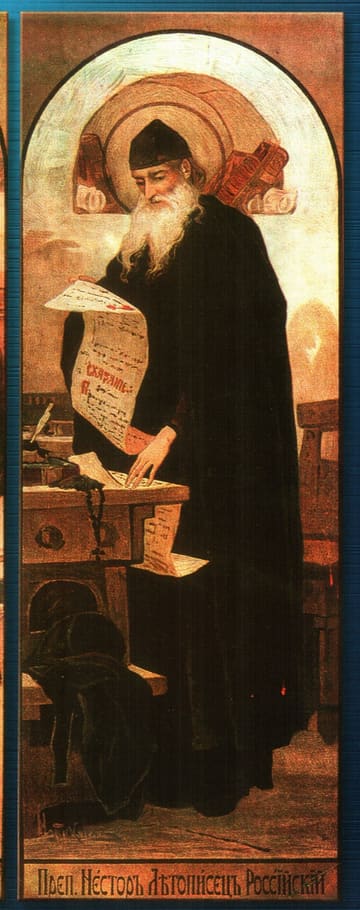
St. Nestor the Chronicler, a monk of the Kyiv Caves, is the first great writer of the Church of Rus'. He wrote the Reading on the life and murder of St. Boris and St. Gleb and the Life of St. Theodosius of the Caves, and since the thirteenth century tradition has named him the author of the Primary Chronicle, the Tale of Bygone Years, on which the history of Rus' is built.
Nothing certain is known of his family or birth. He entered the Kyiv Caves Monastery while St. Theodosius was still its abbot, and Theodosius's successor, Abbot Stephen, tonsured him and later ordained him deacon. He stayed on after Stephen was forced out, and the brethren entrusted him with writing.
In the Reading, meant to be read to the monks at table, he set the death of the two princes within the whole story of salvation, from Creation to the Baptism of Rus' by St. Vladimir, whom he calls a second Constantine, and held up their humble obedience to their elder brother. In the Life of St. Theodosius, the earliest surviving Life of a monk of Rus', he gathered what he heard from older monks, among them the cellarer Theodore, who had learned the saint's boyhood from his mother, and drew the abbot and his brethren with rare liveliness. Calling himself "the sinful Nestor," he wrote so that later monks might be strengthened for their own struggles.
The Kyiv Caves Patericon counts him among the elders who freed the young recluse Nikita, later Bishop of Novgorod, from a demon's deception. Most scholars hold that he was also the monk whom Abbot John sent by night in August 1091 to uncover the relics of St. Theodosius, an event told in the first person in the Chronicle. How much of the Chronicle he composed is still debated.
A sixteenth-century copy names him in its title, and in the 1230s the monk Polycarp called him "Nestor, who wrote the Chronicle," but some of its pages contradict his Life of Theodosius. Many scholars think he gathered earlier chronicles into the Tale of Bygone Years in the early 1110s.
The year of his death is unknown; tradition gives about 1114, and study of his relics suggests that he lived into his sixties or beyond. His relics rest openly in the Near Caves of the Lavra. Honored among the Kyiv Caves fathers from the seventeenth century, he entered the calendar of the whole Russian Church through Synodal decrees of 1762-1784. The Church keeps his memory on October 27, with the fathers of the Near Caves on September 28, and with all the Kyiv Caves saints on the Second Sunday of Great Lent.
Sources
- St. Nestor, Life of St. Theodosius of the Caves
- St. Nestor, Reading on the Life and Murder of the Blessed Passion-Bearers Boris and Gleb
- Primary Chronicle (Tale of Bygone Years), year 6599 (1091)
- Kyiv Caves Patericon, the tales of Nikita the Recluse and Agapit the Physician (St. Polycarp)
- Pravoslavnaya Entsiklopediya, vol. 49, 'Nestor'
- Church Slavonic Menaion, October 27
I thank You, my Master, Lord Jesus Christ, that You have counted me, unworthy as I am, worthy to tell of Your holy servants.
St. Nestor, Life of St. Theodosius of the Caves, opening (translated for Axios! from the Old East Slavic)
Day after day I was held by sorrow and prayed to God to let me write in order the life of our God-bearing father Theodosius, so that the monks after us, reading it and seeing the man's valor, may praise God and be strengthened for their own struggles.
St. Nestor, Life of St. Theodosius of the Caves, preface (translated for Axios! from the Old East Slavic; abridged)
All that I have written above about our blessed and great father Theodosius I learned by careful inquiry from fathers older than I who lived at that time, and I, the sinful Nestor, wrote it down.
St. Nestor, Life of St. Theodosius of the Caves, conclusion (translated for Axios! from the Old East Slavic)
Do you see, brothers, how lofty was the obedience the two saints kept toward their elder brother? Had they resisted him, they would hardly have been granted such a gift of miracles by God.
St. Nestor, Reading on the Life and Murder of the Blessed Passion-Bearers Boris and Gleb, conclusion (translated for Axios! from the Old East Slavic)
I, the sinful Nestor, have written of the life, the slaying and the miracles of these holy and blessed passion-bearers, gathering it carefully from those who knew, and other things I knew myself; of many things I have written down a few, that those who read may glorify God.
St. Nestor, Reading on the Life and Murder of the Blessed Passion-Bearers Boris and Gleb, conclusion (translated for Axios! from the Old East Slavic)
Troparion · Tone 8
In you, O Father, God's image was preserved to perfection; for you took the cross upon yourself and followed Christ, and in your conduct you taught that one should think little of the flesh, for it is fleeting, and take care of the soul, a thing that does not die. And so, O venerable Nestor, your spirit exults together with the angels.
Translated for Axios! from the Church Slavonic General Menaion (the common troparion of a venerable father)
Kontakion · Tone 2
Armed in godly fashion with the soul's purity, and firmly taking up ceaseless prayer as a lance, you pierced the ranks of the demons, O Nestor, our father: pray without ceasing for us all.
Translated for Axios! from the Church Slavonic General Menaion (the common kontakion of a venerable father)
Prayer of St. Nestor the Chronicler
O my Master, Lord Almighty, Giver of good things, Father of our Lord Jesus Christ: come to my help and enlighten my heart to understand Your commandments, and open my lips to tell of Your wonders and to praise Your holy servant, that Your name may be glorified; for You are the helper of all who hope in You forever. Amen.
St. Nestor, Life of St. Theodosius of the Caves, preface (translated for Axios! from the Old East Slavic)
Saints around October 27
Get the full library

770+ saints, in your pocket
Their Lives, sayings and prayers, A to Z and by feast, with search. The Church calendar, the holy icons, and the saying of the day on your Home Screen. All in Axios! for iPhone, iPad and Android.