
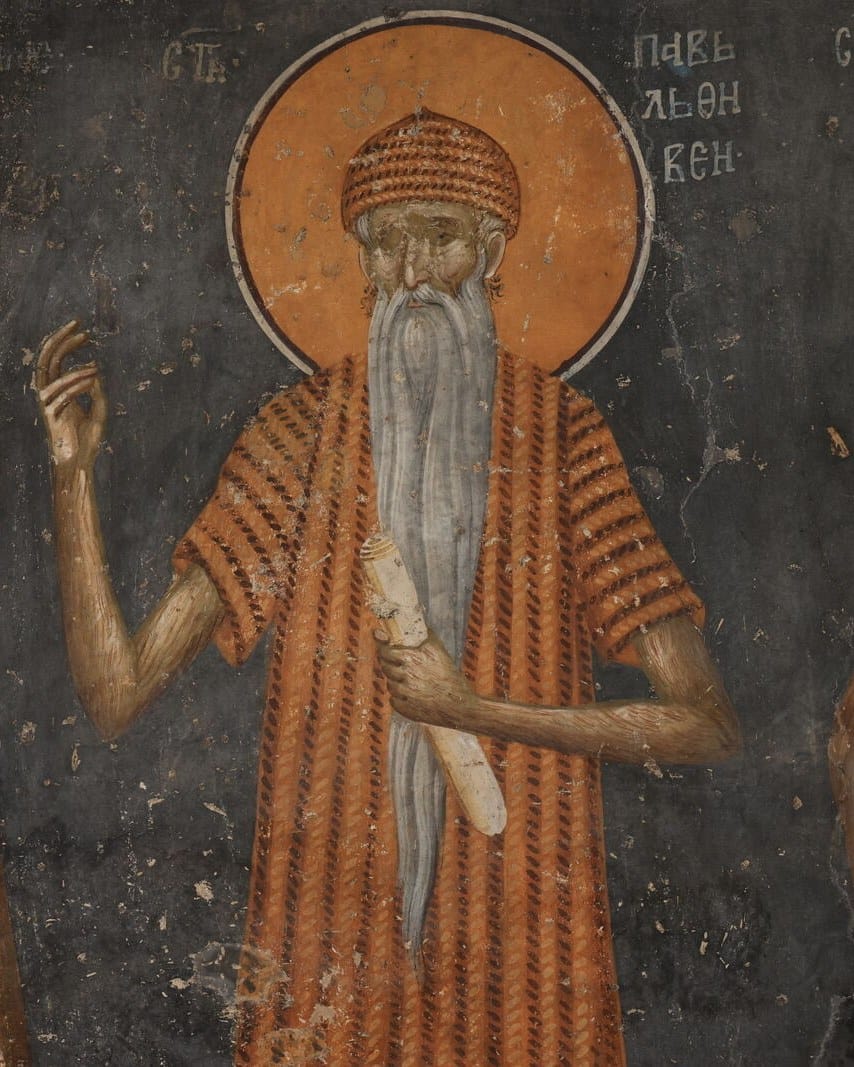
St. Paul of Thebes
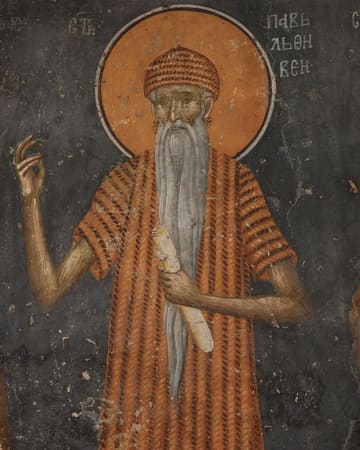
St. Paul of Thebes is honored as the first Christian hermit: he entered the Egyptian desert before St. Anthony the Great and lived there unknown for some ninety years.
Nearly all that is known of him comes from the short Life written around 375 by St. Jerome, who names two disciples of St. Anthony, Amathas and Macarius, as witnesses that Paul was the first to take up the solitary life.
According to Jerome, Paul was born in the Lower Thebaid to a wealthy family and was well taught in Greek and Egyptian letters. Orphaned at about sixteen, during the persecution of Decius around 250, he learned that his sister's husband meant to betray him in order to seize his inheritance, and he fled into the mountains. There he found a cave beside a spring, shaded by an old palm. He had come to wait out the persecution, but, as Jerome says, he turned necessity into free choice and stayed for life, praying in solitude, fed and clothed by the palm.
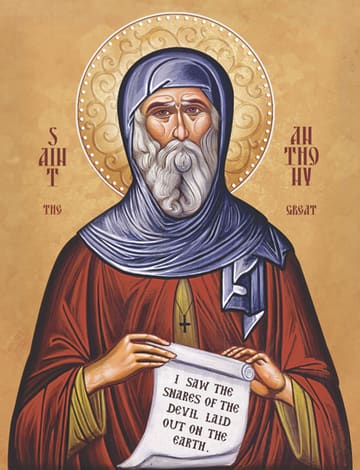
Decades later St. Anthony, then ninety, was tempted to think that no monk had lived in the desert longer than he, and it was revealed to him that a better man dwelt farther in. After a long search he reached Paul's cave and pleaded at the barred door until the old man, smiling, let him in; they embraced and greeted each other by name. A raven brought a whole loaf, and Paul said that for sixty years it had brought him half, but now Christ had doubled His soldiers' rations.
In the morning Paul said that the time of his falling asleep had come and sent Anthony to fetch the cloak St. Athanasius had given him, to wrap his body. Returning, Anthony saw Paul's soul rising among angels, prophets and apostles, and found the body kneeling with head and hands raised as if in prayer. Two lions came out of the desert and dug the grave.
Paul reposed at 113, in the year 342, and Anthony wore his tunic of palm leaves on Pascha and Pentecost. Jerome's Life, which also tells of strange creatures met on the road, was written to edify, and scholars weigh its details differently; the Church has always kept its heart, the hidden life of the first hermit.
The Coptic Monastery of St. Paul in Egypt's Eastern Desert, near the Red Sea, stands around the cave held to be his. Later accounts say his relics were taken to Constantinople under Emperor Manuel I Komnenos in the twelfth century, and afterward to Venice and Hungary. The Church keeps his feast on January 15, two days before that of St. Anthony.
Sources
- St. Jerome, Life of St. Paul the First Hermit (Vita Pauli, c. 375)
- Greek Menaion and Synaxarion, January 15
- Great Synaxaristes, January 15: St. Paul of Thebes (synaxarion.gr)
- OCA, Lives of the Saints: Venerable Paul of Thebes
- Catholic Encyclopedia (1911), 'St. Paul the Hermit'
No recorded sayings. Read the Life to meet this saint.
Troparion · Tone 8
In you, O Father, God's image was preserved to perfection; for you took the cross upon yourself and followed Christ, and in your conduct you taught that one should think little of the flesh, for it is fleeting, and take care of the soul, a thing that does not die. And so, O venerable Paul, your spirit exults together with the angels.
Translated for Axios! from the Church Slavonic, January 15
Kontakion · Tone 3
As an unsetting light of the spiritual Sun, let us come together today and praise you in songs; for you shone on those in the darkness of ignorance, lifting all to the divine height, O adornment of the Thebans, venerable Paul, firm foundation of fathers and ascetics.
Translated for Axios! from the Church Slavonic Menaion, January 15
Saints around January 15
Get the full library
770+ saints, in your pocket
Their Lives, sayings and prayers, A to Z and by feast, with search. The Church calendar, the holy icons, and the saying of the day on your Home Screen. All in Axios! for iPhone, iPad and Android.