
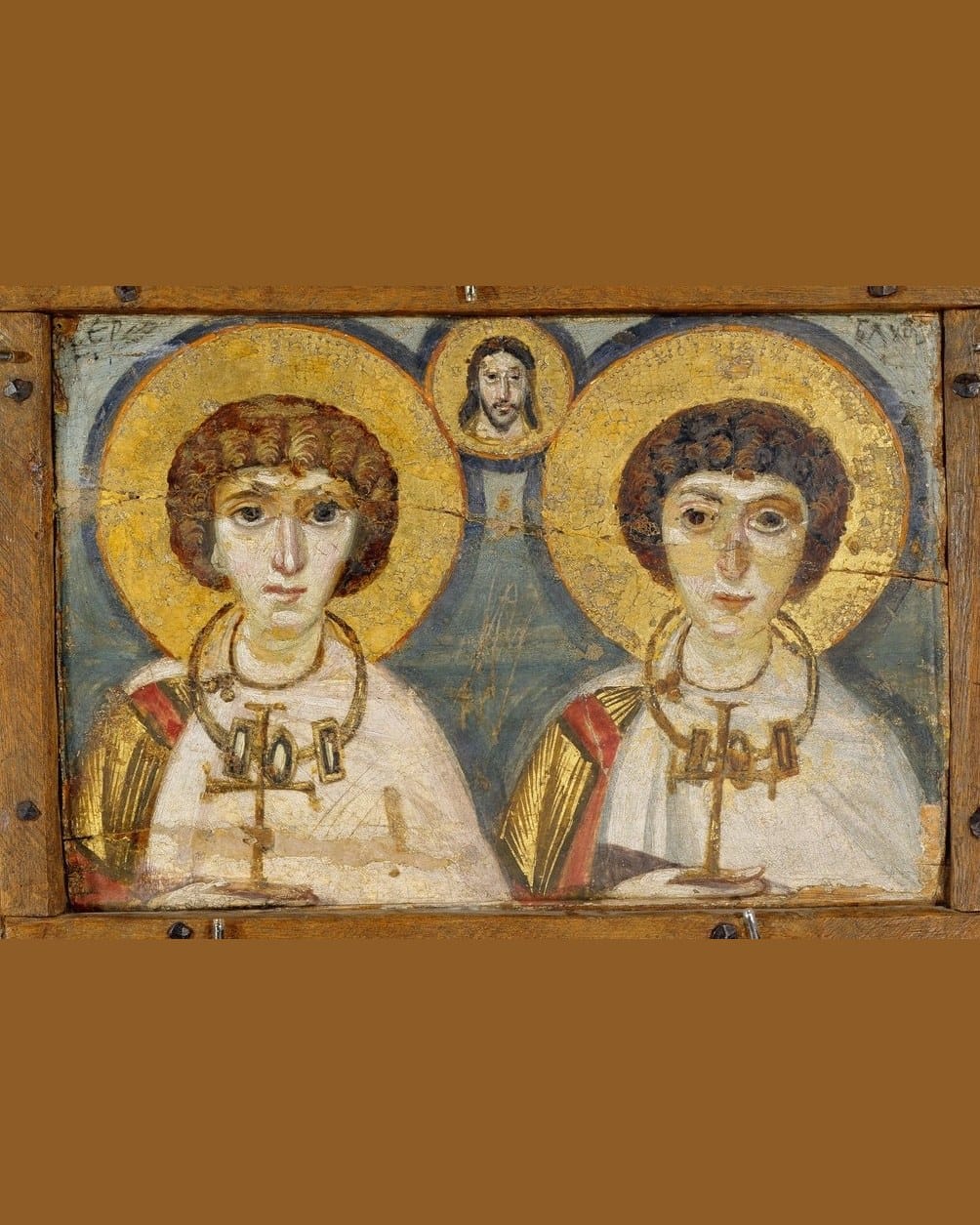
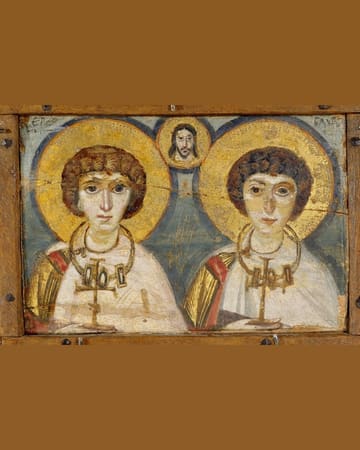
St. Sergius and St. Bacchus
St. Sergius and St. Bacchus were Roman officers who gave their lives for Christ in Syria, by the usual reckoning about the year 303.
Their shrine in the Syrian desert became one of the great pilgrimage places of the Christian East, and the Greek Synaxarion counts them among the great martyrs. The Church keeps their memory on October 7.
According to their Passion, a Greek work of the 5th century, Sergius and Bacchus were high officers of the imperial guard and trusted companions of the emperor Maximian, who knew nothing of their faith. When envious men denounced them, the emperor took them with him to the temple of Zeus, but they stayed outside and prayed. He had their belts and gold insignia stripped from them, sent them through the streets in women's clothing with chains about their necks, and at last dispatched them to Antiochus, the military governor of the province of Euphratesia, who owed his office to them.
Antiochus pleaded with his benefactors to spare themselves and him, but they answered in the words of St. Paul that for them to live was Christ and to die was gain. Bacchus was flogged until he gave up his spirit, at Barbalissos on the Euphrates; the Passion says that he appeared to Sergius that night, radiant as an angel and wearing an officer's uniform, to strengthen him. Sergius was made to march in boots pierced with nails and was beheaded at Rusafa, in the desert south of the river.
Not every detail of the Passion can be checked, but the honor paid to these martyrs is among the best documented of the early Church. Rusafa took the name Sergiopolis, the pilgrim of Piacenza visited Bacchus' tomb at Barbalissos about 570, and Christian Arab tribes of the desert took Sergius as their patron. The emperor Justinian surrounded the shrine with mighty walls, which still stand, and built a church of the two saints beside his palace in Constantinople, known today as the Küçük Ayasofya Mosque. The historian Evagrius records that the Persian king Khosrow I carried off from Sergiopolis a cross given by Justinian and Theodora, and that his grandson Khosrow II, who was not a Christian, sent golden crosses and vessels to St. Sergius in thanks for prayers answered.
Sources
- Greek Menaion and Synaxarion, October 7
- Passion of Sts. Sergius and Bacchus (Greek, 5th century)
- Evagrius Scholasticus, Ecclesiastical History IV.28 and VI.21
- Procopius, Buildings I.4 and II.9
- OCA, Lives of the Saints: Martyrs Sergius and Bacchus in Syria
No recorded sayings. Read the Life to meet this saint.
Troparion · Tone 4
Your martyrs, O Lord, by their contest won from You, our God, the crowns of incorruption; for, holding Your strength, they threw the tyrants down and shattered too the powerless audacity of demons. At their entreaties, O Christ God, save our souls.
Translated for Axios! from the Greek Menaion, October 7
Kontakion · Tone 2
Bravely arraying your minds against the enemies, you overthrew all their deceit; and having received the victory from on high, O all-praised martyrs, you cried out with one mind: It is good and pleasant to be with Christ.
Translated for Axios! from the Greek Menaion, October 7
Saints around October 7
Get the full library
770+ saints, in your pocket
Their Lives, sayings and prayers, A to Z and by feast, with search. The Church calendar, the holy icons, and the saying of the day on your Home Screen. All in Axios! for iPhone, iPad and Android.