
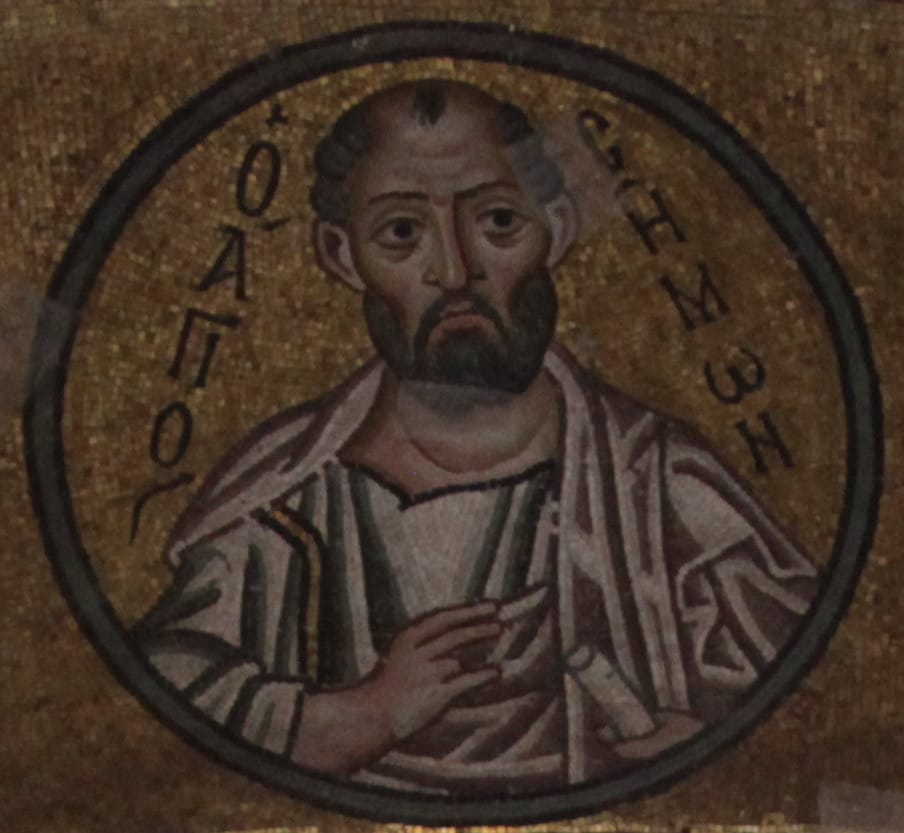
St. Simon the Zealot
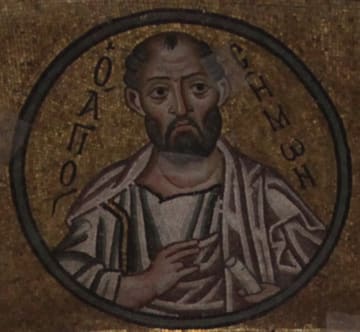
St. Simon the Zealot is one of the Twelve Apostles. Scripture records only his name and surname, yet the Church remembers him as a man of burning zeal who left everything for Christ, carried the Gospel far from Galilee and, according to tradition, sealed his preaching with martyrdom.
He stands tenth or eleventh in the lists of the Twelve (Matthew 10:4; Mark 3:18; Luke 6:15; Acts 1:13). In the Greek of Matthew and Mark he is called the Cananaean, from the Aramaic word for "zealot," which Luke translates. The title may point to the Jewish party of the Zealots or simply to fervent zeal for God's Law; the Synaxarion says he received it for his burning love of God.
St. Jerome and many after him took "Cananaean" to mean "of Cana," and so the Church came to remember him as a native of Cana in Galilee. He is not to be confused with St. Peter, also called Simon, or with Simon the kinsman of the Lord (Matthew 13:55).
The Synaxarion of Constantinople (10th century) preserves a beloved tradition: Simon was the bridegroom at the wedding in Cana, where at the word of the Theotokos the Lord turned water into wine, and after this first sign he left his home and followed Christ (John 2:1-11). The Greek Menaion goes further on April 22, where it identifies Nathanael, whom St. Philip brought to Jesus, with Simon the Zealot; the Russian tradition instead identifies Nathanael with St. Bartholomew. These are pious traditions, not part of the Gospel record.
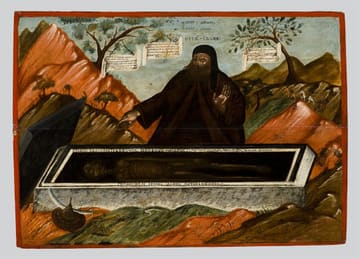
Of his preaching after Pentecost the sources tell many different stories. The Synaxarion speaks of Mauritania, Libya and Britain and of death on a cross, as do the verses of the Menaion, while a Latin Passion sends him with St. Jude to Persia, where the West remembers them together on October 28. A widespread early tradition places his end on the shores of the Black Sea: a fifth-century Latin list of the apostles says barbarians beheaded him at the Bosporus, and in the ninth century the monk Epiphanius described his preaching with St. Andrew in Abkhazia and his tomb at Nikopsia. In the nineteenth century monks from Mount Athos founded the New Athos Monastery in Abkhazia, restored a medieval church held to stand over his grave, and honor a nearby cave as the place of his prayer.
The Church keeps his feast on May 10 and remembers him with the Twelve on June 30.
Sources
- Matthew 10:4; Mark 3:18; Luke 6:15; Acts 1:13; John 2:1-11
- Greek Menaion and Synaxarion, May 10 and April 22
- Epiphanius the Monk, Life of St. Andrew
- OCA, Lives of the Saints: Apostle Simon the Zealot
- Pravoslavnaya Entsiklopediya, 'Simon Kananit'
No recorded sayings. Read the Life to meet this saint.
Troparion · Tone 3
O holy Apostle Simon, intercede with God, who is merciful, that He may grant to our souls the forgiveness of their trespasses.
Translated for Axios! from the Greek Menaion, May 10
Kontakion · Tone 2
The one who firmly set the teachings of wisdom in the souls of the devout, let us all call blessed with praise: Simon, who spoke of God. For he now stands before the throne of glory and rejoices with the bodiless hosts, interceding unceasingly for us all.
Translated for Axios! from the Greek Menaion, May 10
Saints around May 10
Get the full library
770+ saints, in your pocket
Their Lives, sayings and prayers, A to Z and by feast, with search. The Church calendar, the holy icons, and the saying of the day on your Home Screen. All in Axios! for iPhone, iPad and Android.