
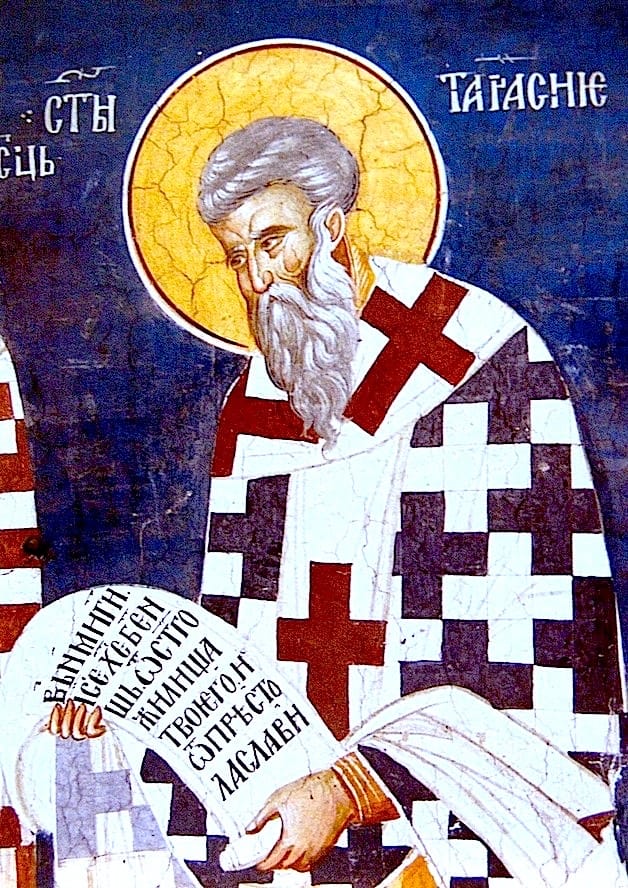
St. Tarasius of Constantinople
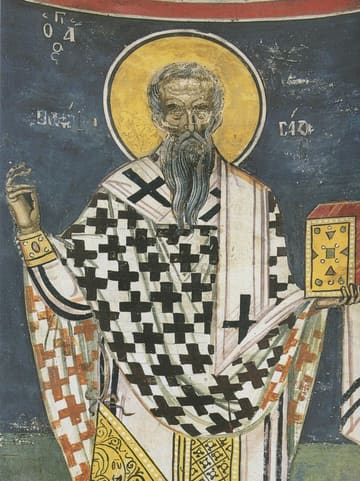
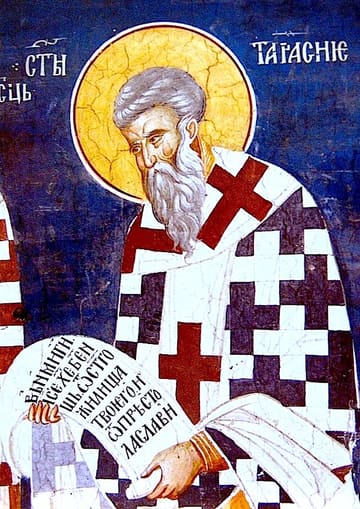
St. Tarasius, Patriarch of Constantinople from 783 to 806, presided over the Seventh Ecumenical Council, which in 787 restored the veneration of the holy icons after more than half a century of iconoclasm.
A layman raised to the patriarchal throne, he governed the Church for over twenty years with wisdom, patience and mercy toward the poor.
He was born in Constantinople into a noble family; his father George was a patrician and prefect of the city, and his mother was named Eukratia. Well educated, he rose to be imperial secretary under Empress Irene and her young son, Constantine VI, and he was the great-uncle of St. Photius the Great. In 783 Patriarch Paul IV resigned, grieving that he had served under the iconoclasts, and urged that an ecumenical council be called; clergy and court then chose Tarasius, still a layman.
At an assembly in the Magnaura palace Tarasius declared himself unworthy and said he would accept only if a council were summoned, for he saw the Church divided and cut off from the Christians of East and West. The people agreed, and in 783 he was consecrated patriarch. A first council, opened in August 786 in the Church of the Holy Apostles, was broken up by iconoclast soldiers.
It met again at Nicaea in the autumn of 787, with Tarasius presiding beside the papal legates and more than three hundred bishops. The council received repentant iconoclast bishops and defined that the holy icons are honored with veneration, not with the worship due to God alone, for the honor given to an image passes to the one it portrays. Its last session met at the Magnaura on October 23.
Afterward Tarasius had to answer zealous monks who thought him too lenient toward the repentant bishops and accused him of tolerating simony; he replied with a synodal letter against it. In 795 Constantine VI put away his wife Maria, a granddaughter of St. Philaret the Merciful, to marry Theodote. Tarasius opposed the divorce, refused to bless the new marriage and in the end barred the emperor from Holy Communion; the priest Joseph celebrated the wedding nonetheless, and because Joseph went unpunished St. Plato and St. Theodore the Studite broke communion with the patriarch, until after the emperor's fall in 797 Tarasius barred Joseph from serving, and peace returned. Tarasius lived simply, curbed luxury among the clergy and cared for widows, orphans and the poor, and his Life says that at Pascha he served them at table himself.
He reposed on February 25, 806, and his body was laid in his own monastery on the Bosphorus, where healings were later recorded at the tomb. His disciple Ignatius the Deacon wrote his Life. The Church keeps his feast on February 25.
Sources
- St. Tarasius, Apologeticus to the People, 784 (PG 98)
- Pravoslavnaya Entsiklopediya, vol. 9, 'Vselensky VII Sobor'
- Pravoslavnaya Entsiklopediya, 'Mikhianskaya skhizma' (the Moechian schism)
- Catholic Encyclopedia (1913), 'St. Tarasius'
- Greek Menaion and Synaxarion, February 25
- OCA, Lives of the Saints: Saint Tarasius, Archbishop of Constantinople
How can I, who have lived in the world, been counted among the laity and served in the emperor's service, leap like this, without examination or forethought, into the greatness of the priesthood? For one as small as I the undertaking is fearful and the attempt bold.
Apologeticus to the People, 784 (PG 98, 1425) (translated for Axios! from the Greek)
I see and behold His Church, founded on the rock, Christ our God, now torn apart and divided.
Apologeticus to the People, 784 (PG 98, 1425) (translated for Axios! from the Greek)
The law and rule of the Church know nothing of faction or contention: as they know how to confess in piety one baptism and one faith, so they know one agreement in every matter of the Church.
Apologeticus to the People, 784 (PG 98, 1425) (translated for Axios! from the Greek)
Nothing is so acceptable and pleasing before God as that we be united and become one catholic Church, as we also confess in the Creed of our sincere faith.
Apologeticus to the People, 784 (PG 98, 1425) (translated for Axios! from the Greek)
Troparion · Tone 4
A rule of faith and an image of meekness, a teacher of self-restraint: so the truth of things showed you to your flock. Therefore by humility you won the heights, by poverty wealth. O Father and Hierarch Tarasius, intercede with Christ our God that our souls may be saved.
Translated for Axios! from the Greek Menaion, February 25
Kontakion · Tone 4
Like a great sun, with the rays of your doctrines and miracles you ever light the way for the whole world, O initiate of heaven, all-blessed Tarasius.
Translated for Axios! from the Greek Menaion, February 25
Saints around February 25
Get the full library
770+ saints, in your pocket
Their Lives, sayings and prayers, A to Z and by feast, with search. The Church calendar, the holy icons, and the saying of the day on your Home Screen. All in Axios! for iPhone, iPad and Android.