
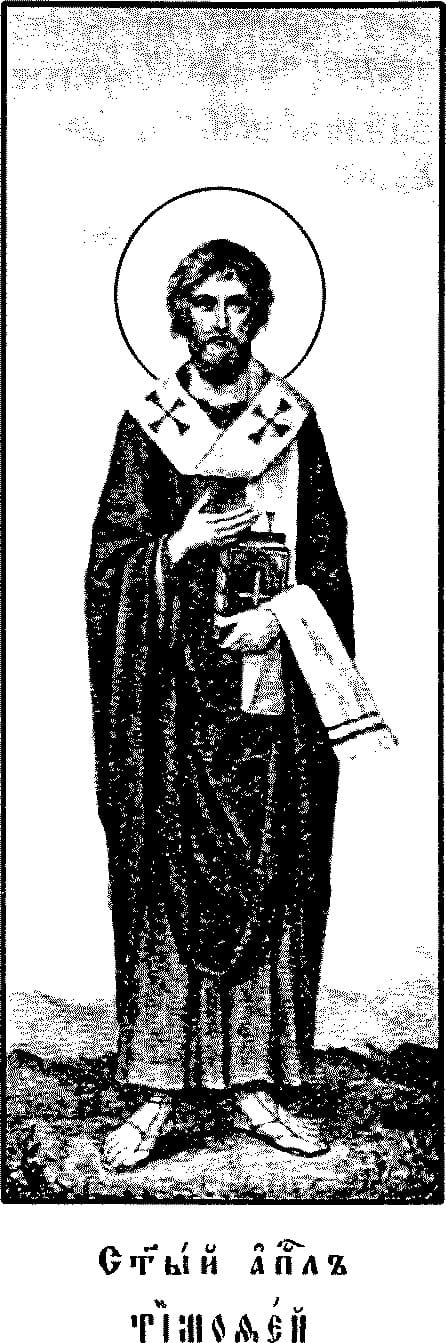
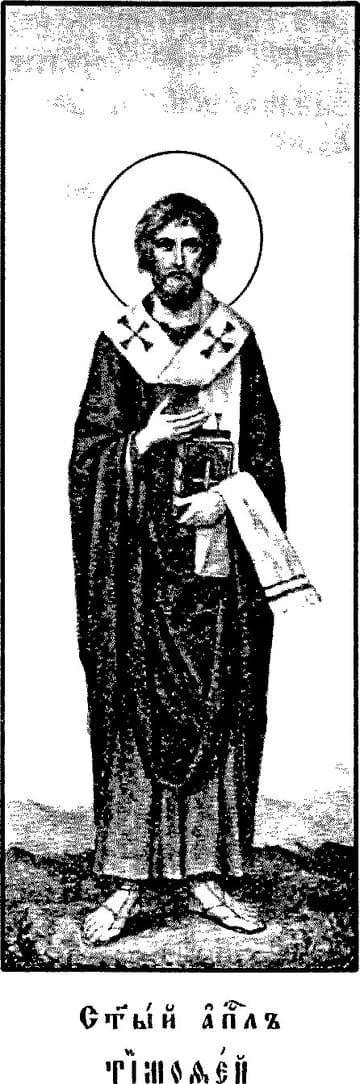
St. Timothy the Apostle
St. Timothy was St. Paul's beloved disciple and closest fellow worker, his "true child in faith" (1 Timothy 1:2), to whom he addressed two Epistles.
The Church honors him as an apostle of the Seventy, the first bishop of Ephesus and a martyr.
He came from Lystra in Lycaonia, the son of a believing Jewish mother and a Greek father (Acts 16:1). From infancy he had known the Holy Scriptures, and Paul praised the sincere faith that lived first in his grandmother Lois and his mother Eunice (2 Timothy 1:5; 3:15). He probably came to faith during Paul's first visit to Lystra, for when the apostle returned, Timothy was already a disciple well spoken of by the brothers of Lystra and Iconium. Paul took him as a companion (Acts 16:2-3), and Timothy received his gift for ministry through the laying on of hands (1 Timothy 4:14; 2 Timothy 1:6).
From then on he shared Paul's labors and dangers. His name stands beside Paul's at the opening of six letters, among them both letters to the Thessalonians and the letter to the Philippians. Paul sent him to strengthen the Thessalonians in their trials (1 Thessalonians 3:2) and to remind the Corinthians of his ways in Christ (1 Corinthians 4:17), and wrote to the Philippians that he had no one else so like-minded (Philippians 2:20).
He left Timothy at Ephesus to guard the Church from false teaching (1 Timothy 1:3), urged him to "be an example to those who believe" (1 Timothy 4:12), and from his last imprisonment begged him to come soon (2 Timothy 4:9). The Epistle to the Hebrews adds that Timothy, too, was set free from prison (Hebrews 13:23).
Eusebius records that Timothy was the first bishop of Ephesus (Church History III.4). According to his Acts, a later account of his martyrdom, he confronted the pagans of Ephesus during the riotous festival called the Katagogia, and they killed him with clubs and stones; the verses of the Synaxarion also say that he was struck down with clubs. Under Emperor Constantius II his relics were brought to Constantinople, in 356 according to manuscripts of the Acts, and laid in the Church of the Holy Apostles together with those of St. Andrew and St. Luke, as St. Jerome and the historian Philostorgius record. The Church keeps his feast on January 22 and remembers him with the Seventy on January 4.
Sources
- Acts 16:1-3; 1 and 2 Timothy; Philippians 2:19-22; Hebrews 13:23
- Eusebius, Church History III.4; St. Jerome, Against Vigilantius 5
- Greek Menaion and Synaxarion, January 22
- OCA, Lives of the Saints: Apostle Timothy of the Seventy
- Acts of Timothy (e-Clavis of Christian Apocrypha, NASSCAL)
No recorded sayings. Read the Life to meet this saint.
Troparion · Tone 4
Having been taught goodness and being sober in all things, you clothed yourself with a good conscience as befits a priest. You drew ineffable things from the Chosen Vessel, and having kept the faith you finished the same course, O Apostle Timothy. Intercede with Christ our God that our souls may be saved.
Translated for Axios! from the Greek Menaion, January 22
Kontakion of St. Timothy and St. Anastasius the Persian (Tone 1)
The divine disciple and fellow traveler of Paul, Timothy, let us all praise in hymns, O faithful, honoring with him the wise Anastasius, who shone forth from Persia like a star and drives away the passions of our souls and the diseases of the body.
Translated for Axios! from the Greek Menaion, January 22
Saints around January 22
Get the full library
770+ saints, in your pocket
Their Lives, sayings and prayers, A to Z and by feast, with search. The Church calendar, the holy icons, and the saying of the day on your Home Screen. All in Axios! for iPhone, iPad and Android.