
June 22
Saints of the day
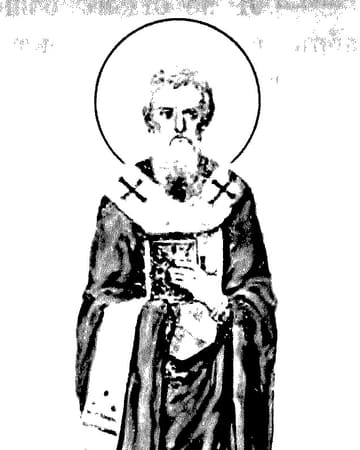
Hymn of Praise
The Church is never without pastors,
Nor without sufferings, nor without heroes.
When the sharp Goliath sword flashed,
The Pastor of Samosata gave resistance:
Eusebius, and with him Meletius,
Like two stars, and a third: Pelagius.
Champions of holy Orthodoxy,
Glorious saints of the Church of God.
There was affliction then for Christians,
Fierce affliction from both sides:
On one side the furious heretics,
On the other the senseless emperors.
Hard it was to preserve the soul
And to uphold the truth of God
Against lies and against violence.
Amid the weeds there was little basil,
Little, little sweet grass and feather grass!
Three hierarchs, three fragrant flowers,
Enough honey for all the poison of the world.
Eusebius began as a champion
And ended his life as a martyr.
O Eusebius, high priest,
Bless us, O pleaser of God!
Reflection
Why does the gracious Lord permit attacks and sufferings upon the true faith, while He allows heresies and paganism to enjoy tranquility? "Why?" asks Saint John Chrysostom, and immediately answers: "So that thou mayest recognize their weakness, when thou seest that even without disturbance they fall apart of themselves, and so that thou mayest be convinced of the power of the faith, which endures calamities and even through its adversaries multiplies."
"If, then, we dispute with pagans or with wretched Jews, it is sufficient to set forth as proof of the divine power the fact that the Christian faith, subjected to countless battles, has maintained the victory," even when the whole world stood against it. And Saint Isaac the Syrian says: "The wondrous love of God toward man is recognized when man is in calamities that destroy his hope. Here God shows His power and His salvation. For man never knows the power of God in rest and freedom."
Contemplation
Contemplate the miraculous striking mute of the high priest Zechariah (Luke 1:20), namely:
- How Zechariah did not believe the angel of God that the aged womb of his wife could conceive and bear, and how because of this he was struck mute, according to the word of the angel,
- How I too am as one struck mute when I cannot speak sufficiently of the miracles of God, because my faith is small.
Homily
On How the Sluggard Makes Excuses
The slothful man saith, There is a lion without
Prov. 22:13
To justify his laziness, the sluggard points out the difficulties and obstacles of a task and magnifies them beyond all measure. If one man hinders him, he will say that the whole village hinders him; if leaves rustle, he will claim that he cannot go to work because of a storm; if there is a hare before his house, he will say: a lion! Only so as not to leave the house, and only to postpone the work.
Sloth is entirely contrary to the nature of man. The nature of man is active: it demands to work, to labor, to build. Laziness is a sure sign of the disfigurement of nature in a person. That laziness is a terrible vice is clear from the fact that an active man never envies the sluggard, while the sluggard envies the active man, just as a sober man does not envy the drunkard, while the drunkard envies the sober man.
O Lord, All-active Creator, save us from the dull and vicious laziness by which we distance ourselves from our original nature, from Thy image and likeness, O Master of all creatures! Inspire us with Thy Holy Spirit, ever-moving and joy-creating. To Thee be glory and praise forever. Amen.
From the Prologue from Ochrid, translated by Marcian Sakarya, OCHRID.COM. CC BY-SA 4.0.
The Prologue, every day
Axios! brings the day’s Hymn of Praise, Reflection, Contemplation and Homily to Today, with the saints, the feasts and the saying of the day, on iPhone, iPad and Android.