
September 4
Saints of the day
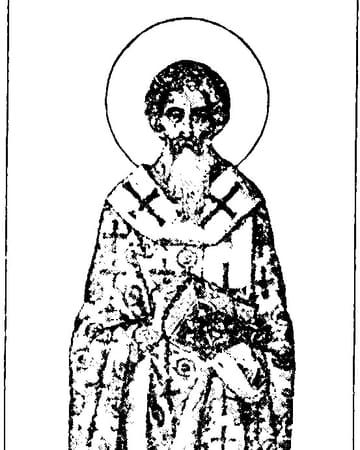
Hymn of Praise
At the gates of the holy temple
The wondrous shepherd bravely stood,
The blood-stained emperor wished to enter,
But the shepherd would not let him pass.
"You know not the true God,
You bow down before idols;
What would you, vile pagan,
Among true-believing Christians?"
The violent emperor used his force,
Placed chains upon Babylas,
But Babylas laughed at the emperor
And glorified his Lord.
The emperor spoke to the saint:
"See, the chains look fine upon you,
Your fitting measure, insolent old man,
As though a craftsman fashioned them for you!"
The emperor said this and fell silent,
And Babylas replied to the emperor:
"I swear to you, this iron
Is dearer to me than gold.
I value these chains more
Than your imperial crown,
O I value them more, emperor,
Than all your empire.
For I wear these chains for Christ,
To purchase freedom with them;
I would wish to step into eternity
With these very chains upon me."
Reflection
The power of the saints after death is much greater than during their lifetime. "That is why God has left us the relics of the saints," says Saint John Chrysostom in his unsurpassed homily on Saint Babylas. Saint Babylas was buried in the city of Antioch. Then Gallus Caesar, the brother of Julian the Apostate, reigned together with Constantius, the son of Constantine. Moved by piety, Gallus translated the relics of Saint Babylas to the suburb of Daphne, built a small church, and placed in it the relics of the martyr. In Daphne there was a renowned temple of Apollo, built on the spot where, according to pagan legend, a maiden had been transformed into a laurel tree in order to save herself from the "god" Apollo, who was pursuing her out of unbridled bodily passion. There stood the idol of Apollo, which supposedly predicted everyone's future. But from the time the relics of Babylas were buried near the temple, the demon in the idol fell silent and ceased to prophesy. When Emperor Julian the Apostate later set out on his fateful war with the Persians, he stopped at that temple and asked the idol about the outcome of the war for which he was preparing. The idol fearfully replied that it could not give a clear answer "because of the dead" buried in its vicinity. This referred, of course, only to Babylas, the presence of whose body had silenced the demon. Julian ordered that the relics of Babylas be transferred back to Antioch. But no sooner were the relics of the martyr removed than fire fell from heaven and burned the temple of Apollo, destroying it forever. Julian went against the Persians and horribly ended his God-hating life. Such was the power of Christ's martyr after death: he silenced the demon, brought down fire from heaven and destroyed the pagan temple, and punished the godless apostate emperor with a dishonorable death.
Contemplation
Contemplate the punishment of God upon David for his sins (II Samuel 15), namely:
- How Absalom, the son of David, raised a revolt against his father;
- How David fled from Jerusalem before his son, going barefoot and weeping.
Homily
On the changing of water into wine
This beginning of miracles in Cana of Galilee
John 2:11
Almighty is our God, and His power has neither end nor description. By His Word He created all that was created. By the word of the Lord were the heavens established. By His Word He fashioned the body of man. By the Word of God the dead earth is transformed into human bodies, into animal bodies, into plant bodies. By the Word of God liquid water is transformed into vapor, and vapor into ice and snow. By that same Word, water in the vine is transformed into wine, and wine maketh glad the heart of man. What miracle is it, then, for the Word of God incarnate, for Christ our Lord, that He changed water into wine at Cana? For us humans, darkened by sin, this is a great miracle; for our nature, weakened by sin, it is an unattainable miracle. But to work miracles, is this not the usual occupation of the Creator? When the servants filled six large vessels with water, the Lord Christ said to them: Draw out now, and bear unto the governor of the feast. He did not even say: "Let the water become wine," but merely thought it. And the thought of God has the same power as the word of God. Why is it said that this was the beginning of miracles, when it seems that the Lord performed other miracles before this one? Because, brethren, the changing of water into wine is the fundamental miracle of Christ, and the essence of all His miracles. The nature of man had become watered down and weeping; it needed to be changed into wine. The divine spark in man had been extinguished; it needed to be kindled. Sickness is like water, health like wine; impurity from evil spirits is like water, purity is like wine; death is like water, life like wine; ignorance is like water, truth like wine. Therefore, whenever the Lord made the sick healthy, the impure pure, the dead alive, the erring enlightened, He was in reality changing water into wine.
O Lord our God, wondrous Changer of water into wine, bring Thy divine flame to the extinguished hearth of our being. Change the water of our existence into divine wine. That we may be like unto Thee, and as ones made like Thee may sit in Thy immortal kingdom, with Thy noble angels. To Thee be glory and praise forever. Amen.
From the Prologue from Ochrid, translated by Marcian Sakarya, OCHRID.COM. CC BY-SA 4.0.
The Prologue, every day
Axios! brings the day’s Hymn of Praise, Reflection, Contemplation and Homily to Today, with the saints, the feasts and the saying of the day, on iPhone, iPad and Android.