
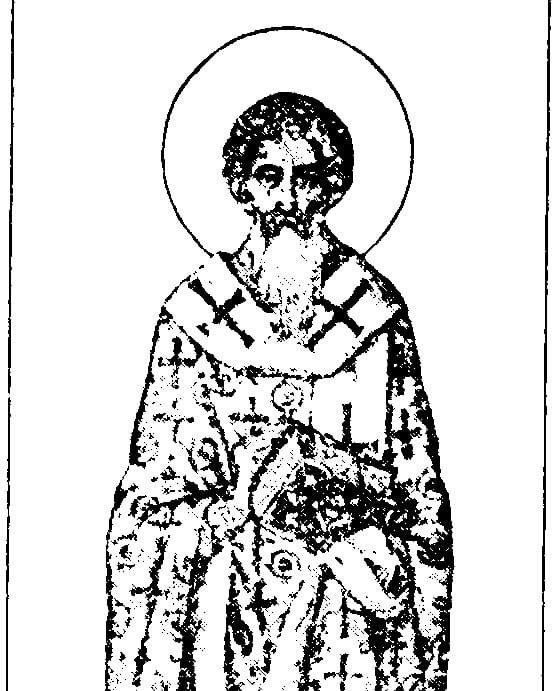
St. Babylas of Antioch
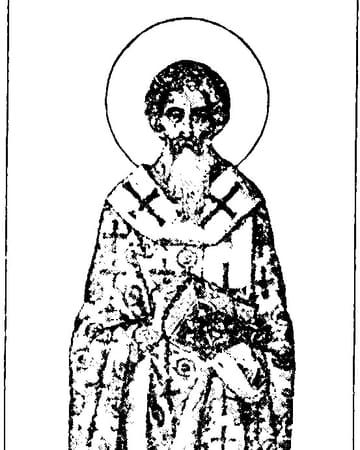
This "great and wondrous man, if indeed it is possible to call him a man," as Saint John Chrysostom speaks of him, was a hierarch in Antioch in the time of the vile Emperor Numerian. This Numerian concluded peace with a certain barbarian king, who was far nobler and more peaceable than Numerian. As a sign of his sincere desire for lasting peace, the barbarian king gave his small son to be at the court of Numerian and to be raised there. One day Numerian slew that innocent child with his own hand and offered him as a sacrifice to the idols. Still hot from his crime and from the innocent blood, this crowned criminal went to a Christian church to see what was being done there. Holy Babylas was at prayer with the people, and hearing that the emperor was coming with his retinue and wished to enter the church, Babylas interrupted the divine service, came out before the church, and told the emperor that as an idolater he could not enter the holy temple where the one true God is glorified. Speaking of Babylas, Chrysostom said: "Whom else in the world would he fear, who addressed the emperor with such authority?... He thereby taught emperors not to extend their power further than the measure given them by God; and he showed to the clergy how they should use their authority." The humiliated emperor returned, but devised revenge. The next day the emperor summoned Babylas and began to rebuke him and urge him to offer sacrifice to the idols, which the saint naturally refused without wavering. Then the emperor put him in chains and cast him into prison. Likewise the emperor tormented three children: Urban, aged twelve, Prilidian, aged nine, and Epolonius, aged seven. Babylas was their spiritual father and teacher, and out of love for him they would not be separated from him. They were the sons of a certain honorable Christian woman, Christodula, who also suffered for Christ. The emperor first ordered that each child be given as many blows as he had years, and then he cast them into prison, and at last beheaded all three with the sword. Babylas, in chains, was present at the beheading of the children and encouraged them, and afterward he himself laid his honorable head beneath the sword. He was buried by the Christians in his chains, as he had willed before his death, in one tomb with those three wondrous youths. Their holy souls flew to the heavenly dwellings, and their wonderworking relics remained for the benefit of the faithful as an ever-present testimony of their heroism in the faith. They suffered around the year 250.
From the Prologue from Ochrid, translated by Marcian Sakarya, OCHRID.COM. CC BY-SA 4.0.
Sources
- The Prologue from Ochrid, September 4, translated by Marcian Sakarya, OCHRID.COM (https://ochrid.com), CC BY-SA 4.0
No recorded sayings. Read the Life to meet this saint.
Troparion · Tone 4
Partaker of the apostles' ways and successor to their thrones, you found in action, O God-inspired one, the way up to contemplation. Therefore you rightly handled the word of truth and contended also for the faith to the point of bloodshed, O Hieromartyr Babylas. Intercede with Christ our God that our souls may be saved.
Translated for Axios! from the Greek General Menaion (the common troparion of a hieromartyr)
Kontakion · Tone 4
Having shone in piety among the priests and run the road of martyrdom to its end, you quenched the worship of idols, becoming the champion of your flock, O godly-minded one. And so the flock honors you and cries to you in mystery: From dangers deliver me at all times by your intercessions, O our father Babylas.
Translated for Axios! from the Greek General Menaion (the common kontakion of a hieromartyr)
Saints around September 4
Get the full library
770+ saints, in your pocket
Their Lives, sayings and prayers, A to Z and by feast, with search. The Church calendar, the holy icons, and the saying of the day on your Home Screen. All in Axios! for iPhone, iPad and Android.