
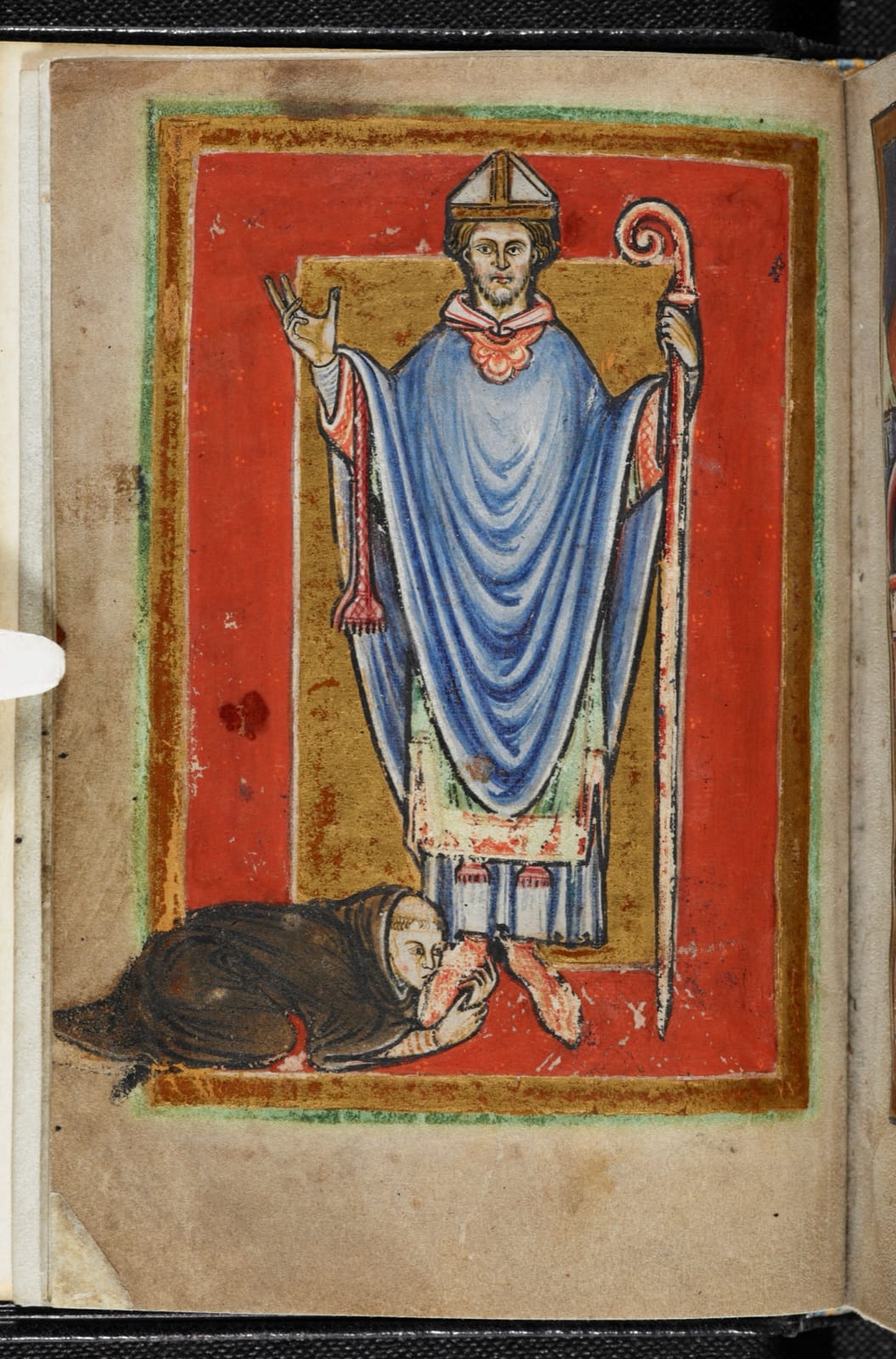
St. Cuthbert of Lindisfarne
St. Cuthbert of Lindisfarne, monk, hermit and bishop, is the best-loved saint of northern England, honored as the Wonderworker of Britain.
A shepherd boy who became a tireless preacher to Northumbria's poorest villages, he joined a hermit's love of silence to a pastor's care, and his tomb became the greatest shrine of early medieval England.
He was born about 634 and as a youth kept sheep in the hills near Melrose. One night in 651, Bede tells, he saw angels carrying a soul to heaven, and learned in the morning that St. Aidan, bishop of Lindisfarne, had died. He entered Melrose under Abbot Eata and the holy prior Boisil, and when Boisil died in the plague of 664 he became prior. On foot or on horseback he went for weeks at a time to remote hill villages, preaching and hearing confessions, and Bede says no one dared hide anything from him.
After the Synod of Whitby, Eata sent him to Lindisfarne as prior, where he led the brethren with great patience. In 676 he withdrew to Inner Farne, built a cell walled so high that he saw only the sky, and grew his own barley. In 684 a synod at Twyford under Archbishop Theodore elected him bishop; he yielded only when King Ecgfrith sailed to the island and the monks begged him on their knees. Consecrated at York at Pascha 685, he took the see of Lindisfarne and for two years visited his people, fed the hungry, defended the poor and healed the sick.
After Christmas 686 he returned to Farne to prepare for death. Herefrith, abbot of Lindisfarne, attended him, and through him Bede preserved his last counsel: to keep peace, charity and hospitality and to hold fast to the teaching of the Fathers. Having received the Body and Blood of Christ, he raised his eyes and hands to heaven and gave up his soul in the night of March 20, 687, the same day on which, as he had foretold, his friend Herbert, the hermit of Derwentwater, reposed.
In 698 the monks opened his grave and found his body incorrupt; about 715 the Lindisfarne Gospels were written in his honor. Fleeing the Danes in 875, they carried his body for seven years, kept it at Chester-le-Street from 883 and in 995 brought it to Durham. When Henry VIII's commissioners stripped the shrine about 1539, an eyewitness says, they found him whole; he was buried again behind the high altar, where pilgrims still pray at his tomb. The Orthodox Church in America, the Russian dioceses in Britain and the Antiochian Western Rite keep his memory on March 20; the translation of his relics is also remembered on September 4.
Sources
- St. Bede, Life of St. Cuthbert (prose, about 721), chs. 4-9, 16-19, 22, 26, 37-42
- St. Bede, Ecclesiastical History of the English People IV.27-30
- OCA, Lives of the Saints: Saint Cuthbert, Wonderworker of Britain (March 20)
- Diocese of Sourozh, British Saints: The Holy Hierarch Cuthbert, Bishop of Lindisfarne
- Durham World Heritage Site, 'St Cuthbert' and 'St Cuthbert's Shrine'
- Catholic Encyclopedia (1908), 'St. Cuthbert'
Always keep peace and divine charity among yourselves; and when you must take counsel about your affairs, take great care to be of one mind in your counsels.
His last counsel to the brethren, in St. Bede, Life of St. Cuthbert 39, from the account of Abbot Herefrith (translated for Axios! from the Latin)
Live in concord with the other servants of Christ. Do not despise those of the household of faith who come to you for hospitality, but welcome them, keep them and send them on their way with friendliness and kindness, never thinking yourselves better than others who share the same faith and life.
His last counsel to the brethren, in St. Bede, Life of St. Cuthbert 39 (translated for Axios! from the Latin)
Rightly is the life of monks in community to be admired: they obey their abbot in all things, and keep all their times of watching, praying, fasting and working at his direction. I have known many of them who far surpass my littleness in purity of mind and in the height of prophetic grace.
His words to the brethren about his life as a hermit, in St. Bede, Life of St. Cuthbert 22 (translated for Axios! from the Latin)
How often the demons cast me headlong from a high rock, how often they threw stones at me as if to kill me! Yet they could never hurt my body in any way, or stain my mind with fear.
His words about his struggle on Farne, in St. Bede, Life of St. Cuthbert 22 (translated for Axios! from the Latin; 'the demons' supplied from the context, and a clause on their other phantoms left out)
Remember, brother Herbert, to ask me now whatever you need and to speak with me, for once we part we shall not see each other again in this world with the eyes of the flesh. I am sure that the time of my departure is at hand, and that the putting off of my tent will be swift.
His words to the hermit Herbert of Derwentwater at Carlisle, in St. Bede, Ecclesiastical History IV.29 (translated for Axios! from the Latin)
Rise, my brother, and do not weep, but rejoice with joy, for the mercy on high has granted us what we asked.
His words to Herbert after praying that they might die on the same day, in St. Bede, Ecclesiastical History IV.29 (translated for Axios! from the Latin)
Troparion · Tone 4
A rule of faith and an image of meekness, a teacher of self-restraint: so the truth of things showed you to your flock. Therefore by humility you won the heights, by poverty wealth. O Father and Hierarch Cuthbert, intercede with Christ our God that our souls may be saved.
Translated for Axios! from the Greek General Menaion (the common troparion of a hierarch)
Kontakion · Tone 2
O divine thunder, trumpet of the Spirit, planter of the faithful and axe of heresies, O Hierarch Cuthbert, greatest servant of the Trinity: ever dwelling with the angels, do not cease from interceding for us all.
Translated for Axios! from the Greek Menaion (the common kontakion of a hierarch)
Saints around March 20
Get the full library
770+ saints, in your pocket
Their Lives, sayings and prayers, A to Z and by feast, with search. The Church calendar, the holy icons, and the saying of the day on your Home Screen. All in Axios! for iPhone, iPad and Android.