
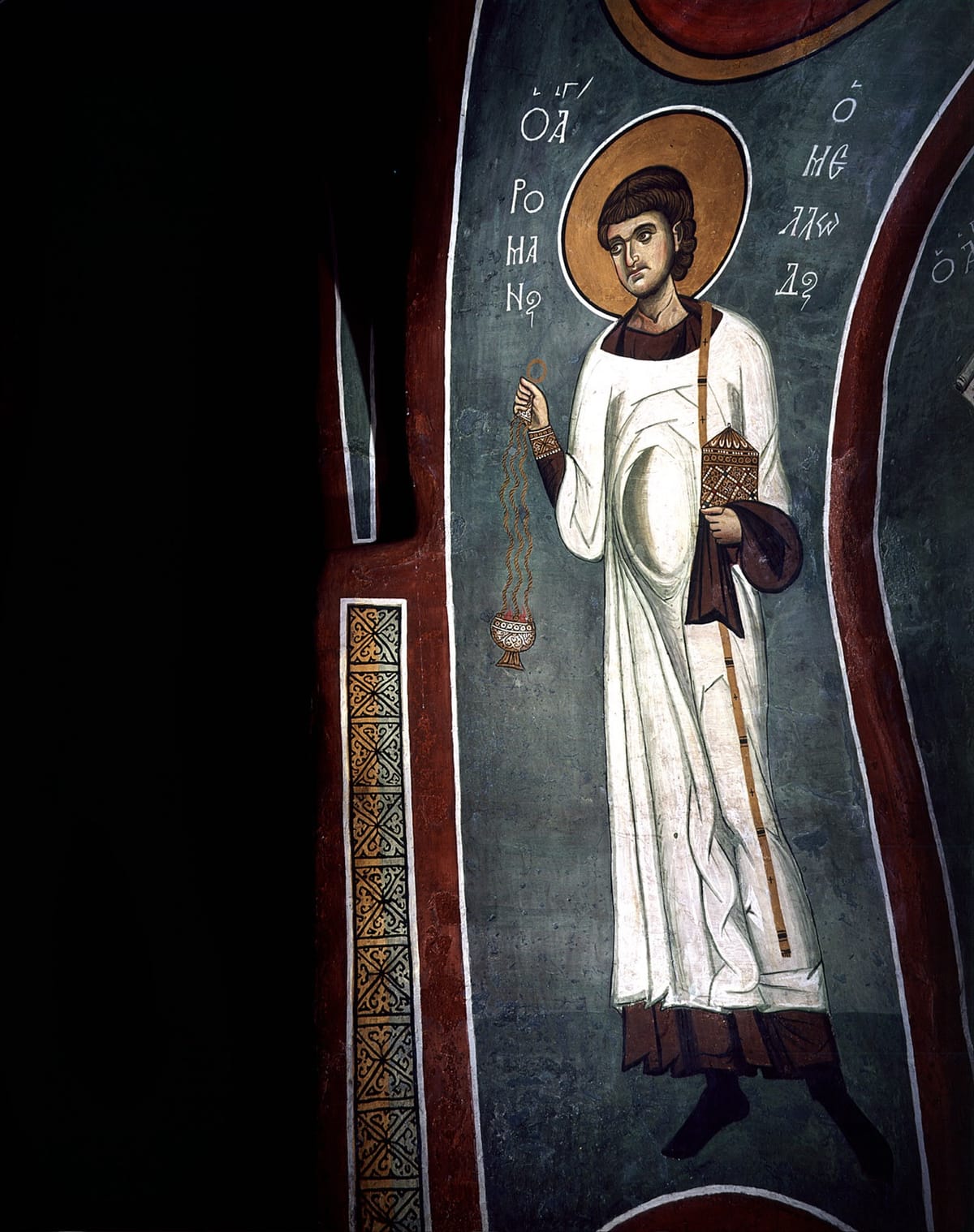
St. Romanos the Melodist
St. Romanos the Melodist (c. 485-510) is honored as the greatest of the Byzantine hymnographers and the master of the kontakion, a sermon sung in verse.
His Christmas hymn, "Today the Virgin gives birth to the One beyond all being," is still sung in every Orthodox church on the Nativity, and the Slavic Churches call him the Sweet-Singer.
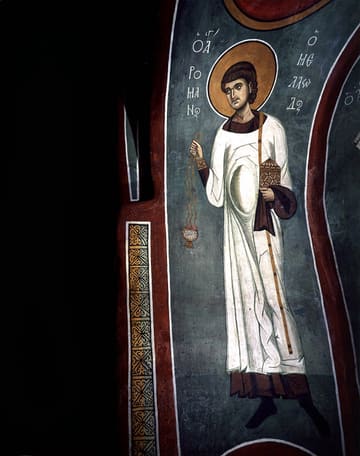
The Synaxarion of Constantinople says that he came from Emesa (Homs) in Syria, and the hymns of his feast call him a Hebrew by birth. He served as a sacristan of the Church of the Resurrection in Berytus (Beirut), then came to Constantinople in the reign of Emperor Anastasius I (491-518) and settled at the church of the Theotokos in the quarter called Kyrou. His Life tells of whole nights he spent in prayer at Blachernae.
On the eve of the Nativity, the Synaxarion relates, the Theotokos appeared to him in a dream, handed him a scroll and told him to eat it. As soon as he had swallowed it he awoke, went up into the ambo and began to sing, in a beautiful voice, the hymn that begins "Today the Virgin." The Slavic Lives add that the clergy had just mocked him for his poor singing. From that day, the Synaxarion says, he composed about a thousand kontakia for the feasts of the Lord and the memories of the saints, many of them written in his own hand and kept at the Kyrou church.
Each kontakion opens with a short prelude, followed by eleven to forty stanzas of the same meter that end in a common refrain, and the first letters of the stanzas often spell "of the humble Romanos." Rich in dialogue and theology, his hymns show his debt to St. Ephrem the Syrian. About sixty survive and are accepted as genuine, among them hymns on the Nativity, on the sinful woman who anointed the Lord, on the Forty Martyrs of Sebaste and on the Theotokos at the Cross.
In the services today usually only the prelude and the first stanza of each are sung, after the sixth ode of the canon at Matins. Some have credited him with the Akathist Hymn, but its author remains uncertain.
Romanos reposed in peace in Constantinople in the year 510. He was buried in the Kyrou church, where his memory was kept. Into the 12th century the choirs of Hagia Sophia and of the Holy Apostles sang his Christmas kontakion together at the emperor's Christmas banquet. The Church keeps his feast on October 1, the day the Slavic Churches also celebrate the Protection of the Theotokos, and Greek church singers honor him as their patron.
Sources
- Synaxarion of Constantinople, October 1 (ed. H. Delehaye, Synaxarium Ecclesiae Constantinopolitanae, 1902)
- Greek Menaion, October 1
- St. Dimitri of Rostov, Lives of the Saints, October 1
- Pravoslavnaya Entsiklopediya, 'Roman Sladkopevets'
- Catholic Encyclopedia (1913), 'St. Romanos'
- Gorgias Encyclopedic Dictionary of the Syriac Heritage, 'Romanos the Melodist'
- OCA, Lives of the Saints: Venerable Romanus the Melodist, 'Sweet-Singer'
Today the Virgin gives birth to the One beyond all being, and the earth offers a cave to the Unapproachable. Angels give glory with shepherds, and Magi journey with a star, for a young Child has been born for our sake, the God who is before the ages.
Kontakion on the Nativity I, prooimion (translated for Axios! from the Greek)
Bethlehem has opened Eden: come, let us see. We have found delight in a hidden place: come, let us take the joys of Paradise within the cave. There a root has appeared that no one watered, putting forth forgiveness.
Kontakion on the Nativity I, stanza 1 (translated for Axios! from the Greek)
O Christ our God, you who called the harlot 'daughter,' make me too a son of repentance: I beg you, rescue me from the mire of my deeds.
Kontakion on the Harlot, prooimion I (translated for Axios! from the Greek)
Great anguish awaits the unchaste there, and I am one of them, ready for the scourges. Fearing them, the harlot remained a harlot no longer; but I, though I fear them, remain in the mire of my deeds.
Kontakion on the Harlot, stanza 1 (translated for Axios! from the Greek)
Leaving behind every army of the world, you clung to the Master in heaven, O forty prizewinners of the Lord. For you passed through fire and water, O blessed ones, and worthily received glory from heaven and a multitude of crowns.
Kontakion on the Forty Martyrs of Sebaste, prooimion I (translated for Axios! from the Greek)
Troparion · Tone 8
In you, O Father, God's image was preserved to perfection; for you took the cross upon yourself and followed Christ, and in your conduct you taught that one should think little of the flesh, for it is fleeting, and take care of the soul, a thing that does not die. And so, O venerable Romanos, your spirit exults together with the angels.
Translated for Axios! from the Greek Menaion, October 1
Kontakion · Tone 8
Adorned from your youth with the divine virtues of the spirit, O most wise Romanos, you became a most honored ornament of the Church of Christ, for you adorned her with beautiful singing, O blessed one. Therefore we pray you: grant a share of your divine gift to those who long for it, that we may cry out to you: Rejoice, O most blessed father, beauty of the Church.
Translated for Axios! from the Church Slavonic Menaion, October 1
Saints around October 1
Get the full library
770+ saints, in your pocket
Their Lives, sayings and prayers, A to Z and by feast, with search. The Church calendar, the holy icons, and the saying of the day on your Home Screen. All in Axios! for iPhone, iPad and Android.