
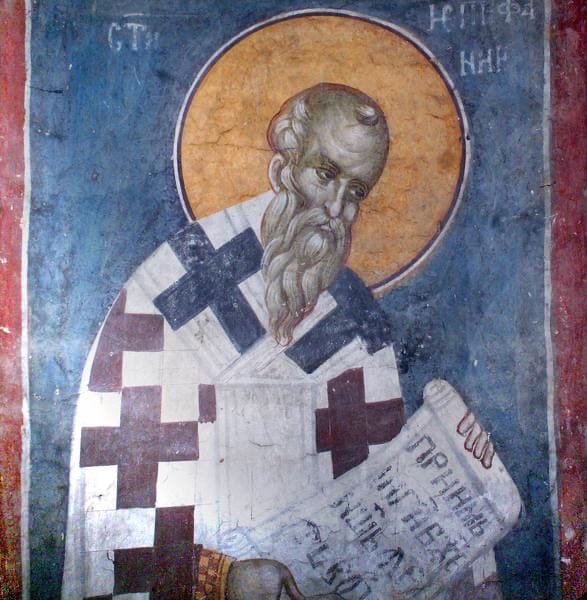
St. Epiphanius of Cyprus
St. Epiphanius, bishop of Salamis in Cyprus for fifty-five years, was one of the great defenders of the Orthodox faith in the fourth century: a monk formed among the ascetics of Egypt, a tireless student of the Scriptures, and the author of the Panarion, a "medicine chest" against the heresies.
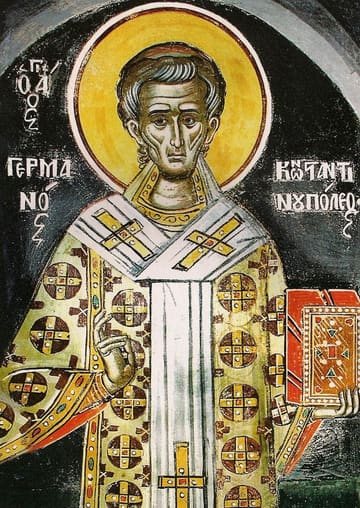
The historian Sozomen thought him perhaps the most revered man under heaven. The Church keeps his memory on May 12, together with St. Germanus of Constantinople.
He was born about 288 at Besanduk, a village near Eleutheropolis in Palestine. A later Life says he was brought up in the Jewish faith and baptized as a young man, though a letter ascribed to him speaks of parents of the Nicene faith. From his youth he was taught by renowned ascetics and spent much of his time in Egypt, and in the late 330s he founded a monastery near his native village, which he guided for some years. In his sixtieth year, about 348, the bishops of Cyprus chose him for the see of Constantia, the ancient Salamis, the chief city of the island, and in practice he led its Church.
In the 370s he wrote the Ancoratus, the "well-anchored" exposition of the faith in the Holy Trinity, and the Panarion, which describes and refutes eighty heresies, and like St. Jerome he championed the ever-virginity of the Theotokos. His sayings among the Desert Fathers commend unceasing prayer, the reading of Scripture, and peace with everyone before sleep. Late in life he saw in the speculations of Origen a danger to the faith: in 393 he preached against them at Jerusalem and quarreled with its bishop John, and about 401 a council of Cyprus under him condemned Origen's books.
In 402 or 403, at the urging of Theophilus of Alexandria, he came to Constantinople to act against the monks called the Long Brothers, whom Theophilus accused of Origenism, and he refused to pray with St. John Chrysostom, who had given them shelter. When the monks met him and showed that he had condemned them without reading their works, he was, Sozomen says, partly convinced, and he set sail for home. He died aboard ship on May 12, 403, and was buried in the basilica he had built at Constantia; under Emperor Leo VI (886-912) his relics were brought to Constantinople.
Sources
- Sozomen, Church History VI.32 and VIII.14-15; Socrates, Church History VI.10-14
- St. Jerome, Letter 51 (Epiphanius to John of Jerusalem) and Against John of Jerusalem
- St. Epiphanius, Ancoratus and Panarion
- Apophthegmata Patrum, Epiphanius 1-17 (PG 65)
- Greek Menaion and Synaxarion, May 12
- Pravoslavnaya Entsiklopediya, 'Epifany Kiprsky'
It is plain that you neglect the other hours of the day and rest from prayer. For the true monk must have prayer and psalmody in his heart without ceasing.
Apophthegmata Patrum, Epiphanius 3 (translated for Axios! from the Greek, PG 65)
Since I received the monastic habit, I have not let anyone go to sleep with something against me, nor have I gone to sleep with something against anyone.
Apophthegmata Patrum, Epiphanius 4 (translated for Axios! from the Greek, PG 65)
The Canaanite woman cries out, and she is heard; the woman with the flow of blood is silent, and she is called blessed; the Pharisee shouts, and he is condemned; the publican does not even open his mouth, and he is heard.
Apophthegmata Patrum, Epiphanius 6 (translated for Axios! from the Greek, PG 65)
The acquiring of Christian books is necessary for those who have the means. For the very sight of the books by itself makes us slower to sin and urges us to rise up rather toward righteousness.
Apophthegmata Patrum, Epiphanius 8 (translated for Axios! from the Greek, PG 65)
Ignorance of the Scriptures is a great precipice and a deep abyss. It is a great betrayal of salvation to know none of the divine laws.
Apophthegmata Patrum, Epiphanius 10-11 (translated for Axios! from the Greek, PG 65)
God sells righteousness very cheaply to those eager to buy it: for a little piece of bread, a cheap garment, a cup of cold water, a single coin.
Apophthegmata Patrum, Epiphanius 16 (translated for Axios! from the Greek, PG 65)
It surely becomes us, dearly beloved, not to abuse our rank as clergy, so as to make it an occasion of pride, but by diligently keeping and observing God's commandments, to be in reality what in name we profess to be.
Letter to John of Jerusalem 1 (Jerome, Letter 51; NPNF, trans. Fremantle)
Rather give way to the truth and love me who love both you and the truth.
Letter to John of Jerusalem 8 (Jerome, Letter 51; NPNF, trans. Fremantle)
Troparion of St. Epiphanius and St. Germanus (Tone 4)
O God of our fathers, You who ever act toward us in Your meekness, do not remove Your mercy from us, but through their prayers direct our life in peace.
Translated for Axios! from the Greek Horologion, May 12
Kontakion of St. Epiphanius and St. Germanus (Tone 4)
Let us the faithful duly praise the wondrous pair of hierarchs, the divine Epiphanius together with Germanus; for they burned up the tongues of the godless and set out most wise doctrines for all who in Orthodox manner ever sing the great mystery of piety.
Translated for Axios! from the Greek Menaion, May 12
Saints around May 12
Get the full library
770+ saints, in your pocket
Their Lives, sayings and prayers, A to Z and by feast, with search. The Church calendar, the holy icons, and the saying of the day on your Home Screen. All in Axios! for iPhone, iPad and Android.