
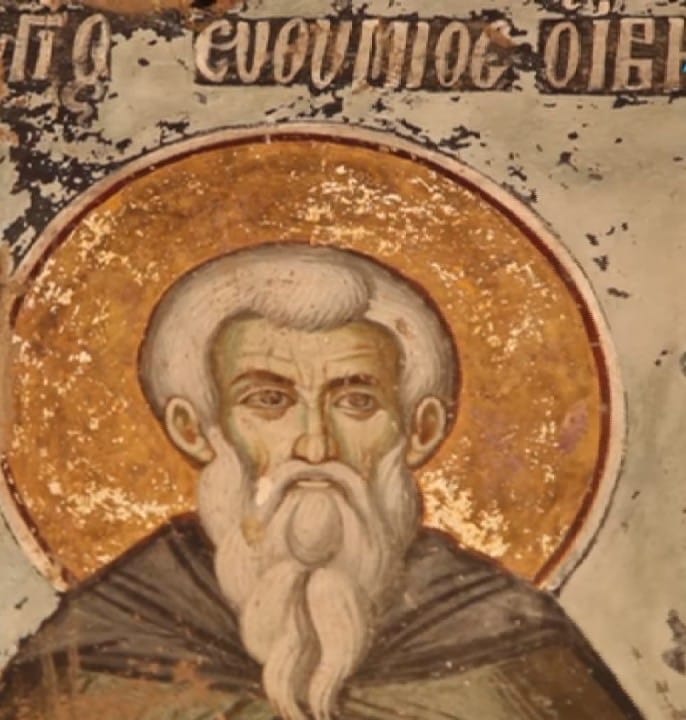
St. Euthymius the Athonite
St. Euthymius the Athonite, called in Georgian Ekvtime Mtatsmindeli, was abbot of the Georgian monastery of Iviron on Mount Athos and the great translator of the Georgian Church.
Through more than 160 translations he gave his people much of the treasury of Byzantine theology, and King David III called him a new Chrysostom. He reposed on May 13, 1028, the day on which the Georgian and Greek Churches keep his memory.
He was born in 955 in Tao, in southwestern Georgia, the son of a nobleman at the court of King David III Kuropalates who later became the monk John. While still a boy Euthymius was sent to Constantinople among the hostages of an alliance between Georgia and the empire, and his father, by then a monk on Mount Olympus in Bithynia, obtained him from the emperor. John had him taught first Georgian and then all the learning of the Greeks.
In 965 John settled on Mount Athos at the Great Lavra of St. Athanasius, where his son joined him. According to his Life, when the young Euthymius lay dying and could no longer speak, the Theotokos appeared to him, raised him up and gave him fluent Georgian; his father then charged him to translate, since Georgia lacked books. St. Athanasius persuaded him to accept the priesthood.
About 980 John founded Iviron with his brother-in-law, the general John Tornikios, and the support of Emperor Basil II. After his father's repose in 998, Euthymius succeeded him as abbot and gave the brotherhood its rule; in 1019 he handed the abbacy to his kinsman George in order to give himself to translation. He revised the Georgian New Testament, adding the Book of Revelation, and rendered the homilies of St. Gregory the Theologian and works of St. Basil, St. John Chrysostom, St. Maximus the Confessor, St. Isaac the Syrian and St. John Climacus, among many others.
Into Greek he put the Georgian tale of Barlaam and Joasaph. Three days a week he ate only bread and water, wore a chain over a hair shirt, taught the brethren two or three times a month, and declined the see of Cyprus offered by Basil II.
In 1028 he was called to Constantinople over troubles on the Mountain. Riding a mule through the city, he stopped to give alms to a beggar; the animal shied at the rags and threw him, and he died of his injuries a few days later, on May 13. His body was brought back to Iviron, where his relics rest in the katholikon of the Dormition. He is also honored in the Synaxis of the Athonite Fathers, and the Greek Synaxarion remembers with him his father, St. John, and his kinsman St. George.
Sources
- St. George the Hagiorite, Life of Sts. John and Euthymius (Georgian, 1042-1044; Latin version by P. Peeters, Analecta Bollandiana 36-37, 1917-1919)
- Greek Menaion and Synaxarion, May 13
- Pravoslavnaya Entsiklopediya, 'Evfimy Svyatogorets'
- OCA, Lives of the Saints: Saint Euthymius the New, Founder of the Iviron Monastery
Those who live in community are saved by these three things: humility, obedience and the renouncing of their own will.
His frequent saying to the brethren of Iviron, in St. George the Hagiorite, Life of Sts. John and Euthymius 61 (translated for Axios! from the Latin version of P. Peeters, Analecta Bollandiana 36-37, 1917-1919, p. 52)
These are the enemy's snares, my dear: to cheat you of the greater good for the sake of a lesser one. From anyone who comes into church God asks that he stand there watchful and with compunction. If you cannot keep awake in church, have your fill of sleep in your cell, and do not sleep here.
His words to a monk who dozed in church, in St. George the Hagiorite, Life of Sts. John and Euthymius 62 (translated for Axios! from the Latin version of P. Peeters, Analecta Bollandiana 36-37, 1917-1919, p. 52)
Troparion · Tone 8
In you, O Father, God's image was preserved to perfection; for you took the cross upon yourself and followed Christ, and in your conduct you taught that one should think little of the flesh, for it is fleeting, and take care of the soul, a thing that does not die. And so, O venerable Euthymius, your spirit exults together with the angels.
Translated for Axios! from the Greek General Menaion (the common troparion of a venerable father)
Kontakion · Tone 2
Armed in godly fashion with the soul's purity and wielding ceaseless prayer as a lance, you mightily cut through the battle lines of the demons, O Euthymius, wonderworker, our father, interceding without ceasing for us all.
Translated for Axios! from the Greek Menaion (the common kontakion of a venerable father)
Saints around May 13
Get the full library
770+ saints, in your pocket
Their Lives, sayings and prayers, A to Z and by feast, with search. The Church calendar, the holy icons, and the saying of the day on your Home Screen. All in Axios! for iPhone, iPad and Android.