
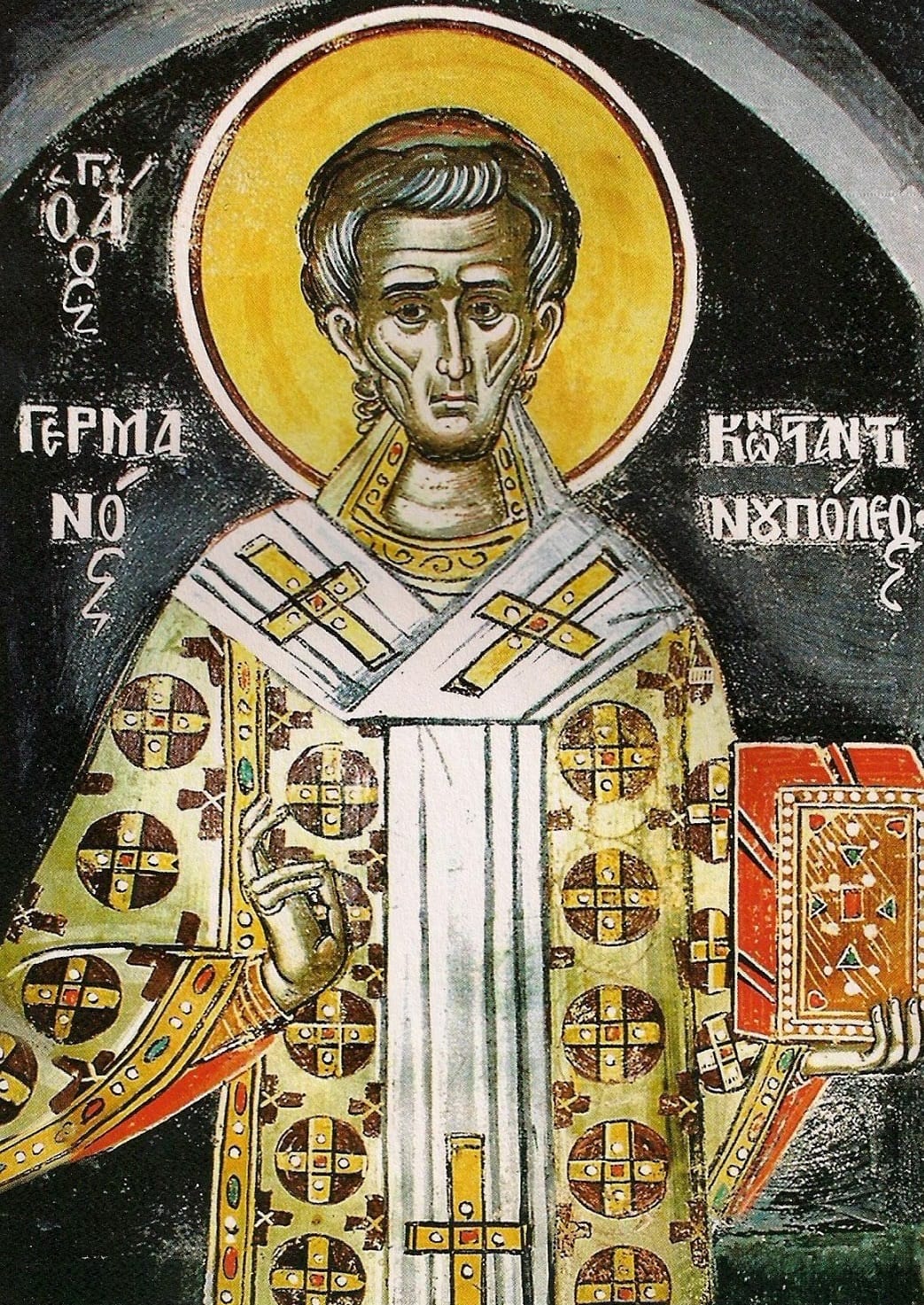
St. Germanus of Constantinople
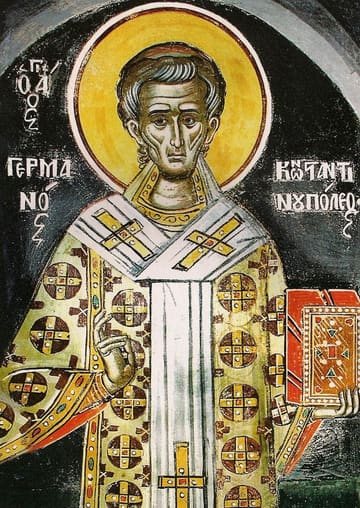
St. Germanus, Patriarch of Constantinople from 715 to 730, was the first great confessor of the holy icons. When Emperor Leo III turned against their veneration, the aged patriarch refused to put his name to the new teaching and gave up his throne rather than betray the tradition of the Church.
His sermons on the Theotokos are among the treasures of Byzantine preaching.
He was born in the middle of the 7th century into the high nobility of Constantinople. His father, the patrician Justinian, was executed for a plot after the murder of Emperor Constans II in 668, and the young Germanus was castrated and made to become a monk against his will. Around 705 he became metropolitan of Cyzicus. St. Theophanes the Confessor records that in 712, under the Monothelite emperor Philippicus, he and St. Andrew of Crete signed the acts of a council that rejected the Sixth Ecumenical Council; that emperor fell the next year, and the Church returned to the faith of the Sixth Council.
In 715 Germanus was transferred to the patriarchal throne with the approval of a papal legate and of the clergy, the senate and the people. He defended the Council of Chalcedon in a letter to the Armenian Church, and in 717 he crowned Leo III. Leo, however, began to favor bishops such as Constantine of Nakoleia who rejected the icons, and in 726 he declared against their veneration himself.
Germanus wrote to the bishops of Asia Minor that Christians do not portray the invisible Godhead but the Son of God made man, and that the honor paid to images is not the worship owed to God alone. On January 17, 730, when he refused the emperor's demand that he sign a statement against the icons, Leo removed him from his throne.
He was confined in a monastery and reposed there in great old age, about 740 by tradition. Later stories that he was beaten or killed are legends. The iconoclast council of 754 anathematized him, but in 787 the Seventh Ecumenical Council read his letters aloud and proclaimed his memory eternal.
His homilies on the Entry of the Theotokos into the Temple, the Annunciation, her Dormition and her holy Girdle are still treasured, and many stichera of the Menaion bear his name. After the sack of Constantinople in 1204 his relics were taken to France, to the abbey of Bort-les-Orgues, where they were partly destroyed in 1793; a portion is kept in Venice. The Church keeps his feast on May 12, together with St. Epiphanius of Cyprus.
Sources
- St. Theophanes the Confessor, Chronographia, years 712-730
- St. Germanus, Letter to John of Synada, read at the Seventh Ecumenical Council (PG 98)
- Pravoslavnaya Entsiklopediya, vol. 11, 'German I'
- Greek Menaion and Church Slavonic Menaion, May 12
- OCA, Lives of the Saints: Saint Germanus, Patriarch of Constantinople
We do not portray an image or likeness, a shape or a form, of the invisible Godhead, which not even the highest ranks of the holy angels have the strength to comprehend or search out.
Letter to John of Synada (PG 98, 157) (translated for Axios! from the Greek)
Since the only-begotten Son deigned to become man... we form the image of His human appearance according to the flesh, and not of His incomprehensible and unseen Godhead.
Letter to John of Synada (PG 98, 157) (translated for Axios! from the Greek)
He did not unite our nature to Himself in appearance or as a shadow, as some heretics of old taught in error; in very deed and truth He became perfect man in all things, save only the sin sown in us by the enemy.
Letter to John of Synada (PG 98, 157) (translated for Axios! from the Greek)
No one is filled with the knowledge of God except through you, O All-holy; no one is saved except through you, O Theotokos; no one is free from dangers except through you, O Virgin Mother; no one is redeemed except through you, O Mother of God.
Homily II on the Dormition of the Theotokos (PG 98, 349) (translated for Axios! from the Greek)
Eve was the mother of dust; you are the mother of light... She, being earth, went down into the earth; but you bore Life for us and returned to life, and even after death you have power to win life for mankind.
Homily II on the Dormition of the Theotokos (PG 98, 349) (translated for Axios! from the Greek)
Troparion of St. Germanus and St. Epiphanius (Tone 4)
O God of our fathers, You who ever act toward us in Your meekness, do not remove Your mercy from us, but through their prayers direct our life in peace.
Translated for Axios! from the Church Slavonic Menaion, May 12
Kontakion of St. Germanus and St. Epiphanius (Tone 4)
Let us the faithful duly praise the wondrous pair of hierarchs, the divine Epiphanius together with Germanus; for they burned up the tongues of the godless and set out most wise doctrines for all who in Orthodox manner ever sing the great mystery of piety.
Translated for Axios! from the Greek Menaion, May 12
Saints around May 12
Get the full library
770+ saints, in your pocket
Their Lives, sayings and prayers, A to Z and by feast, with search. The Church calendar, the holy icons, and the saying of the day on your Home Screen. All in Axios! for iPhone, iPad and Android.