
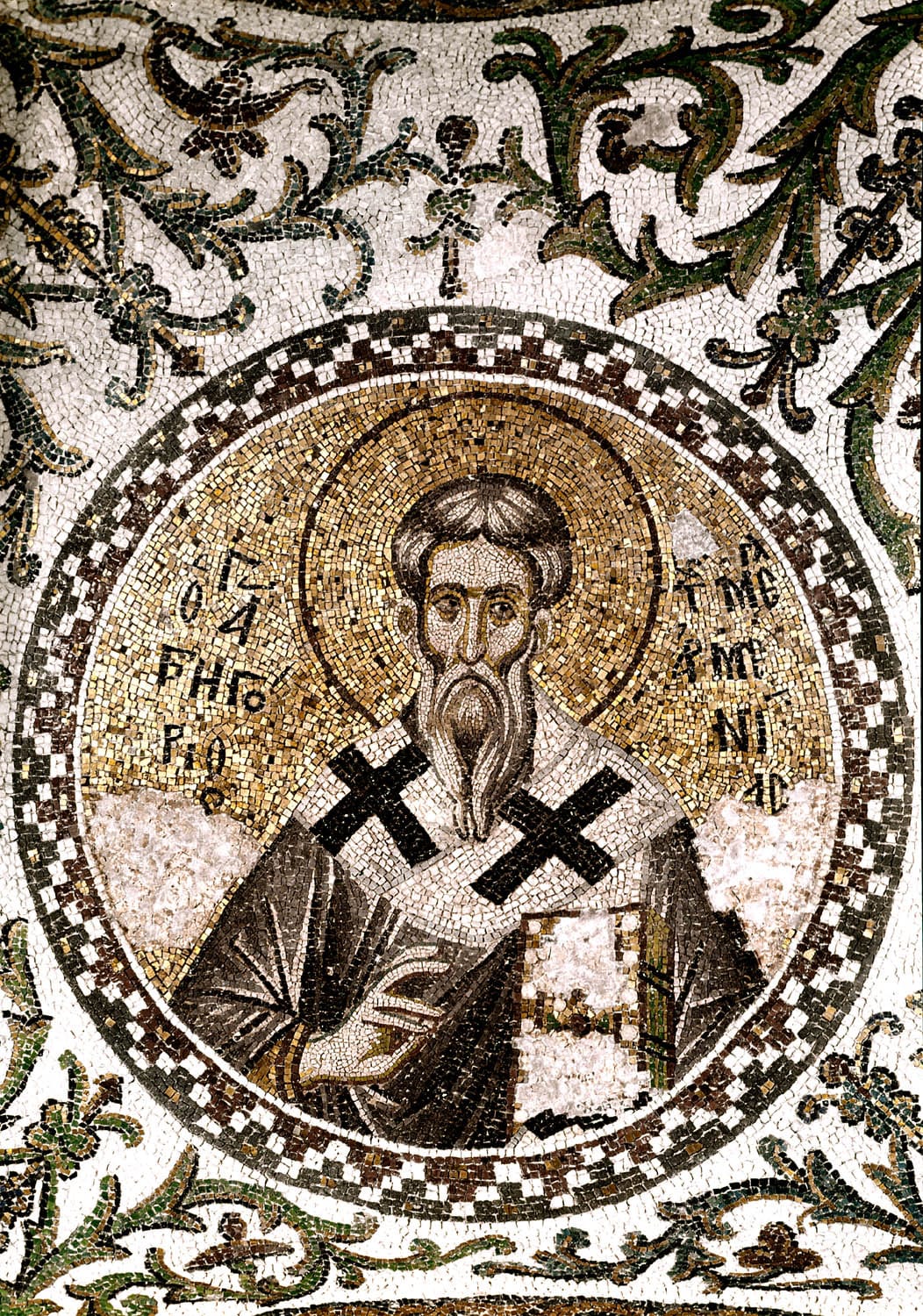
St. Gregory the Illuminator
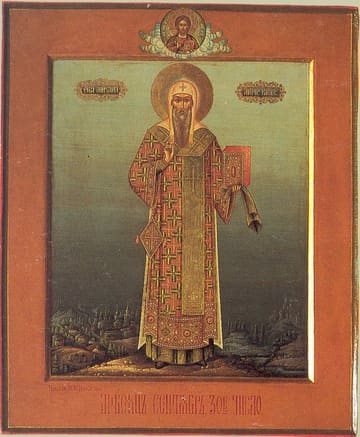
St. Gregory the Illuminator is the apostle of Armenia, through whom King Tiridates III and his people received Holy Baptism early in the fourth century, so that Armenia became the first kingdom to make the Christian faith its own.
Because of the long sufferings he endured for Christ, the Orthodox Church honors him as a Hieromartyr, though he died in peace. His memory is kept on September 30, together with the holy virgins Hripsime and Gayane.
The historian Sozomen heard that the Armenians were the first nation to embrace Christianity, after a divine sign in King Tiridates' house, and Eusebius records that in 312 the Christian Armenians took up arms rather than sacrifice to idols at Emperor Maximinus' command. Gregory grew up in the Christian community of Caesarea in Cappadocia, where he married and had two sons. About 314 Bishop Leontius of Caesarea consecrated him bishop of the Armenians, and for generations the heads of the Armenian Church went to Caesarea for their ordination.
He turned the pagan temples into churches and set up bishops throughout the land. Near the end of his life he handed his see to his son Aristakes, who took part in the First Ecumenical Council at Nicaea in 325, and withdrew to a hermit's cave, where he reposed about 335.
The fuller story comes from the History of Agathangelos, a fifth-century Armenian work rich in wonders. It tells that Gregory was the son of the Parthian Anak, who murdered King Khosrov, the father of Tiridates, and that he was saved as an infant and raised at Caesarea. Coming home to serve Tiridates, he refused to sacrifice to the gods of the kingdom, was tortured, and was cast into a pit of serpents near the royal city of Artashat, where the monastery of Khor Virap now stands; a widow kept him alive with bread for many years.
When the king had the virgin Hripsime, the abbess Gayane and their companions put to death, he was stricken with a madness that the story describes as the form of a boar. Only Gregory, drawn up from the pit, could heal him, and then the king and his people were baptized, by tradition in 301.
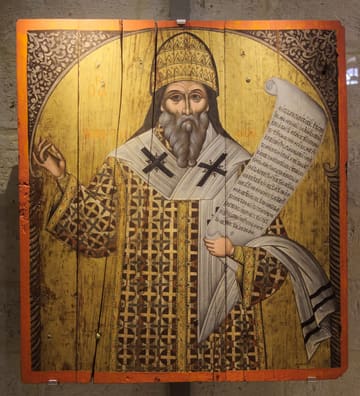
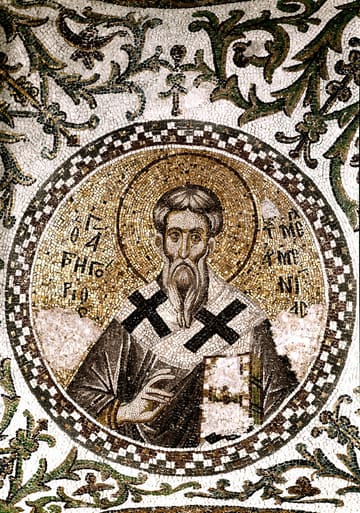
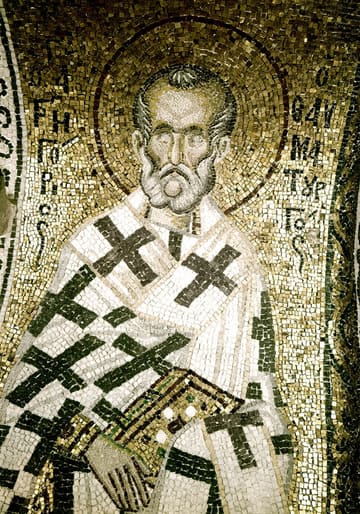
His relics, found by shepherds after his death, were divided among many churches, and his right hand, kept at Etchmiadzin, is the symbol of the authority of the head of the Armenian Church. The Byzantine Church added his feast to its calendar by the eighth century; St. Photius promoted his memory, and his image was set among the mosaics of Hagia Sophia. In Moscow one of the chapels of St. Basil's Cathedral bears his name.
Sources
- Agathangelos, History of the Armenians
- Sozomen, Church History II.8; Eusebius, Church History IX.8.2
- Greek Menaion and Synaxarion, September 30
- Pravoslavnaya Entsiklopediya, 'Grigory Prosvetitel'
- OCA, Lives of the Saints: Hieromartyr Gregory, Enlightener of Greater Armenia
- Catholic Encyclopedia (1913), 'St. Gregory the Illuminator'
No recorded sayings. Read the Life to meet this saint.
Troparion · Tone 4
Partaker of the apostles' ways and successor to their thrones, you found in action, O God-inspired one, the way up to contemplation. Therefore you rightly handled the word of truth and contended also for the faith to the point of bloodshed, O Hieromartyr Gregory. Intercede with Christ our God that our souls may be saved.
Translated for Axios! from the Greek Menaion, September 30
Kontakion · Tone 2
The renowned hierarch, as a champion of the truth, let all of us faithful praise today with divine songs and hymns: the watchful shepherd and teacher Gregory, the luminary of the whole world; for he intercedes with Christ for our salvation.
Translated for Axios! from the Greek Menaion, September 30
Saints around September 30
Get the full library
770+ saints, in your pocket
Their Lives, sayings and prayers, A to Z and by feast, with search. The Church calendar, the holy icons, and the saying of the day on your Home Screen. All in Axios! for iPhone, iPad and Android.