
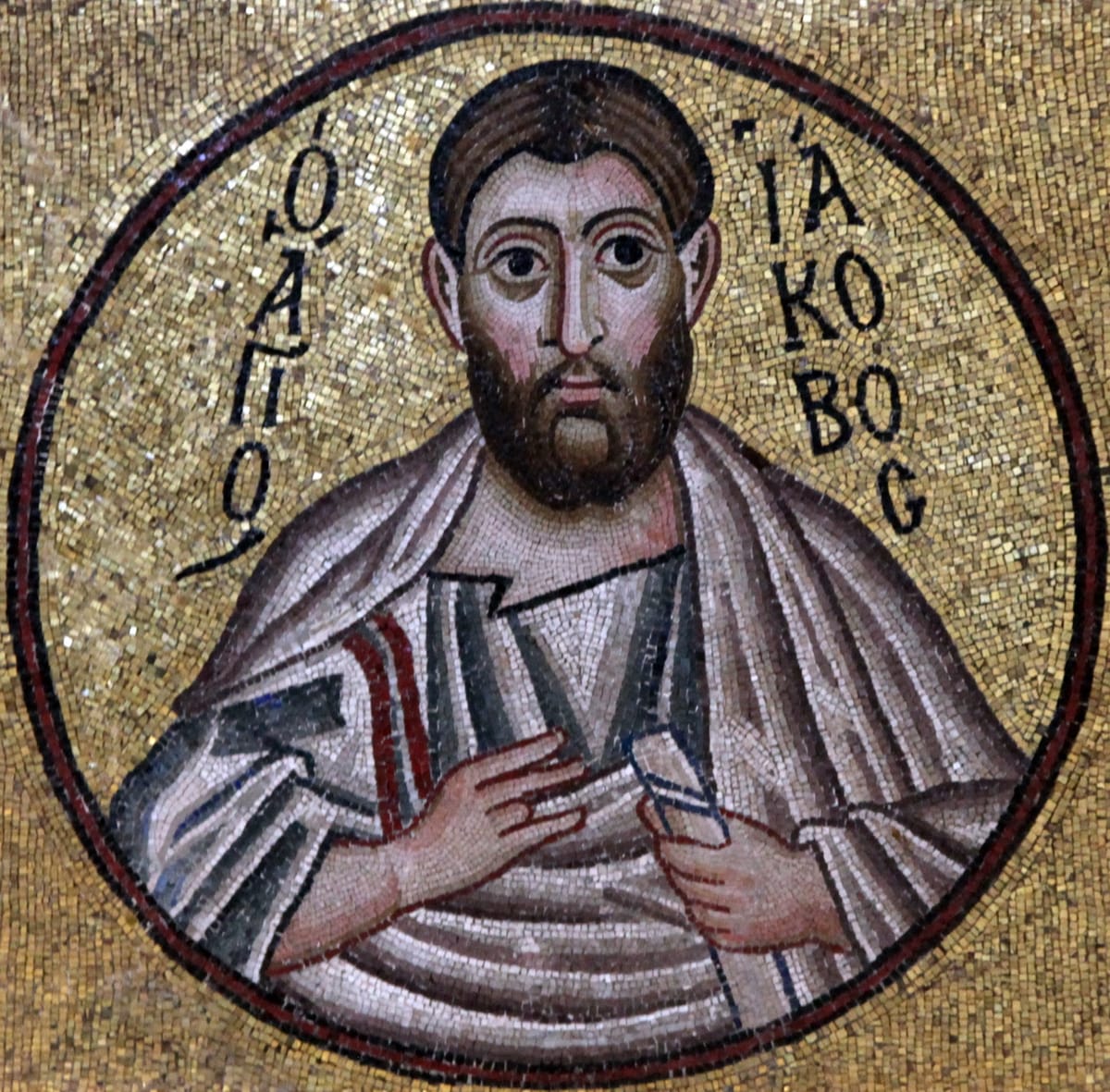
St. James the Son of Zebedee
St. James the son of Zebedee, the brother of St. John the Theologian, was one of the Twelve and, with Peter and John, one of the three apostles closest to Christ.
He saw the raising of Jairus's daughter, the Transfiguration and the agony in Gethsemane, and he became the first of the Twelve to die as a martyr.
James and John were fishermen on the Sea of Galilee. Matthew does not name their mother, but comparing the Gospels the Church has long identified her with Salome, one of the myrrh-bearing women (Matthew 27:56; Mark 15:40). When Jesus called the brothers as they mended their nets, they left the boat and their father at once and followed Him (Matthew 4:21-22), and He named them Boanerges, "Sons of Thunder" (Mark 3:17). He took James, with Peter and John, into the house of Jairus, up the mountain of the Transfiguration and into Gethsemane (Mark 5:37; 9:2; 14:33).
The Gospels do not hide the brothers' fiery zeal before it was purified. They wanted to call down fire on a Samaritan village and were rebuked (Luke 9:54-55), and they asked for the places at the Lord's right and left in His glory. When He asked whether they could drink the cup He was to drink, they answered, "We are able," and He told them that they would (Mark 10:35-40).
That word was fulfilled first in James. About the year 44 King Herod Agrippa I "killed James, the brother of John, with the sword" (Acts 12:2). Clement of Alexandria, writing around 200 from what earlier Christians had handed down, adds that the man who brought James to trial was so moved by his witness that he confessed himself a Christian. On the way to execution he asked the apostle's forgiveness; James thought for a moment, said "Peace be with you," and kissed him, and the two were beheaded together (Eusebius, Church History II.9).
Later traditions grew around his name. One, first written down in the seventh century, says that he had preached in Spain, and since the ninth century the Western Church has venerated his tomb at Compostela; the Synaxarion of Constantinople (10th century) tells only what the New Testament says. Armenian tradition holds that his head rests in the Cathedral of St. James in Jerusalem. The Church keeps his feast on April 30, and with all the Twelve on June 30.
Sources
- Matthew 4:21-22; Mark 3:17; 5:37; 9:2; 10:35-40; 14:33; Luke 9:54-55; Acts 12:1-2
- Clement of Alexandria, Hypotyposes VII, in Eusebius, Church History II.9
- Greek Menaion and Synaxarion, April 30
- OCA, Lives of the Saints: Apostle James the Brother of Saint John the Theologian
- Pravoslavnaya Entsiklopediya, 'Iakov Zevedeev'
Peace be with you.
Clement of Alexandria, Hypotyposes VII, quoted in Eusebius, Church History II.9.3 (NPNF, trans. McGiffert), to his accuser on the way to execution
Troparion · Tone 3
O holy Apostle James, intercede with God, who is merciful, that He may grant to our souls the forgiveness of their trespasses.
Translated for Axios! from the Greek Menaion, April 30
Kontakion · Tone 2
When you heard the divine voice calling you, you set aside a father's love and ran to Christ, O James, together with your brother, O glorious one; and with him you were counted worthy to see the divine Transfiguration of the Lord.
Translated for Axios! from the Greek Menaion, April 30
Saints around April 30
Get the full library
770+ saints, in your pocket
Their Lives, sayings and prayers, A to Z and by feast, with search. The Church calendar, the holy icons, and the saying of the day on your Home Screen. All in Axios! for iPhone, iPad and Android.