
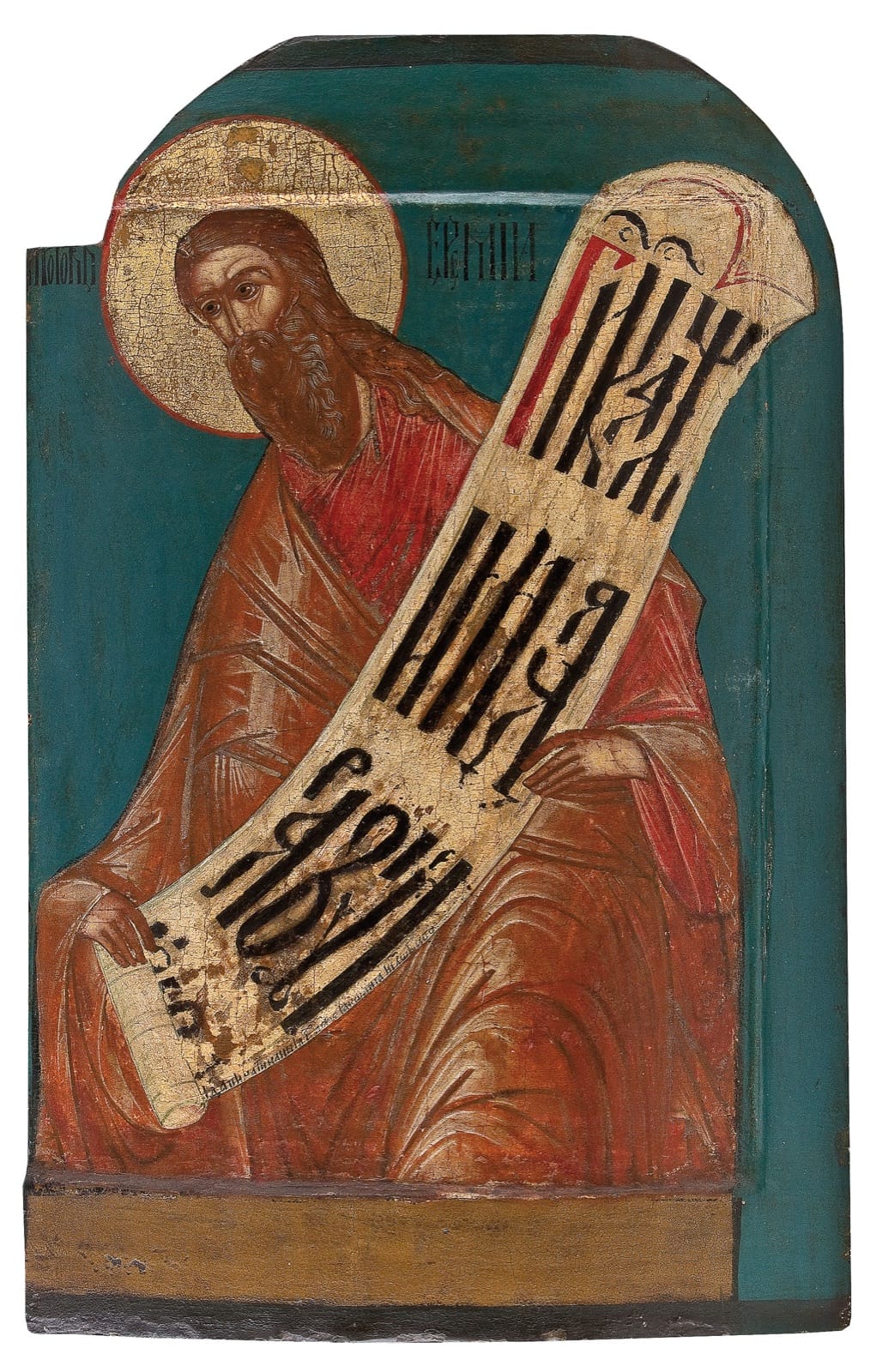
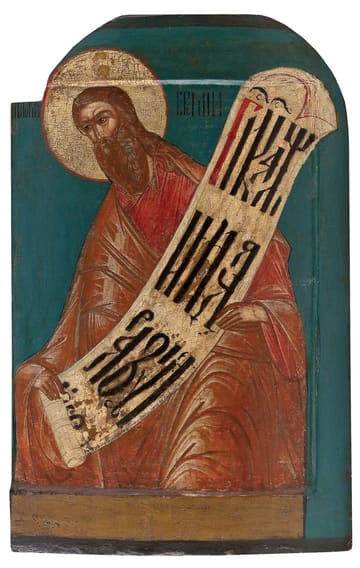
St. Jeremiah the Prophet
St. Jeremiah, one of the four Major Prophets, was set apart by God before his birth and sent to Judah in its last years, to warn of judgment, to weep for his people, and to announce the New Covenant.
Rejected by kings, priests and false prophets, he is remembered as the weeping prophet, and the Church honors him as a prophet and martyr whose sufferings foreshadowed those of Christ.
The son of Hilkiah, of a priestly family of Anathoth in the land of Benjamin, he was called in the thirteenth year of King Josiah, about 627 BC. God told him that He had known him before forming him in the womb and had appointed him a prophet to the nations. Jeremiah protested that he was only a child, but the Lord touched his mouth and put His words in it. For some forty years, under Josiah, Jehoiakim and Zedekiah, he called Judah to return to God, warned that the Temple would not shield a people who trusted in it while doing evil, and foretold the coming of Babylon.
His obedience cost him dearly. He was told not to marry, was beaten and put in the stocks, and was nearly killed after his sermon in the Temple. King Jehoiakim cut up and burned the scroll his scribe Baruch had written from his dictation, and Jeremiah dictated it again.
During the final siege he was lowered into a muddy cistern and rescued by Ebed-melech the Ethiopian. Yet in that dark hour he bought a field at Anathoth as a pledge that the land would be restored, and he proclaimed that God would make a new covenant and write His law on His people's hearts, words the Epistle to the Hebrews applies to Christ. The Church also hears Christ in his lament, "I was like a gentle lamb that is led to the slaughter."
After Jerusalem fell in 586 BC, the Babylonians set him free, and he stayed with the remnant in Judah until, after the murder of the governor Gedaliah, they took him against his will to Tahpanhes in Egypt. Tradition, kept in the Lives of the Prophets and in the verses of the Synaxarion, holds that his own people stoned him there, that the Egyptians honored his grave because his prayers had driven away serpents, and that Alexander the Great moved his relics to Alexandria. In 2 Maccabees he appears after his death to Judas Maccabeus as one "who prays much for the people and the holy city."
The Septuagint opens the Book of Lamentations with Jeremiah weeping over Jerusalem. The Church keeps his memory on May 1.
Sources
- The Book of Jeremiah and Lamentations (with the Septuagint); 2 Maccabees 15:12-16; Hebrews 8:8-12
- Synaxarion and Menaion, May 1
- Lives of the Prophets (attributed to St. Epiphanius of Cyprus), Jeremiah
- St. Dimitri of Rostov, Lives of the Saints, May 1: Prophet Jeremiah
- OCA, Lives of the Saints: Prophet Jeremiah
Ah, Lord God! Behold, I don't know how to speak; for I am a child.
Jeremiah 1:6 (WEBBE)
Oh that my head were waters, and my eyes a spring of tears, that I might weep day and night for the slain of the daughter of my people!
Jeremiah 9:1 (8:23 LXX) (WEBBE)
Lord, I know that the way of man is not in himself. It is not in man who walks to direct his steps.
Jeremiah 10:23 (WEBBE)
Heal me, O Lord, and I will be healed. Save me, and I will be saved; for you are my praise.
Jeremiah 17:14 (WEBBE)
If I say that I will not make mention of him, or speak any more in his name, then there is in my heart as it were a burning fire shut up in my bones. I am weary with holding it in. I can't.
Jeremiah 20:9 (WEBBE)
The Lord is good to those who wait for him, to the soul who seeks him. It is good that a man should hope and quietly wait for the salvation of the Lord.
Lamentations 3:25-26 (WEBBE)
Turn us to yourself, Lord, and we will be turned. Renew our days as of old.
Lamentations 5:21 (WEBBE)
Troparion · Tone 2
Celebrating the commemoration of Your prophet Jeremiah, O Lord, we implore You through him: Save our souls.
Translated for Axios! from the Greek Menaion, May 1
Kontakion · Tone 3
Having cleansed in spirit, O great prophet and martyr, your heart that shines with light, O glorious Jeremiah, from above you received the gift of prophecy, and with a loud voice you cried out in every land: Behold our God, and none other shall be compared with Him, who took flesh and appeared on earth.
Translated for Axios! from the Church Slavonic Menaion, May 1
Saints around May 1
Get the full library
770+ saints, in your pocket
Their Lives, sayings and prayers, A to Z and by feast, with search. The Church calendar, the holy icons, and the saying of the day on your Home Screen. All in Axios! for iPhone, iPad and Android.