
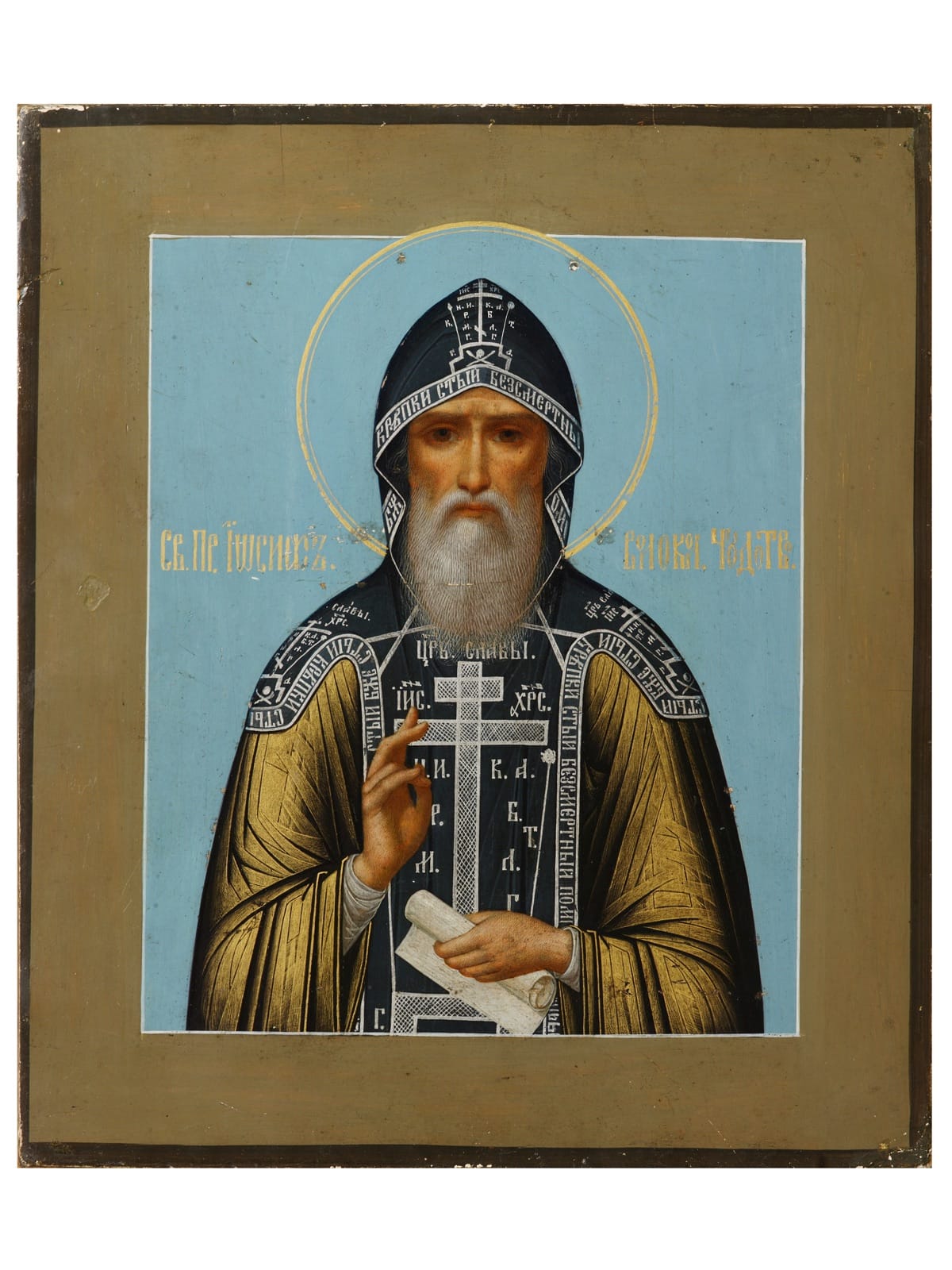
St. Joseph of Volokolamsk
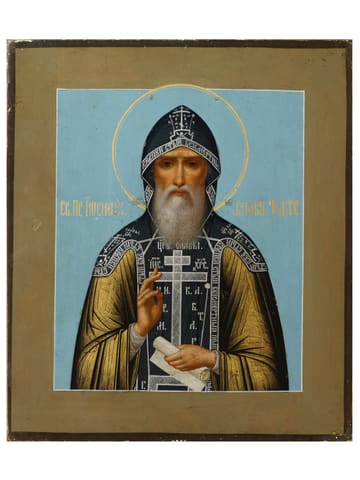
St. Joseph of Volokolamsk founded the Dormition Monastery near Volok Lamsky, northwest of Moscow, and was one of the great abbots and teachers of the Russian Church.
He is honored as a master of the common life and of reverent prayer, a merciful father to the hungry and a tireless defender of the Orthodox faith.
Born Ivan Sanin in 1439 or 1440 to a landowning family of the Volok district, he was taught from the age of seven by Elder Arseny of the local Monastery of the Exaltation of the Cross. At twenty he came to St. Paphnutius of Borovsk, who tonsured him with the name Joseph on February 13, 1460. He served in the kitchen, bakery and infirmary, became the monastery's singer, and nursed his ailing father in his cell for fifteen years. When St. Paphnutius reposed in 1477, Joseph became abbot, as his elder had wished.
Meeting resistance to a stricter common life, and in conflict with Grand Prince Ivan III over the monastery's peasants, he left Borovsk and visited other monasteries as a simple monk, among them St. Cyril's on the White Lake. In June 1479, helped by Prince Boris of Volok, he founded a new monastery in the forest near his family's lands, and Dionisy, the foremost iconographer of the age, painted its stone cathedral. Joseph's Rule of common prayer, shared goods, silence and labor made the house a school of bishops and a great library. In famine he fed hundreds of the hungry each day, took in children and borrowed to buy grain over his monks' protests.
His Enlightener, the first great theological treatise written in Russia, answered a movement in Novgorod and Moscow, known in church history as the heresy of the Judaizers, that rejected the Holy Trinity, the divinity of Christ, icons and monasticism. He pressed for its condemnation, which came in 1504, and his call for executing unrepentant heretics was contested even then by northern elders. In 1503, according to accounts written later in that century, he defended the right of monasteries to hold villages, whose income served worship and the poor, while St. Nilus of Sora wished monks to live by the work of their hands. The Church venerates both.
His last years brought illness and conflict: in 1509 his archbishop, St. Serapion of Novgorod, barred him from priestly ministry until a council lifted the ban, and their Lives tell that the two were reconciled. Joseph received the great schema and reposed on September 9, 1515. He was glorified locally in 1578 and throughout Russia in 1591. His relics, hidden beneath the cathedral, were uncovered in 2001; the Church keeps that event on October 18.
Sources
- Dosifei Toporkov, Funeral Oration for St. Joseph; Bishop Savva (Chorny), Life of St. Joseph (1546), in the Great Menaion Reader, September 9
- St. Joseph of Volokolamsk, Spiritual Charter (Rule) and Letters (Poslaniya Iosifa Volotskogo, ed. A. A. Zimin and Ya. S. Lurie, 1959)
- Pravoslavnaya Entsiklopediya, vol. 25, 'Iosif (Sanin), Volotsky'
- Church Slavonic Menaion, September 9
- OCA, Lives of the Saints: Venerable Joseph, Abbot of Volokolamsk
The divine Scriptures command us to hold [our household servants] not as slaves, but to have mercy on them as brothers, to feed and clothe them sufficiently, and to care for the salvation of their souls.
Letter to a Nobleman about His Slaves (translated for Axios! from the Old Russian, abridged)
We are all the Lord's creation, all one flesh, all anointed with the one chrism, and all in the hand of the Lord, who makes poor whom He wills; and all of us must stand before the one fearsome King at His judgment.
Letter to a Nobleman about His Slaves (translated for Axios! from the Old Russian, abridged)
Many people, sovereign, are now dying of hunger, and apart from you there is no one to help in this disaster: no one else can help it unless you, sovereign, take care of it, set the price by your sovereign command in your land and bring the poor back to life; and for this you will receive mercy from God.
Second Letter to Prince Yury Ivanovich of Dmitrov, on feeding the poor in time of famine (translated for Axios! from the Old Russian, abridged)
And now, for God's sake, forgive me, your sinful servant, for I have offended many of you in deed and in word.
Letter to the Monks of the Monastery of St. Paphnutius, on leaving Borovsk, 1479 (translated for Axios! from the Old Russian)
Troparion · Tone 5
As the adornment of fasters and the beauty of the fathers, the giver of mercy and the lamp of discernment, let all of us faithful come together and praise the teacher of meekness and the confounder of heresies, the all-wise Joseph, the star of Russia, who prays to the Lord that our souls may receive mercy.
Translated for Axios! from the Church Slavonic Menaion, September 9
Kontakion · Tone 8
The storms of life, the turmoil of the world and the surging of the passions you counted as nothing, and you showed yourself a citizen of the desert, becoming a guide of many, O venerable Joseph, a gatherer of monks, a faithful man of prayer and a lover of purity. Intercede with Christ our God that our souls may be saved.
Translated for Axios! from the Church Slavonic Menaion, September 9
Saints around September 9
Get the full library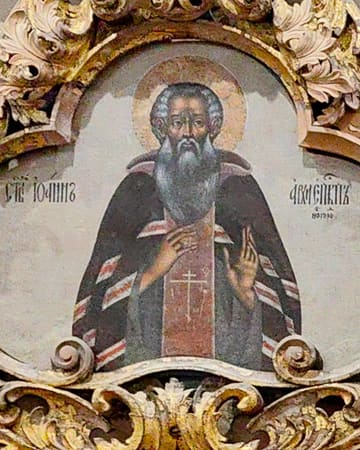
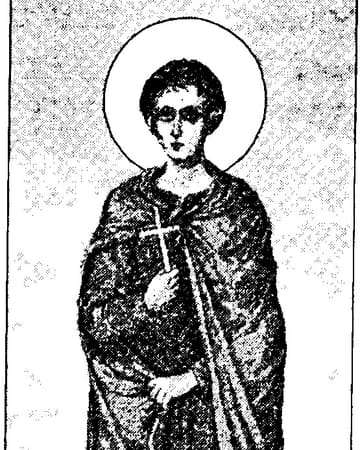
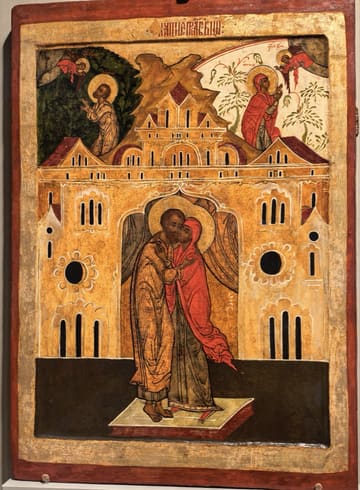
770+ saints, in your pocket
Their Lives, sayings and prayers, A to Z and by feast, with search. The Church calendar, the holy icons, and the saying of the day on your Home Screen. All in Axios! for iPhone, iPad and Android.