
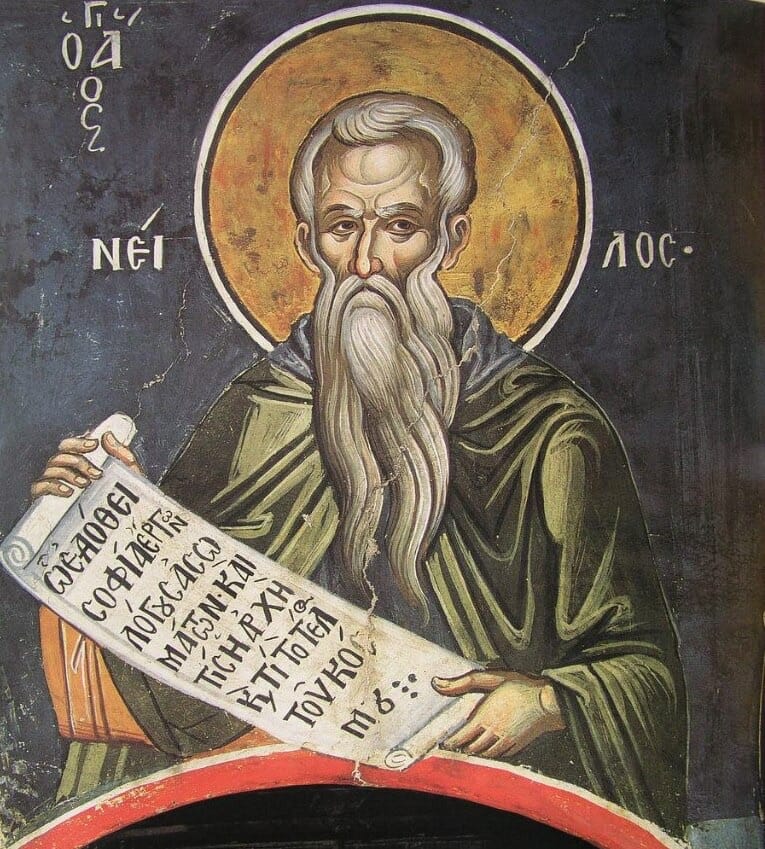
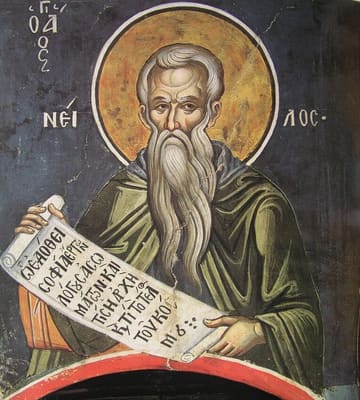
St. Nilus of Sinai
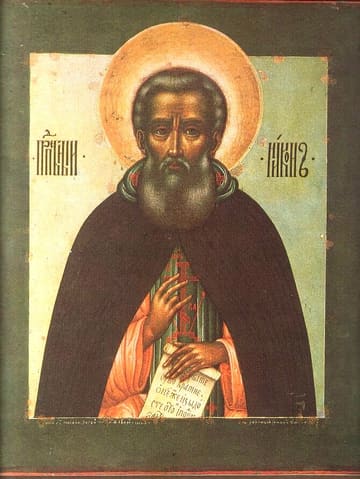
St. Nilus of Sinai, called in Greek Nilus the Ascetic, is honored by the Church as a great teacher of the monastic life, whose ascetic writings and letters were read wherever monks lived.
The tradition recorded in the Synaxarion remembers him as a high official of Constantinople who left the world with his son for the desert of Mount Sinai.
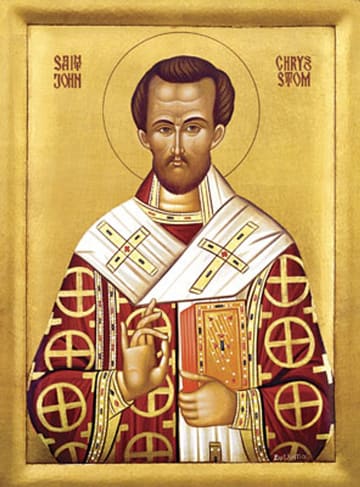
According to that tradition he was a disciple of St. John Chrysostom and served as prefect of the capital. He was married with two children, and around 390 he and his wife agreed to leave the world: she went with their daughter to a convent in Egypt, and he went with his son Theodulus to Sinai, where he lived for many years in a cave in fasting, vigil and prayer. A well-known narrative under his name tells how Saracen raiders carried off Theodulus, and how father and son were later reunited and ordained priests. He reposed in old age, and tradition holds that his relics were brought to Constantinople in the reign of Justin II (565-578) and laid in the Church of the Holy Apostles.
His surviving works include an Ascetic Discourse that presents the monastic life as the true philosophy, a treatise On Voluntary Poverty, and a collection of more than a thousand letters under his name, many of them short extracts, addressed to monks, clergy and officials. His letter to the prefect Olympiodorus, urging that churches be painted with scenes from the Old and New Testaments for those who cannot read, was quoted at the Seventh Ecumenical Council in 787 in defense of the holy icons.
Modern scholars identify the writer with Nilus, abbot of a monastery near Ancyra in Galatia, who died around 430, and regard the Sinai captivity story as a later narrative attached to his name. Two works long read under his name, the chapters On Prayer (printed as his in the Philokalia) and On the Eight Spirits of Evil, are now known to be by Evagrius Ponticus. The Greek and Slavic Menaia keep his feast on November 12, together with St. John the Merciful.
Sources
- St. Nilus, Ascetic Discourse and Letters (PG 79)
- Narrations on the slaughter of the monks of Sinai and the captivity of Theodulus, attributed to Nilus (PG 79)
- Acts of the Seventh Ecumenical Council (787), Session 4: the letter to Olympiodorus
- Greek Menaion and Synaxarion, November 12
- OCA, Lives of the Saints: Venerable Neilos the Ascetic of Sinai
- Oxford Dictionary of Byzantium, 'Neilos of Ankyra'
Many among the Greeks, and not a few among the Jews, set out to love wisdom; but only the disciples of Christ have pursued the true philosophy, for they alone had Wisdom Himself as their teacher, who showed by His deeds the way of life that befits it.
St. Nilus, Ascetic Discourse 1 (translated for Axios! from the Greek)
To be the slave of men has perhaps harmed no one who lived rightly; but to serve pleasures, with the passions for masters, has brought shame and much ridicule.
St. Nilus, Ascetic Discourse 1 (translated for Axios! from the Greek)
Philosophy is the setting right of our ways, joined with true knowledge of Him who is.
St. Nilus, Ascetic Discourse 3 (translated for Axios! from the Greek)
Fill the holy church on both sides with scenes from the Old and New Testaments, by the hand of the finest painter, so that those who do not know letters and cannot read the divine Scriptures may, by looking at the paintings, remember the brave deeds of those who genuinely served the true God.
St. Nilus, Letters IV.61, to the prefect Olympiodorus (translated for Axios! from the Greek)
Troparion · Tone 8
By the outpouring of your tears you tilled the barren ground of the desert, and with deep-drawn sighs you made your labors yield fruit a hundredfold, and became a light-giver to the world, gleaming with wonders, O Nilus, our venerable father. Intercede with Christ our God that our souls may be saved.
Translated for Axios! from the Greek Menaion, November 12
Kontakion · Tone 8
The uprisings of the bodily passions, dry as brushwood, you cut down with the blade of your wakeful prayer, O blessed Nilus. But since you have boldness before the Lord, free me from every kind of danger, that I may cry to you: Rejoice, O father of all the world.
Translated for Axios! from the Greek Menaion, November 12
Saints around November 12
Get the full library
770+ saints, in your pocket
Their Lives, sayings and prayers, A to Z and by feast, with search. The Church calendar, the holy icons, and the saying of the day on your Home Screen. All in Axios! for iPhone, iPad and Android.