
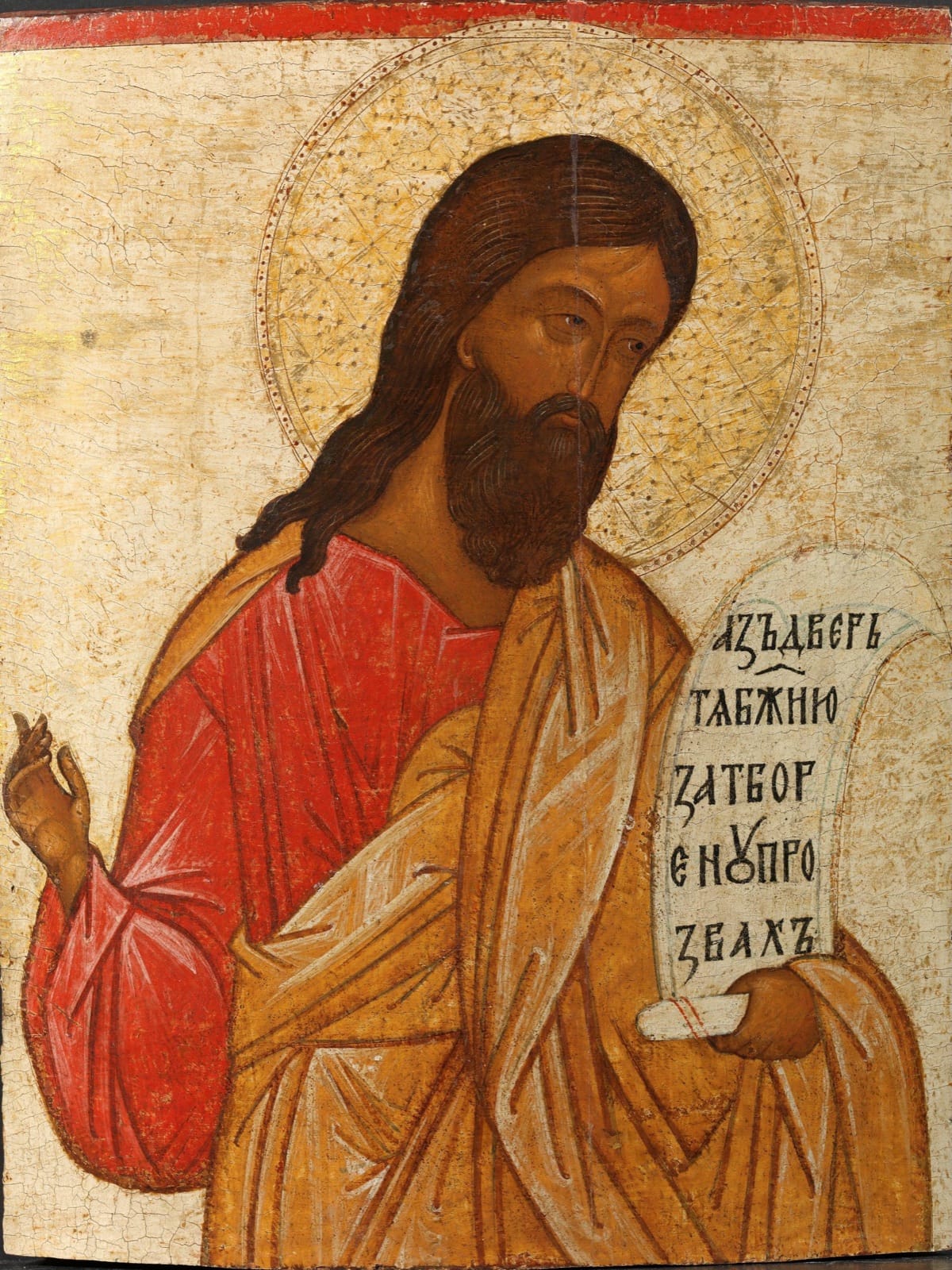
St. Ezekiel the Prophet
Also commemorated
- July 23Greek usage
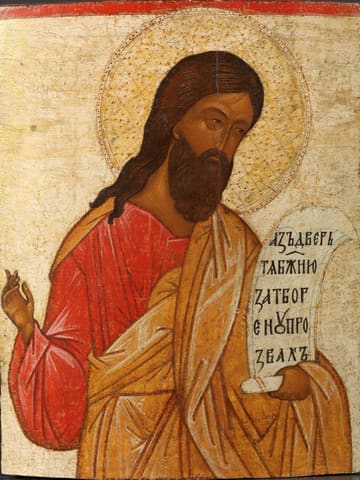
St. Ezekiel, one of the four Major Prophets, was a priest of Judah carried into exile in Babylon, where God showed him the throne of His glory and made him a watchman over His scattered people.
The Church honors him as a seer of the mysteries of Christ. In the gate of the Temple that was to stay shut because the Lord God would enter by it, she sees the Virgin who gave birth to the Lord and remained a virgin.
The son of Buzi, of a priestly family, Ezekiel was taken to Babylon with King Jehoiachin in the deportation of 597 BC and lived among the exiles at Tel Abib by the river Chebar. In the fifth year of the captivity the heavens opened to him. He saw four living creatures, wheels full of eyes, and above them a throne bearing one in the likeness of a man, surrounded by brightness like a rainbow: "the appearance of the likeness of the Lord's glory." He was given a scroll to eat that tasted as sweet as honey, and sent to speak to a rebellious house whether they would listen or not.
For years he warned Jerusalem of its coming fall, often through signs he acted out, lying bound on his side before a brick on which he had drawn the besieged city and shaving his head and beard. When his wife died, God forbade him to mourn openly, as a sign to the people. In visions he saw the glory of the Lord depart from the Temple, and in 586 BC the city fell.
Then his message turned to hope: God Himself would shepherd His sheep, give His people a new heart and a new spirit, and raise the valley of dry bones into a living multitude. The Church reads this vision at Matins of Holy Saturday as a prophecy of the resurrection, and the shut eastern gate of the new Temple at Vespers of the feasts of the Theotokos.
Tradition, recorded in the ancient Lives of the Prophets and by St. Dimitri of Rostov, adds that he parted the waters of the Chebar so that his people could escape their pursuers, as Moses had parted the sea, and that a leader of the exiles whom he rebuked for idolatry put him to death. It says that he was buried in the tomb of Shem and Arphaxad, and a shrine at al-Kifl, south of Babylon in present-day Iraq, has long been honored as his tomb. The Greek Church keeps his memory on July 23, while the Slavic Churches and the OCA keep it on July 21.
Sources
- The Book of Ezekiel (with the Septuagint); 2 Kings 24:10-17
- Synaxarion, July 23 (Greek Menaion); Slavonic Menaion, July 21
- St. Dimitri of Rostov, Lives of the Saints, July 21: Prophet Ezekiel
- OCA, Lives of the Saints: Prophet Ezekiel
- Orthodox Synaxaristes (saint.gr): Prophet Ezekiel
Now in the thirtieth year, in the fourth month, in the fifth day of the month, as I was among the captives by the river Chebar, the heavens were opened, and I saw visions of God.
Ezekiel 1:1 (WEBBE)
As the appearance of the rainbow that is in the cloud in the day of rain, so was the appearance of the brightness all around. This was the appearance of the likeness of the Lord's glory. When I saw it, I fell on my face, and I heard a voice of one that spoke.
Ezekiel 1:28 (1:28-2:1 LXX) (WEBBE)
I looked, and behold, the Lord's glory filled the Lord's house; so I fell on my face.
Ezekiel 44:4 (WEBBE)
Ah Lord God! Will you destroy all the residue of Israel in your pouring out of your wrath on Jerusalem?
Ezekiel 9:8 (WEBBE)
The Lord's hand was on me, and he brought me out in the Lord's Spirit, and set me down in the middle of the valley; and it was full of bones.
Ezekiel 37:1 (WEBBE)
So I prophesied as He commanded me, and the breath entered into them, and they lived and stood upon their feet, a very great gathering.
Ezekiel 37:10 (LXX, translated for Axios!)
Troparion · Tone 2
Celebrating the commemoration of Your prophet Ezekiel, O Lord, we implore You through him: Save our souls.
Translated for Axios! from the Church Slavonic Menaion, July 21
Kontakion · Tone 4
You were shown to be God's prophet, O wondrous Ezekiel, and you foretold to all the Lord's Incarnation: His who is the Lamb and the Maker, the Son of God, who has appeared unto the ages.
Translated for Axios! from the Church Slavonic Menaion, July 21
Saints around July 21
Get the full library
770+ saints, in your pocket
Their Lives, sayings and prayers, A to Z and by feast, with search. The Church calendar, the holy icons, and the saying of the day on your Home Screen. All in Axios! for iPhone, iPad and Android.